How to Use Ratios in Real Life: 10 Practical Examples
Discover how ratios are used in everyday life with 10 practical real world examples covering cooking, shopping, maps, budgeting, sports, business, and design.
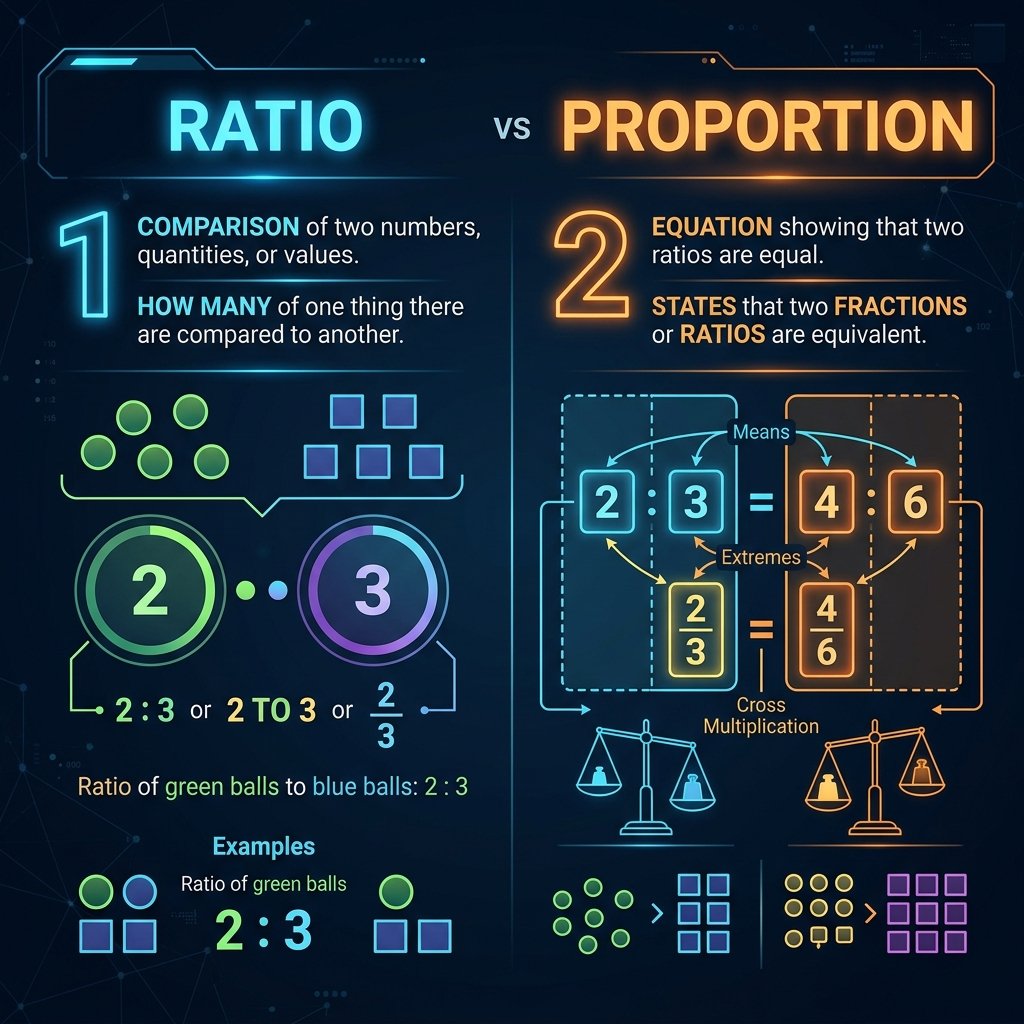
How to Use Ratios in Real Life: 10 Practical Examples
A ratio is a simple mathematical tool that compares two or more quantities. In daily life, ratios appear whenever you compare amounts, balance ingredients, calculate travel distances on a map, split living expenses, or evaluate store discounts.
Understanding how to use ratios gives you the ability to solve practical everyday problems quickly and accurately. Instead of guessing how much flour to add or how to split a dinner bill fairly, ratios provide a clear mathematical method to calculate the exact numbers you need.
To calculate proportions or verify any calculation instantly, you can use the free Ratio Calculator available on RatioCalculator.site. For structured lessons on proportional reasoning, you can also explore the Khan Academy ratio lessons.
What Is a Ratio?
A ratio represents the relative size of two or more values. According to the formal mathematical definition of ratio, a ratio expresses the quotient of quantities showing how many times one value contains or relates to another.
Ratios are commonly written with a colon between numbers:
- The ratio 2:3 compares two parts of one quantity to three parts of another quantity.
- The ratio 3:5 indicates that for every three units of the first item, five units of the second item exist.
- The ratio 4:7 shows a proportional relationship of four units to seven units.
The order of numbers in a ratio is crucial. A ratio of 2:3 represents a different relationship than 3:2. For example, a drink recipe with 2 parts juice and 3 parts sparkling water will taste light and refreshing. If you reverse the ratio to 3:2, you have more juice than water, changing the flavor completely. Always write and read ratios in the exact order of the items being compared. To explore comparing different proportions, read our guide on How to Compare Ratios.
Why Are Ratios Used in Real Life?
Ratios are essential across numerous practical situations because they allow people to:
- Compare quantities accurately. Ratios show the relative proportion between two items regardless of the total amount.
- Scale amounts up or down. You can double or triple a recipe without changing how the food tastes.
- Navigate with maps. Map scales use ratios to translate inches or centimeters on paper into miles or kilometers on the ground.
- Manage personal finances. Budgeting strategies divide income into proportional categories such as necessities, savings, and discretionary spending.
- Analyze sports performance. Coaches and fans use ratios to evaluate shooting accuracy, win records, and player efficiency.
- Plan building materials. Construction projects rely on precise mixture ratios for concrete, mortar, and paint to ensure structural safety.
- Make smart shopping choices. Unit price ratios help shoppers determine which package size provides the best value for money.
- Design visual layouts. Photographers and screen manufacturers use aspect ratios to create balanced compositions and display formats.
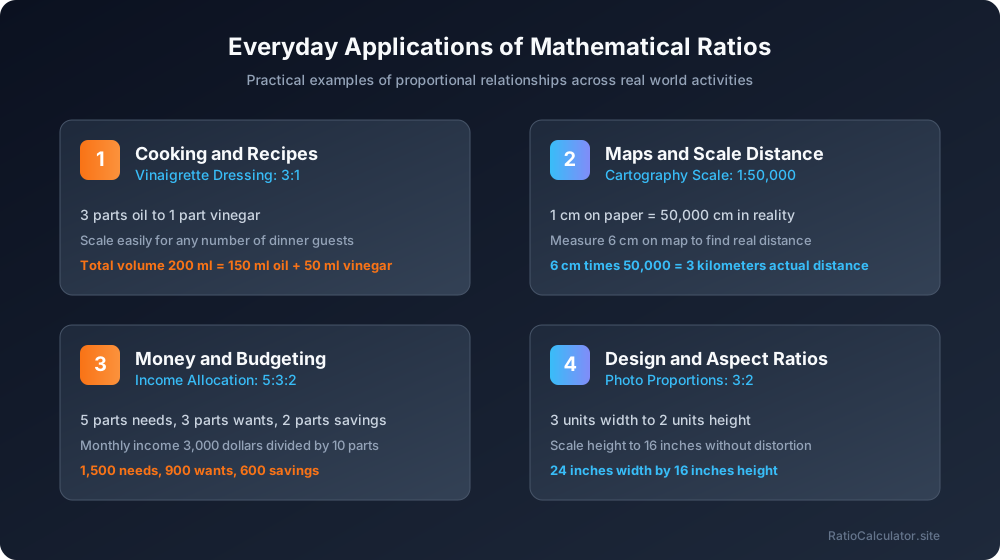
10 Practical Examples of Ratios in Real Life
Here are ten realistic examples showing how ratios solve common everyday problems across various activities.
Example 1: Ratios in Cooking and Recipes
A classic vinaigrette salad dressing uses an oil to vinegar ratio of 3:1. This means you need three parts olive oil for every one part vinegar. If you want to prepare 200 milliliters of dressing in total, you can calculate the exact volume of each ingredient.
- Add the ratio parts: 3 + 1 = 4 total parts.
- Find the volume of one part: 200 ml divided by 4 = 50 ml.
- Calculate olive oil: 3 times 50 ml = 150 ml.
- Calculate vinegar: 1 times 50 ml = 50 ml.
- Check the total: 150 ml + 50 ml = 200 ml.
Final Answer: You need 150 ml of olive oil and 50 ml of vinegar.
Why this ratio is useful: Using a consistent ratio ensures the salad dressing retains the ideal flavor balance no matter how much dressing you prepare.
Example 2: Ratios in Shopping and Unit Pricing
A grocery shopper wants to find the better deal between two brands of laundry detergent. Brand A offers a 60 ounce bottle for 12 dollars. Brand B offers an 80 ounce bottle for 20 dollars.
- Write the ratio of price to ounces for Brand A: 12 dollars to 60 ounces, which equals 12 divided by 60 = 0.20 dollars per ounce.
- Write the ratio of price to ounces for Brand B: 20 dollars to 80 ounces, which equals 20 divided by 80 = 0.25 dollars per ounce.
- Compare the two rates: 0.20 dollars per ounce is lower than 0.25 dollars per ounce.
Final Answer: Brand A costs 0.20 dollars per ounce, making it the better purchase.
Why this ratio is useful: Calculating price to quantity ratios helps consumers avoid misleading package sizes and save money on household groceries.
Example 3: Ratios in Maps and Scale
A road map has a scale ratio of 1:50,000. This means 1 centimeter on the map equals 50,000 centimeters in real life. Two towns are 6 centimeters apart on the map.
- Multiply the map distance by the scale factor: 6 cm times 50,000 = 300,000 cm.
- Convert centimeters to meters: 300,000 cm divided by 100 = 3,000 meters.
- Convert meters to kilometers: 3,000 meters divided by 1,000 = 3 kilometers.
Final Answer: The actual distance between the two towns is 3 kilometers.
Why this ratio is useful: Scale ratios enable cartographers to represent vast geographical areas accurately on manageable paper sheets and digital screens.
Example 4: Ratios in Money and Budgeting
A worker earns a monthly take home pay of 3,000 dollars and divides income into needs, wants, and savings using the popular 5:3:2 budgeting ratio.
- Add the ratio parts: 5 + 3 + 2 = 10 total parts.
- Find the value of one part: 3,000 dollars divided by 10 = 300 dollars.
- Calculate needs: 5 times 300 dollars = 1,500 dollars.
- Calculate wants: 3 times 300 dollars = 900 dollars.
- Calculate savings: 2 times 300 dollars = 600 dollars.
- Verify the total: 1,500 + 900 + 600 = 3,000 dollars.
Final Answer: Allocate 1,500 dollars for needs, 900 dollars for wants, and 600 dollars for savings.
Why this ratio is useful: Budget ratios provide a sustainable framework for managing monthly expenses and building emergency savings. For more multi part calculations, explore How to Solve Three Number Ratio Problems.
Example 5: Ratios in Sports and Performance
A basketball player attempts 40 shots during practice and makes 24 of them. The coach wants to express the ratio of successful shots to missed shots in simplest form.
- Calculate missed shots: 40 total shots minus 24 made shots = 16 missed shots.
- Write the ratio of made shots to missed shots: 24:16.
- Find the greatest common factor of 24 and 16, which is 8.
- Divide both numbers by 8: 24 divided by 8 = 3, and 16 divided by 8 = 2.
Final Answer: The simplified ratio of successful shots to missed shots is 3:2.
Why this ratio is useful: Performance ratios help athletes and coaches identify strengths, track improvements over training sessions, and set realistic practice goals.
Example 6: Ratios in School and Classrooms
A middle school field trip requires a supervisor to student ratio of 1:8 to ensure proper student safety. If 72 students are attending the trip, how many supervisors are needed?
- Write the proportion: 1 supervisor per 8 students = x supervisors per 72 students.
- Divide total students by the student group size: 72 divided by 8 = 9.
- Multiply by the supervisor requirement: 9 times 1 = 9 supervisors.
Final Answer: The school must assign 9 adult supervisors for the field trip.
Why this ratio is useful: Safety ratios ensure appropriate adult supervision and compliance with educational safety regulations during school outings.
Example 7: Ratios in Business and Inventory
A small retail store aims to maintain a ratio of 4:1 between product inventory cost and monthly operating reserve cash. If the store holds 28,000 dollars in merchandise inventory, how much cash reserve should it maintain?
- Write the ratio: 4 parts inventory to 1 part cash reserve.
- Find the value of one part by dividing inventory by 4: 28,000 dollars divided by 4 = 7,000 dollars.
- Multiply by the reserve ratio number: 1 times 7,000 dollars = 7,000 dollars.
Final Answer: The business should maintain a cash reserve of 7,000 dollars.
Why this ratio is useful: Financial ratios help small business owners balance inventory investments with operational liquidity to maintain fiscal stability.
Example 8: Ratios in Construction and Concrete
A builder mixes standard concrete using cement, sand, and gravel in a ratio of 1:2:4 by volume. To prepare 28 cubic feet of concrete mixture, how much of each ingredient is required?
- Add the ratio parts: 1 + 2 + 4 = 7 total parts.
- Find the volume of one part: 28 cubic feet divided by 7 = 4 cubic feet.
- Calculate cement: 1 times 4 = 4 cubic feet.
- Calculate sand: 2 times 4 = 8 cubic feet.
- Calculate gravel: 4 times 4 = 16 cubic feet.
- Verify total: 4 + 8 + 16 = 28 cubic feet.
Final Answer: Mix 4 cubic feet of cement, 8 cubic feet of sand, and 16 cubic feet of gravel.
Why this ratio is useful: Following exact mixture ratios ensures that poured concrete cures with the required compressive strength and structural durability.
Example 9: Ratios in Photography and Screen Displays
A photographer shoots digital images with a standard camera sensor aspect ratio of 3:2. The client wants an enlargement where the shorter side measures 16 inches. What is the longer dimension?
- Identify the ratio: 3 units width to 2 units height.
- Find the scale multiplier: 16 inches divided by 2 = 8.
- Multiply the longer ratio unit: 3 times 8 = 24 inches.
Final Answer: The enlarged print will measure 24 inches by 16 inches.
Why this ratio is useful: Aspect ratios allow visual artists to resize and print images without distorting subjects or cropping essential visual elements. For detailed steps on two value comparisons, visit How to Calculate a Ratio From Two Numbers.
Example 10: Ratios in Everyday Mixtures and Cleaning Solutions
A concentrated household disinfectant bottle specifies a dilution ratio of 1:9 with clean water. To fill a 500 milliliter spray bottle, how much concentrated cleaner and water should you combine?
- Add the parts: 1 part concentrate + 9 parts water = 10 total parts.
- Find one part: 500 ml divided by 10 = 50 ml.
- Calculate concentrate: 1 times 50 ml = 50 ml.
- Calculate water: 9 times 50 ml = 450 ml.
- Verify total: 50 ml + 450 ml = 500 ml.
Final Answer: Combine 50 milliliters of concentrate with 450 milliliters of water.
Why this ratio is useful: Proper dilution ratios ensure chemical cleaners sanitize surfaces effectively while preventing product waste and surface damage.
How to Scale a Ratio in Real Life
Scaling a ratio means multiplying or dividing all numbers in the ratio by the same positive number (the scale factor). This increases or decreases the total quantity while keeping the exact same proportional relationship.
Example 1: Scaling Up a Cookie Recipe
A recipe for 12 cookies calls for flour and butter in the ratio 3:2 (300 grams flour to 200 grams butter). You want to make 36 cookies for a family party.
- Find the scale factor: 36 cookies divided by 12 cookies = 3.
- Multiply flour by 3: 300 grams times 3 = 900 grams.
- Multiply butter by 3: 200 grams times 3 = 600 grams.
- The scaled ratio remains 900:600, which simplifies back to 3:2.
Example 2: Scaling Down a Lawn Fertilizer Mixture
A commercial fertilizer mix specifies nitrogen, phosphorus, and potassium in the ratio 4:2:1. A standard package contains 28 pounds (16 lbs nitrogen, 8 lbs phosphorus, 4 lbs potassium). You only need 7 pounds for a small garden bed.
- Find the scale factor: 7 pounds divided by 28 pounds = 0.25 (or 1/4).
- Multiply nitrogen: 16 times 0.25 = 4 pounds.
- Multiply phosphorus: 8 times 0.25 = 2 pounds.
- Multiply potassium: 4 times 0.25 = 1 pound.
- Verify total: 4 + 2 + 1 = 7 pounds.
To master scale calculations across various practical contexts, check our tutorial on How to Find Equivalent Ratios.
How to Divide an Amount Using a Ratio
Dividing any total quantity using a ratio involves four consistent mathematical steps:
- Add all ratio parts together to determine the total number of equal shares.
- Divide the total amount by the sum of parts to calculate the numerical value of one single share.
- Multiply the value of one share by each individual ratio number to find every specific amount.
- Add the calculated amounts together to verify they equal the original total quantity.
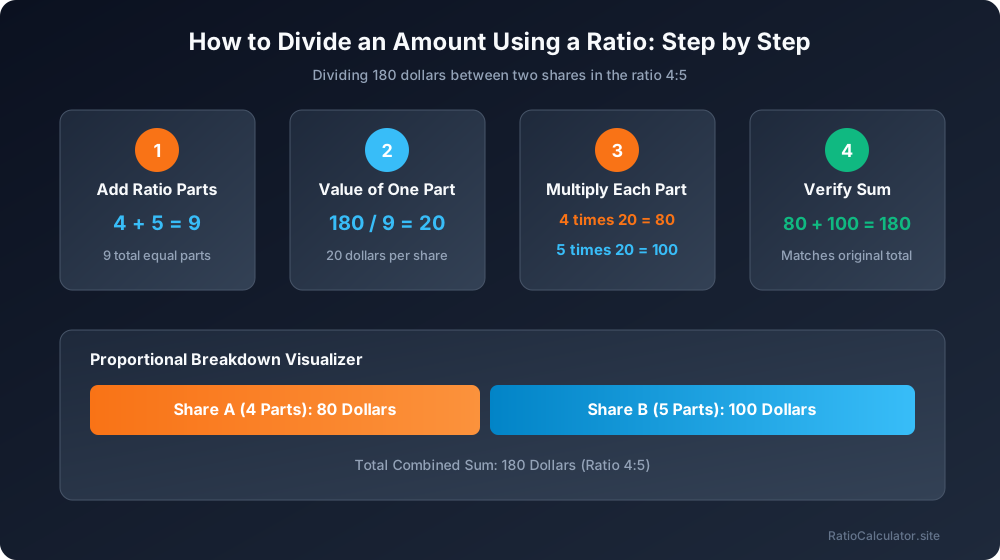
For example, to divide 180 dollars between two people in the ratio 4:5:
- Add the parts: 4 + 5 = 9 shares.
- Value of one share: 180 dollars divided by 9 = 20 dollars.
- First person: 4 times 20 = 80 dollars.
- Second person: 5 times 20 = 100 dollars.
- Verification: 80 + 100 = 180 dollars.
For an extensive step by step guide on proportional distribution, explore our dedicated tutorial on How to Divide a Number in a Given Ratio.
How to Simplify Ratios in Real Life
Simplifying a ratio means reducing its numbers to the smallest possible whole numbers while maintaining the exact proportional balance. This is done by dividing all terms by their greatest common factor.
Simplifying makes numerical comparisons intuitive. Comparing 48:32 is difficult to visualize instantly, but simplifying both numbers by their greatest common factor (16) yields 3:2, which is easy to understand.
Step by Step Simplification Example
Suppose a garden contains 45 red flowers and 30 yellow flowers:
- Write the initial ratio: 45:30.
- Find factors of 45: 1, 3, 5, 9, 15, 45.
- Find factors of 30: 1, 2, 3, 5, 6, 10, 15, 30.
- Identify the greatest common factor: 15.
- Divide 45 by 15 = 3.
- Divide 30 by 15 = 2.
- Simplified ratio: 3:2.
For additional simplification techniques and examples, visit our guide on How to Calculate Ratios Step by Step.
How to Compare Two Ratios
In practical situations, you often need to compare two different ratios to see which provides a greater proportion or better value.
Practical Example: Comparing Lemonade Sweetness
Pitcher A uses a lemon juice to sugar ratio of 3:2. Pitcher B uses a ratio of 5:4. Which lemonade is sweeter?
To compare them, convert both ratios into decimals by dividing the first number by the second number:
- Pitcher A juice to sugar: 3 divided by 2 = 1.50 parts juice per part sugar.
- Pitcher B juice to sugar: 5 divided by 4 = 1.25 parts juice per part sugar.
Because Pitcher B has only 1.25 parts juice per part sugar compared to 1.50 in Pitcher A, Pitcher B has a higher relative concentration of sugar, making it the sweeter lemonade.
To learn alternative comparison techniques such as finding common denominators, read our comprehensive walkthrough on How to Compare Ratios.
Ratio vs Percentage in Everyday Situations
Although ratios and percentages both describe proportional relationships, they represent quantities from different perspectives:
- A ratio compares one part directly to another part (part to part) or one part to the whole (part to whole). A ratio of 1:4 boys to girls compares two separate groups.
- A percentage expresses a part as a fraction out of 100 total parts (always part to whole).
To convert a part to part ratio such as 1:4 into a percentage of the total group:
- Add the ratio parts: 1 + 4 = 5 total parts.
- Write the fraction for the first part: 1/5.
- Convert to decimal: 1 divided by 5 = 0.20.
- Multiply by 100: 0.20 times 100 = 20 percent.
In this group, boys make up 20 percent of the total people, while girls make up 80 percent. For complete conversion instructions and visual formulas, read How to Convert a Ratio to a Percentage.
How to Use a Ratio Calculator
Calculating ratios by hand is great for building mathematical intuition, but an online calculator saves time and prevents arithmetic mistakes when working with large numbers, decimals, or multi part ratios.
Here is how you can use the free Ratio Calculator on RatioCalculator.site:
- Open the Ratio Calculator on RatioCalculator.site.
- Enter your known numbers into the designated input fields.
- Select whether you want to simplify a ratio, find an equivalent proportion, or solve for an unknown missing number.
- Click calculate to receive the simplified ratio along with an instant step by step breakdown.
For foundational guidance on ratio operations, explore How to Calculate a Ratio. If you encounter algebraic unknowns, check our tutorial on How to Find the Missing Number in a Ratio.
Frequently Asked Questions
How are ratios used in real life?
Ratios are used in real life to compare quantities, scale cooking recipes, read map distances, manage personal budgets, mix construction materials, and evaluate shopping prices.
What are some examples of ratios in everyday life?
Everyday ratio examples include recipe ingredient proportions, price per unit comparisons, fuel efficiency mileage, screen display aspect dimensions, and student to teacher classroom ratios.
Why are ratios important in real life?
Ratios are important because they enable people to scale quantities up or down accurately without changing the underlying balance or proportional relationship.
Where are ratios used in everyday life?
Ratios are widely used in home kitchens, retail shopping centers, bank accounts, construction job sites, photography studios, athletic stadiums, and road navigation maps.
How are ratios used in cooking?
In cooking, ratios specify the relative proportions of ingredients, allowing chefs to increase or decrease serving sizes while keeping taste and texture consistent.
How are ratios used in money?
In money management, ratios help individuals divide monthly income into structured categories such as essential living needs, discretionary wants, and emergency savings.
How are ratios used in maps?
On maps, scale ratios represent the relationship between measured map distances and actual ground distances, allowing travelers to calculate real geographical travel distances.
How are ratios used in business?
In business, ratios are used to compare sales revenue against operating costs, assess inventory turnover speed, and measure company financial health.