How to Calculate a Ratio From Two Numbers: Step by Step With Examples
Learn how to calculate a ratio from two numbers step by step. Master ratio simplification, greatest common factors, decimals, and formulas with easy examples.
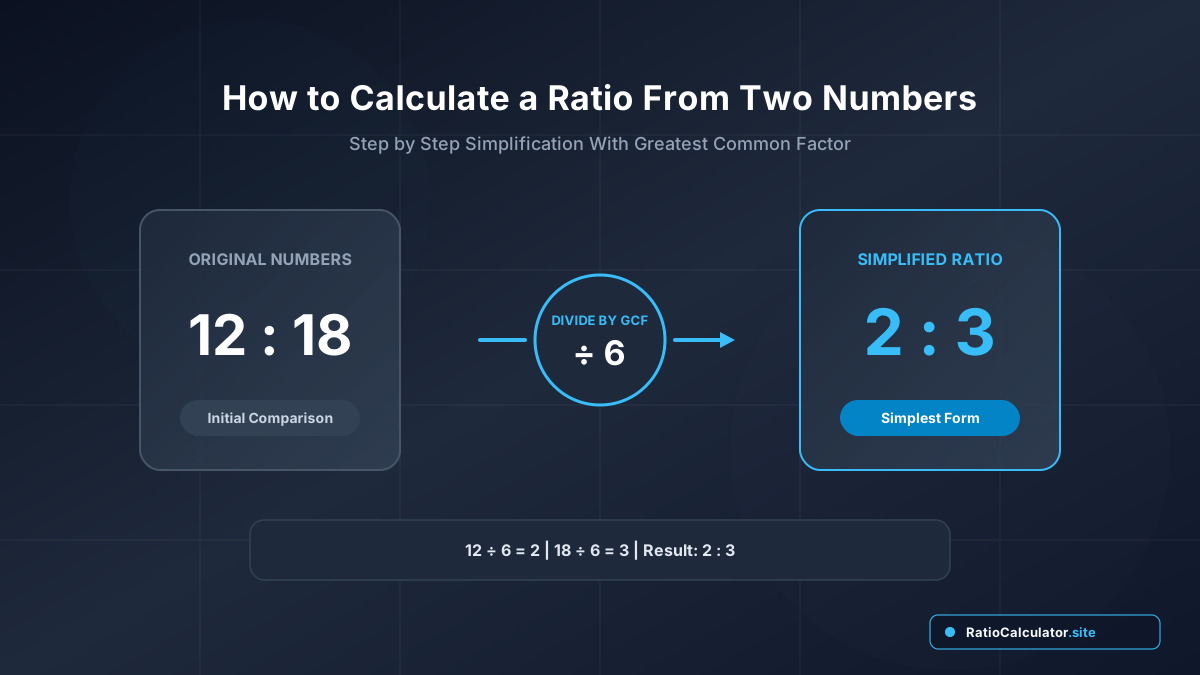
A ratio between two numbers represents a mathematical comparison of two quantities, showing how much of one value exists relative to another value. When comparing two numbers, such as 12 and 18, the relationship can be written as 12:18, as a fraction 12/18, or in words as 12 to 18. This initial comparison can then be simplified to 2:3, which expresses the exact relationship in its simplest form.
Understanding how to find and simplify ratios allows you to scale recipes, calculate financial metrics, evaluate screen dimensions, and solve everyday mathematical problems with confidence. For instant calculations and step by step mathematical breakdowns, you can also use the free Ratio Calculator available on RatioCalculator.site.
What Is a Ratio Between Two Numbers?
A ratio is a mathematical expression comparing two quantities by division. As defined on Wolfram MathWorld ratio definition, a ratio expresses the quotient of two mathematical expressions or physical quantities. In any two number ratio, the first number is called the antecedent and the second number is called the consequent. The first number indicates how many parts belong to the first group, while the second number shows how many parts belong to the second group.
The order of the numbers in a ratio is essential because changing the order completely changes the relationship. For example, a ratio of 2:5 means there are 2 units of the first item for every 5 units of the second item. If you write 5:2 instead, you are stating there are 5 units of the first item for every 2 units of the second item. Because 2:5 and 5:2 describe opposite proportional balances, keeping numbers in their proper sequence is critical for accurate calculations. To learn more about evaluating different relationships, read our detailed guide on How to Compare Ratios.
How to Calculate a Ratio From Two Numbers
Calculating a ratio between two numbers involves five clear mathematical steps:
- Identify the two quantities you want to compare.
- Write the two numbers in ratio notation separated by a colon, such as A:B.
- Determine the greatest common factor shared by both numbers.
- Divide both numbers by that same greatest common factor.
- Write down the resulting simplified values as your final ratio.
For comprehensive educational exercises on ratios and proportions, explore the Khan Academy ratio lessons. If you need to distribute an overall total among these parts, consult our walkthrough on How to Divide a Number in a Given Ratio.
Example 1: Finding the Ratio of 10 and 15
To find the ratio of 10 and 15, write the numbers as 10:15. The greatest common factor of 10 and 15 is 5. Divide 10 by 5 to get 2. Divide 15 by 5 to get 3. The simplified ratio is 2:3.
Example 2: Finding the Ratio of 14 and 21
To find the ratio of 14 and 21, write 14:21. The greatest common factor of 14 and 21 is 7. Divide 14 by 7 to obtain 2. Divide 21 by 7 to obtain 3. The final simplified ratio is 2:3.
Example 3: Finding the Ratio of 16 and 24
To find the ratio of 16 and 24, write 16:24. The greatest common factor of 16 and 24 is 8. Divide 16 by 8 to get 2. Divide 24 by 8 to get 3. The simplest ratio is 2:3.
How to Write a Ratio Using Two Numbers
There are three standard ways to express a ratio between two numbers:
- Colon notation: The numbers are separated by a colon, such as 4:5. This is the most common format in mathematics and science.
- Fraction notation: The first number becomes the numerator and the second number becomes the denominator, such as 4/5. This format makes algebraic manipulation straightforward.
- Word notation: The word to connects the two values, such as 4 to 5. This format is widely used in written reports and conversational explanations.
All three formats express the exact same mathematical proportion. For instance, stating that the ratio of boys to girls in a classroom is 4:5, 4/5, or 4 to 5 provides identical proportional information. Once you establish a base ratio, you can generate equivalent proportions as outlined in How to Find Equivalent Ratios.
How to Simplify a Ratio From Two Numbers
Simplifying a ratio means reducing both numbers to their lowest possible whole integer values while preserving their proportional relationship. This process requires finding the greatest common factor, which is the largest whole number that divides both numbers evenly without leaving a remainder.
Both numbers must be divided by the exact same value. Dividing only one number or dividing them by different numbers alters the proportional balance and creates an incorrect result.
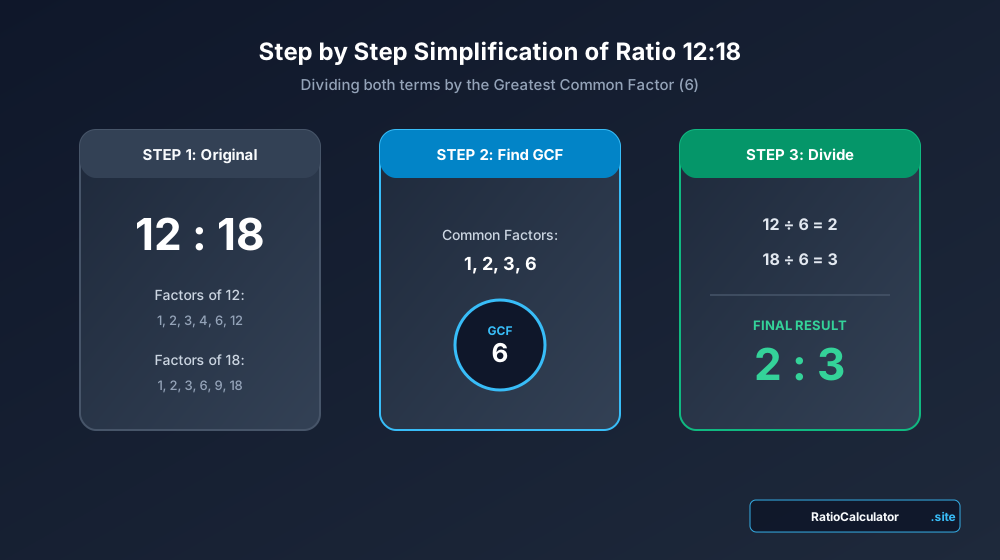
Calculation 1: Simplifying 12:18
- Factors of 12: 1, 2, 3, 4, 6, 12
- Factors of 18: 1, 2, 3, 6, 9, 18
- Greatest common factor: 6
- Divide 12 by 6: 2
- Divide 18 by 6: 3
- Result: 2:3
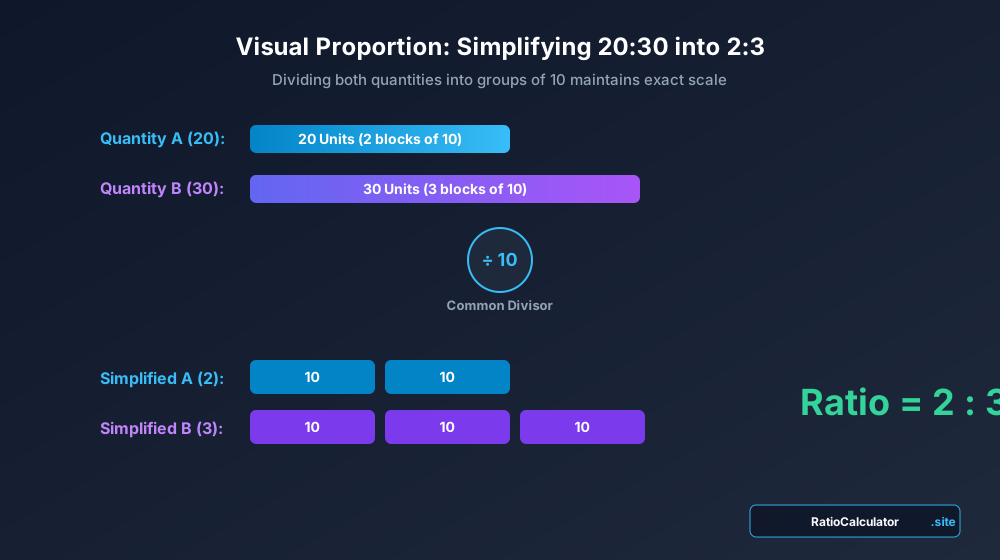
Calculation 2: Simplifying 20:30
- Factors of 20: 1, 2, 4, 5, 10, 20
- Factors of 30: 1, 2, 3, 5, 6, 10, 15, 30
- Greatest common factor: 10
- Divide 20 by 10: 2
- Divide 30 by 10: 3
- Result: 2:3
Calculation 3: Simplifying 24:36
- Factors of 24: 1, 2, 3, 4, 6, 8, 12, 24
- Factors of 36: 1, 2, 3, 4, 6, 9, 12, 18, 36
- Greatest common factor: 12
- Divide 24 by 12: 2
- Divide 36 by 12: 3
- Result: 2:3
Calculation 4: Simplifying 35:49
- Factors of 35: 1, 5, 7, 35
- Factors of 49: 1, 7, 49
- Greatest common factor: 7
- Divide 35 by 7: 5
- Divide 49 by 7: 7
- Result: 5:7
How to Find the Simplest Ratio Between Two Numbers
A ratio is in its simplest form when the only positive integer that divides both numbers evenly is 1. When two numbers share no common factors other than 1, they are called coprime or relatively prime.
| Original Ratio | Greatest Common Factor | Can It Be Simplified? | Simplest Form |
|---|---|---|---|
| 8:12 | 4 | Yes | 2:3 |
| 7:11 | 1 | No (Already in simplest form) | 7:11 |
| 15:25 | 5 | Yes | 3:5 |
| 9:16 | 1 | No (Already in simplest form) | 9:16 |
| 18:27 | 9 | Yes | 2:3 |
| 13:17 | 1 | No (Already in simplest form) | 13:17 |
To check whether a ratio is fully simplified, list the factors of both numbers. If the greatest common factor equals 1, the ratio is already in its simplest form.
How to Calculate a Ratio When the Numbers Are Large
When dealing with large numbers, identifying the greatest common factor through mental arithmetic can be challenging. A practical approach is using the Euclidean algorithm, which provides a fast method for finding common divisors of large values.
Step by Step Example: Calculating the Ratio of 144 and 216
- Divide the larger number by the smaller number: 216 divided by 144 equals 1 with a remainder of 72.
- Divide the previous divisor by the remainder: 144 divided by 72 equals 2 with a remainder of 0.
- Because the remainder is now 0, the greatest common factor is 72.
- Divide the first number by 72: 144 divided by 72 equals 2.
- Divide the second number by 72: 216 divided by 72 equals 3.
- The simplified ratio of 144:216 is 2:3.
Alternatively, you can divide large numbers repeatedly by smaller obvious common factors, such as 2, 3, or 5, until no common factors remain.
How to Calculate a Ratio From Two Numbers With Decimals
Ratios should always be expressed using whole numbers. When you have decimal values, convert them into integers before simplifying by multiplying both numbers by the same power of 10.
Step by Step Example: Calculating the Ratio of 1.5 and 2.5
- Identify the number of decimal places: Both 1.5 and 2.5 have one decimal place.
- Multiply both numbers by 10 to eliminate decimals: 1.5 times 10 equals 15, and 2.5 times 10 equals 25.
- Write the whole number ratio: 15:25.
- Find the greatest common factor of 15 and 25, which is 5.
- Divide both numbers by 5: 15 divided by 5 equals 3, and 25 divided by 5 equals 5.
- The final simplified ratio is 3:5.
If the numbers have different numbers of decimal places, such as 0.25 and 1.5, multiply both by the higher power of 10, which is 100 in this case, resulting in 25:150, simplifying to 1:6.
How to Calculate a Ratio From Two Numbers With Fractions
When comparing two fractions, eliminate denominators by multiplying both fractions by their lowest common denominator or by applying cross multiplication.
Step by Step Example: Calculating the Ratio of 2/3 and 4/5
- Write the initial fractional ratio: (2/3) : (4/5).
- Find the lowest common denominator for 3 and 5, which is 15.
- Multiply the first fraction by 15: (2/3) times 15 equals 10.
- Multiply the second fraction by 15: (4/5) times 15 equals 12.
- Write the whole number ratio: 10:12.
- Simplify by dividing both numbers by their greatest common factor of 2: 10 divided by 2 equals 5, and 12 divided by 2 equals 6.
- The simplified ratio is 5:6.
How to Calculate a Ratio Using a Ratio Calculator
Calculating ratios manually is valuable for understanding mathematical concepts, but automated tools save time and prevent calculation mistakes on complex problems. The Ratio Calculator on RatioCalculator.site provides instant calculations:
- Enter your first number into the first input field.
- Enter your second number into the second input field.
- Click the calculate button to process the ratio.
- View the simplified ratio, the greatest common factor, and the step by step breakdown instantly.
You can also explore related specialized tools and tutorials across our platform, including How to Calculate a Ratio, the Scale Factor Calculator, and the Aspect Ratio Calculator.
Interactive Two Number Ratio Calculator Tool
Use this built in interactive ratio calculator to find and simplify any ratio between two numbers instantly:
Instant Two Number Ratio Calculator
Interactive ToolEnter two numbers below to calculate their simplest ratio, greatest common factor, and calculation steps:
Real Life Examples of Ratios Between Two Numbers
Ratios appear across everyday activities, professional fields, and practical problem solving:
- Classroom Students: A school room with 15 boys and 20 girls has a student ratio of 15:20. Dividing both values by 5 yields a simplified ratio of 3:5, meaning there are 3 boys for every 5 girls.
- Culinary Recipes: A bread recipe using 400 grams of flour and 240 grams of water creates a flour to water ratio of 400:240. Dividing both by 80 produces 5:3.
- Shopping Value: Comparing two bulk purchase bundles containing 24 items for 36 dollars gives a price ratio of 24:36, which simplifies by factor 12 down to 2 items per 3 dollars.
- Personal Finance: Saving 500 dollars while spending 2000 dollars each month represents a savings to spending ratio of 500:2000, simplifying to 1:4.
- Sports Performance: A basketball team winning 28 games and losing 14 games has a win to loss ratio of 28:14, which simplifies by dividing by 14 to give 2:1.
- Construction Measurements: Mixing 50 kilograms of sand with 25 kilograms of cement produces a 50:25 mixture, which simplifies by factor 25 to 2:1.
- Cartography Maps: A map scale showing 2 centimeters on paper for every 50 kilometers on land represents a simplified visual scale relationship of 1:25.
- Business Economics: A firm generating 60000 dollars in gross profit from 180000 dollars in gross sales holds a profit to revenue ratio of 60000:180000, reducing to 1:3.
For applied scenario problem solving, explore How to Solve Ratio Word Problems and How to Find the Missing Number in a Ratio.
Common Mistakes When Calculating a Ratio
Avoiding these typical calculation errors ensures accurate proportional answers:
- Reversing the order of numbers: Writing 5:2 when the problem asks for the ratio of 2 to 5. Always place the first mentioned quantity before the colon.
- Dividing only one number: Dividing the first number by a factor while leaving the second number unchanged. Always divide both numbers by the identical common factor.
- Using different divisors: Dividing the first number by 3 and the second number by 4. Both terms must be divided by the exact same greatest common factor.
- Forgetting to fully simplify: Leaving an answer as 12:18 instead of reducing it completely to 2:3. Check whether the numbers still share common factors greater than 1.
- Treating a ratio as subtraction: Thinking the ratio of 10 to 6 is 4 because 10 minus 6 is 4. Ratios evaluate multiplicative division relationships, never differences.
- Confusing ratios with percentages: Forgetting that a 1:4 part to part ratio means 1 part out of 5 total parts, representing 20 percent rather than 25 percent of the whole.
Ratio vs Fraction vs Percentage
Ratios, fractions, and percentages are closely related mathematical tools, but each expresses numerical relationships from a distinct perspective:
| Format | Primary Meaning | Standard Notation | Example Comparing 2 Red and 3 Blue Blocks |
|---|---|---|---|
| Ratio | Compares one quantity directly to another quantity (Part to Part or Part to Whole) | A:B or A to B | 2:3 (Red to Blue) |
| Fraction | Represents specific parts relative to the total whole amount (Part to Whole) | A/B | 2/5 (Red out of Total Blocks) |
| Percentage | Expresses the part to whole proportion as a fraction out of 100 | P% | 40% (Red out of Total Blocks) |
To convert the part to part ratio 2:3 into a fraction of the whole, add the parts together to find the total (2 plus 3 equals 5). The fractional part for red blocks is 2/5. To convert this into a percentage, divide 2 by 5 to get 0.4 and multiply by 100, which yields 40 percent. For quick conversion calculations, test the Ratio to Percentage Calculator or consult our detailed guide on How to Convert a Ratio to a Percentage.
How to Check Your Ratio Answer
You can verify any simplified ratio by applying cross multiplication or by checking for equal proportional quotients:
- Reconstruct original values: Multiply both numbers in your simplified ratio by the greatest common factor you divided by. If you simplified 12:18 to 2:3 using factor 6, multiply 2 by 6 to get 12, and multiply 3 by 6 to get 18. Because both original numbers are restored, your calculation is correct.
- Decimal division equivalence: Divide the original first number by the original second number, then divide the simplified first number by the simplified second number. For 12:18, 12 divided by 18 equals 0.6667. For 2:3, 2 divided by 3 equals 0.6667. Matching decimal values confirm the two ratios are mathematically equivalent.
Frequently Asked Questions
How do you calculate a ratio from two numbers?
You calculate a ratio by writing the two numbers separated by a colon and dividing both by their greatest common factor.
How do you find the ratio between two numbers?
You find the ratio between two numbers by identifying their shared common factors and reducing both values to their lowest whole integers.
How do you simplify the ratio of two numbers?
You simplify the ratio of two numbers by dividing both terms by the highest number that divides into both evenly.
What is the easiest way to calculate a ratio?
The easiest way to calculate a ratio is entering both values into an online ratio calculator to obtain the simplified proportion instantly.
How do you find the simplest ratio between two numbers?
You find the simplest ratio by dividing both numbers by their greatest common factor until they share no common divisors other than 1.
How do you calculate a ratio using the greatest common factor?
You list the factors of both numbers, select the largest matching factor, and divide each number by that value.
Can a ratio be written as a fraction?
Yes, a ratio comparing two numbers can be written as a fraction where the first number is the numerator and the second is the denominator.
How do you check a ratio calculation?
You check a ratio calculation by multiplying both simplified numbers by the common factor to confirm you recreate the original values.