How to Convert a Ratio to a Percentage (Easy Step by Step Guide)
Learn how to convert a ratio to a percentage with simple steps, clear formulas, and practical examples. Calculate percentages for any ratio accurately.
How to Convert a Ratio to a Percentage: Step by Step With Examples
Converting a ratio to a percentage is the mathematical process of finding what portion each part of a ratio represents out of the whole amount, expressed as a number out of 100. While a ratio compares numbers to each other, a percentage compares each number to a standard base of 100.
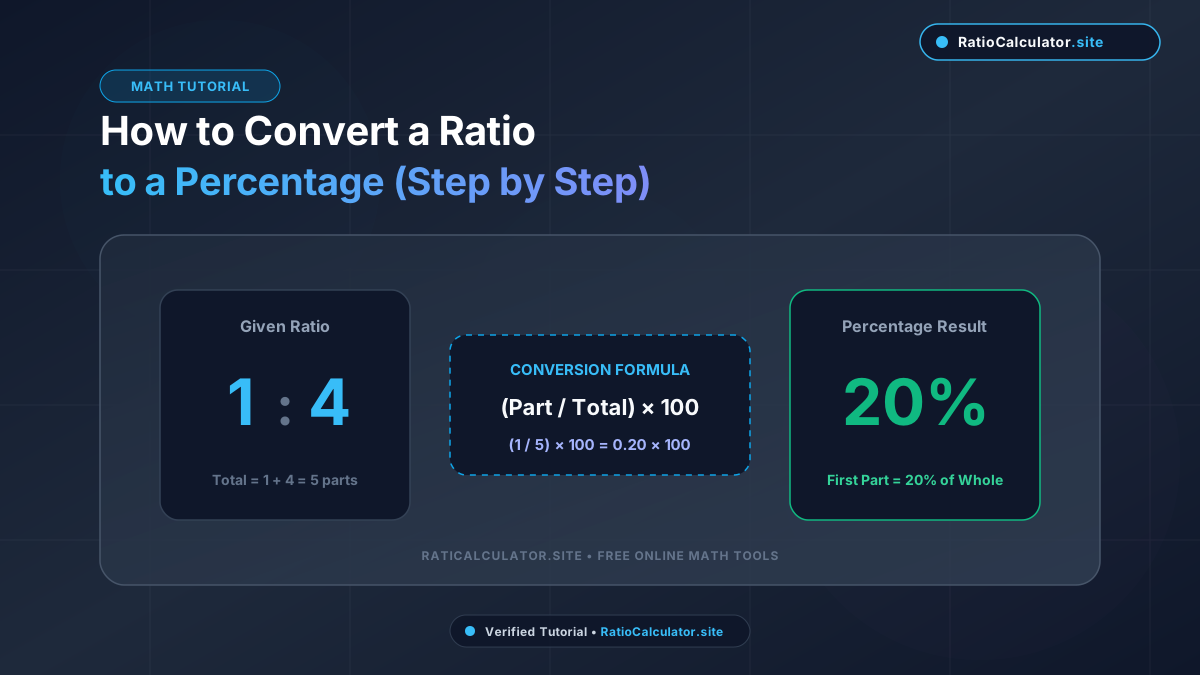
To convert any ratio into a percentage, you first determine what portion the number represents of the total amount. For example, consider the ratio 1:4. If a recipe calls for 1 part lemon juice and 4 parts water, the entire mixture contains 1 plus 4, which equals 5 total parts. The lemon juice represents 1 part out of 5 total parts. Dividing 1 by 5 gives 0.20, and multiplying 0.20 by 100 yields 20 percent. The water represents 4 parts out of 5, which equals 0.80, or 80 percent. Together, 20 percent and 80 percent complete the whole 100 percent mixture.
Understanding this conversion allows you to interpret financial reports, analyze statistics, calculate retail discounts, and solve math problems with confidence. If you want to compute proportions quickly or check your manual calculations, you can use the Ratio Calculator on RatioCalculator.site to simplify ratios and convert values in seconds.
What Does a Ratio to Percentage Mean?
Quick Answer (Featured Snippet): To convert a ratio (A:B) into a percentage, add the ratio parts to find the total sum (A + B), divide the chosen part by that total sum, and multiply by 100:
Percentage of A = (A ÷ (A + B)) × 100. For example, the ratio 1:4 converts to 20% (1 ÷ 5 × 100) and 80% (4 ÷ 5 × 100).
A ratio describes the proportional relationship between two or more quantities. If you are exploring proportional arithmetic for the first time, our guide on How to Calculate a Ratio provides a comprehensive introduction. A percentage expresses a portion as a fraction of 100. When you convert a ratio to a percentage, you translate a relative comparison into a universal scale that anyone can understand immediately.
According to established mathematics education standards, proportional reasoning connects fractional quantities with standardized percentages. Ratios can describe two distinct types of relationships:
- Part to part comparisons, such as comparing 3 red balls to 5 blue balls.
- Part to whole comparisons, such as comparing 3 red balls to an entire collection of 8 balls.
Most ratios in daily life are written in a part to part format. Converting them to percentages requires finding the total of all parts first. Percentages make comparisons clearer because humans naturally evaluate values based on a 100 point scale. Saying that an investment grew at a 4:1 ratio of profit to cost requires mental arithmetic, whereas saying that profit represents 80 percent of total value delivers immediate clarity.
Converting ratios to percentages is especially useful in the following everyday scenarios:
- Evaluating classroom test scores and student performance.
- Adjusting food and drink recipes for different serving sizes.
- Comparing sports statistics such as win to loss records.
- Calculating sales tax, commission rates, and business profit margins.
- Understanding demographic data and public opinion polls.
How to Convert a Ratio to a Percentage
Converting any ratio into a percentage follows a dependable four step procedure. You can apply this method to simple ratios, large numbers, and multi part proportions.
The Step by Step Method
- Add all ratio parts together to find the total sum of parts.
- Divide the specific part being measured by the total sum of parts to produce a decimal fraction.
- Multiply the resulting decimal fraction by 100.
- Attach the percent symbol (%) to state the final percentage value.
Step by Step Demonstration Using 1:4
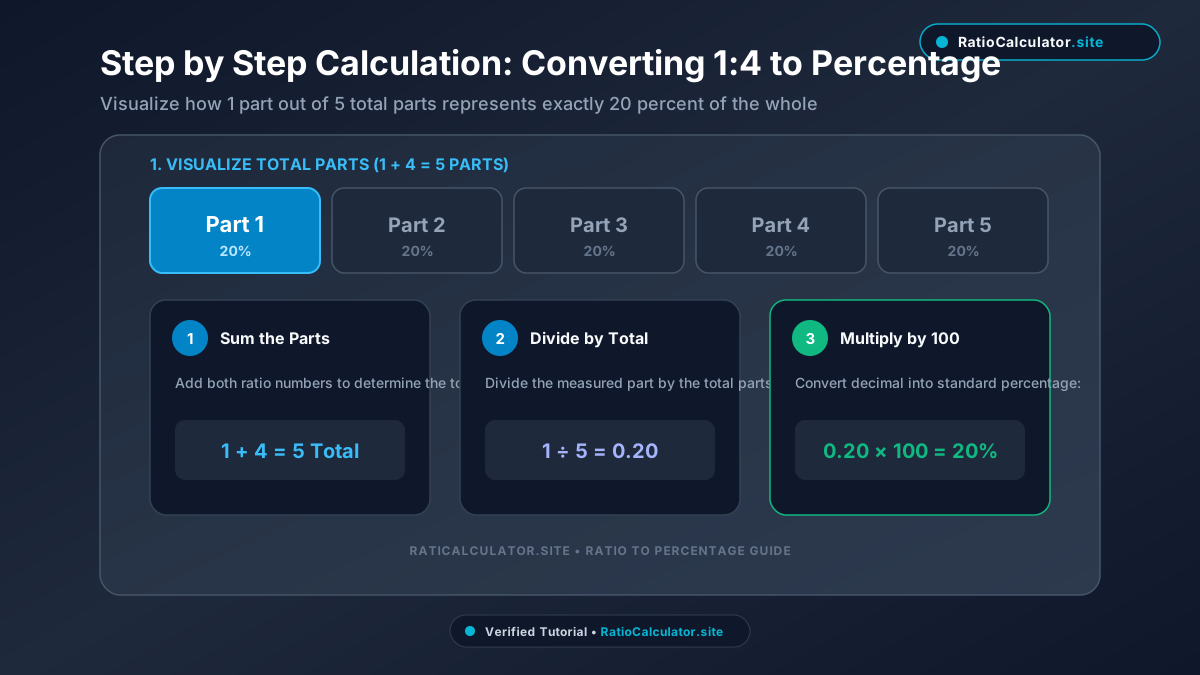
Let us convert the ratio 1:4 into a percentage for the first number:
- Step 1: Add the ratio parts together. 1 plus 4 equals 5 total parts.
- Step 2: Divide the first part by the total parts. 1 divided by 5 equals 0.20.
- Step 3: Multiply by 100. 0.20 multiplied by 100 equals 20.
- Step 4: Write the final answer as 20 percent.
If you also want to convert the second part:
- Step 1: Use the same total of 5 parts.
- Step 2: Divide the second part by the total parts. 4 divided by 5 equals 0.80.
- Step 3: Multiply by 100. 0.80 multiplied by 100 equals 80.
- Step 4: Write the final answer as 80 percent.
Notice that 20 percent plus 80 percent equals 100 percent, confirming that the entire whole is accounted for correctly.
Ratio to Percentage Formula
Mathematical formulas define the conversion clearly for any two part ratio. For a ratio written as a:b, the numbers a and b represent individual portions of a combined whole, as noted in the formal mathematical definition of ratio.
Formula for the First Part
The percentage represented by the first part (a) is calculated as:
Percentage of Part a = (a / (a + b)) * 100Formula for the Second Part
The percentage represented by the second part (b) is calculated as:
Percentage of Part b = (b / (a + b)) * 100Key Mathematical Distinction: Part to Whole vs Part to Part
Understanding the formula requires distinguishing between part to part ratios and part to whole ratios:
- In a part to part ratio (a:b), neither a nor b represents the total. The total is the sum (a + b). You must always add both terms before dividing.
- In a part to whole ratio (a:total), the second number is already the total sum. In this case, the formula is simply (a / total) * 100.
Applying the correct formula ensures that your percentage reflects the true proportion of the whole.
Try the Live Ratio to Percentage Converter
Test any two ratio numbers below to see their exact percentages, decimal fractions, and animated proportional share in real time:
Live Ratio to Percentage Tool
InteractiveEnter two ratio parts to instantly calculate the percentage share of each part:
Examples of Converting Ratios to Percentages
Working through diverse examples builds practical understanding. Here are five detailed calculations showing how different ratios convert into exact percentages.
Example 1: Converting 1:4 to Percentage
- Ratio: 1:4
- Calculate Total: 1 plus 4 equals 5
- First Part Calculation: (1 / 5) * 100 equals 0.20 * 100 equals 20 percent
- Second Part Calculation: (4 / 5) * 100 equals 0.80 * 100 equals 80 percent
- Verification: 20 percent plus 80 percent equals 100 percent
Example 2: Converting 2:3 to Percentage
- Ratio: 2:3
- Calculate Total: 2 plus 3 equals 5
- First Part Calculation: (2 / 5) * 100 equals 0.40 * 100 equals 40 percent
- Second Part Calculation: (3 / 5) * 100 equals 0.60 * 100 equals 60 percent
- Verification: 40 percent plus 60 percent equals 100 percent
Example 3: Converting 3:5 to Percentage
- Ratio: 3:5
- Calculate Total: 3 plus 5 equals 8
- First Part Calculation: (3 / 8) * 100 equals 0.375 * 100 equals 37.5 percent
- Second Part Calculation: (5 / 8) * 100 equals 0.625 * 100 equals 62.5 percent
- Verification: 37.5 percent plus 62.5 percent equals 100 percent
Example 4: Converting 4:6 to Percentage
- Ratio: 4:6
- Calculate Total: 4 plus 6 equals 10
- First Part Calculation: (4 / 10) * 100 equals 0.40 * 100 equals 40 percent
- Second Part Calculation: (6 / 10) * 100 equals 0.60 * 100 equals 60 percent
- Note on Simplification: Simplifying 4:6 into Equivalent Ratios by dividing both numbers by 2 gives 2:3. As shown in Example 2, 2:3 yields the exact same results of 40 percent and 60 percent.
- Verification: 40 percent plus 60 percent equals 100 percent
Example 5: Converting 7:13 to Percentage
- Ratio: 7:13
- Calculate Total: 7 plus 13 equals 20
- First Part Calculation: (7 / 20) * 100 equals 0.35 * 100 equals 35 percent
- Second Part Calculation: (13 / 20) * 100 equals 0.65 * 100 equals 65 percent
- Verification: 35 percent plus 65 percent equals 100 percent
How to Convert a Ratio With Two Parts to Percentages
When a ratio contains two parts, both parts represent distinct shares of a single complete entity. Converting both parts into percentages reveals the complete composition of the whole.
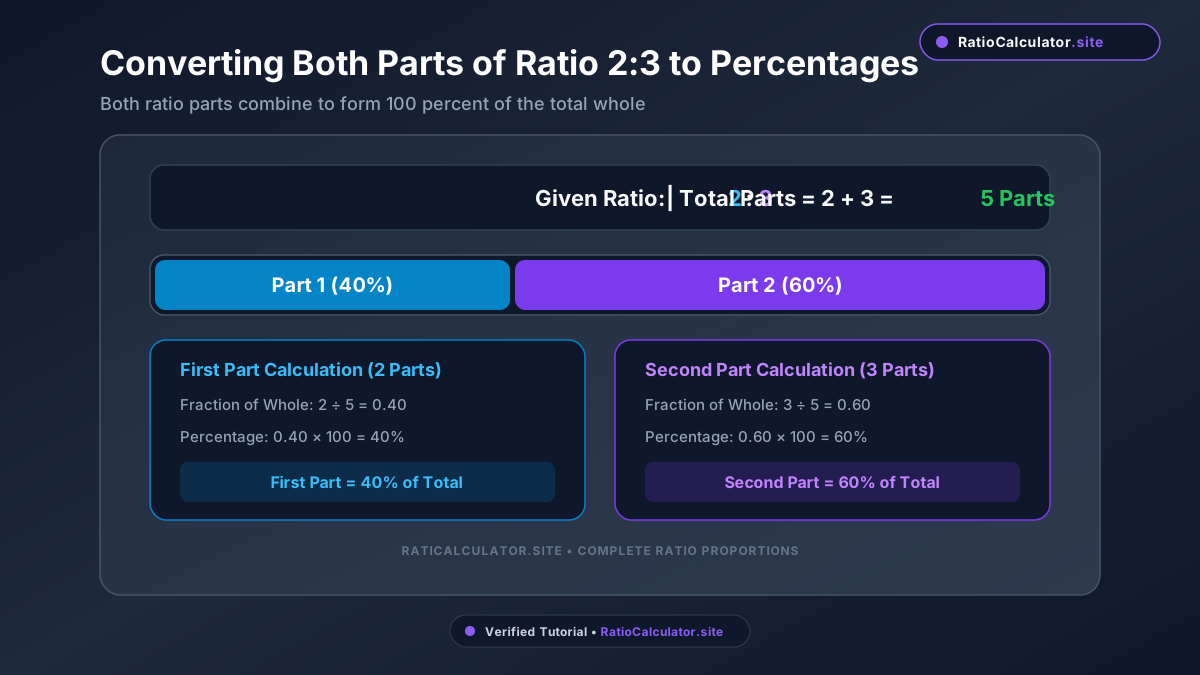
Consider a ratio of 2:3 representing votes for two competing proposals:
- Calculate the total parts: 2 plus 3 equals 5 total parts.
- Convert the first part (Proposal A): (2 / 5) * 100 equals 40 percent.
- Convert the second part (Proposal B): (3 / 5) * 100 equals 60 percent.
Why Both Percentages Must Equal 100 Percent
In mathematics, 100 percent represents the entire quantity under consideration. When you convert every individual part of a ratio, the sum of those percentages must always equal 100 percent:
40 percent + 60 percent = 100 percentIf your calculated percentages do not add up to 100 percent, one of two things has happened:
- A calculation mistake occurred during addition or division.
- Repeating decimals were rounded. For instance, the ratio 1:2 produces 33.33 percent and 66.67 percent, which sum to 100.00 percent when rounded to two decimal places.
Checking that the sum equals 100 percent serves as an immediate verification tool for any ratio calculation.
How to Convert a Ratio to a Percentage Without a Calculator
Mental math techniques and manual arithmetic allow you to convert ratios to percentages quickly without digital tools.
Method 1: Benchmark Fractions
Memorizing common benchmark fraction conversions allows instant calculation. Here is a handy reference table for the most common ratio and fraction benchmarks:
| Ratio (Part:Part) | Total Parts | Fraction of Whole | Decimal | Percentage Benchmark |
|---|---|---|---|---|
| 1:1 | 2 parts | 1/2 | 0.50 | 50% |
| 1:2 | 3 parts | 1/3 | 0.333 | 33.33% |
| 1:3 | 4 parts | 1/4 | 0.25 | 25% |
| 1:4 | 5 parts | 1/5 | 0.20 | 20% |
| 2:3 | 5 parts | 2/5 | 0.40 | 40% |
| 3:1 | 4 parts | 3/4 | 0.75 | 75% |
| 1:9 | 10 parts | 1/10 | 0.10 | 10% |
| 1:19 | 20 parts | 1/20 | 0.05 | 5% |
When converting a ratio like 1:4, the total is 5 parts. The fraction 1/5 is a known benchmark equal to 20 percent, giving you the answer instantly.
Method 2: Scaling Denominators to 100
If the total number of parts can be multiplied easily to reach 100, scale both numbers by that factor:
- Take the ratio 7:13. The total is 20 parts.
- To turn 20 into 100, multiply by 5.
- Multiply the first part: 7 multiplied by 5 equals 35. Therefore, the first part is 35 percent.
- Multiply the second part: 13 multiplied by 5 equals 65. Therefore, the second part is 65 percent.
Method 3: Manual Long Division
When numbers do not scale easily, use standard long division:
- For the ratio 3:5, the total is 8 parts.
- Set up 3.000 divided by 8 using long division.
- 8 goes into 30 three times (remainder 6).
- 8 goes into 60 seven times (remainder 4).
- 8 goes into 40 five times (remainder 0).
- The decimal result is 0.375.
- Move the decimal point two places to the right to obtain 37.5 percent.
How to Convert a Ratio to a Percentage Using a Calculator
Using a physical or digital calculator simplifies calculations involving complex numbers, large values, and odd proportions.
Steps on a Standard Handheld Calculator
- Add the two ratio numbers together to determine the total sum. Note this total.
- Clear the calculator screen.
- Enter the first ratio number.
- Press the division key (/).
- Enter the total sum calculated in Step 1.
- Press the multiplication key (*).
- Enter 100 and press the equals key (=).
- The displayed number is your percentage.
Converting Ratios Instantly on RatioCalculator.site
For complex problems, solving proportions with unknown terms via our How to Find the Missing Number in a Ratio guide, or performing instant conversions, the free online tools on RatioCalculator.site provide immediate answers with complete mathematical breakdowns.
When you visit the Ratio Calculator or use the dedicated Ratio to Percentage Calculator, you can input your ratio values directly. The calculator simplifies proportions, determines missing terms, and provides fractional and percentage equivalents automatically. This saves time and ensures total accuracy for schoolwork, business planning, and practical projects.
Ratio to Percentage Examples in Real Life
Ratios and percentages appear throughout daily life. You can also explore how to split quantities evenly using our guide on How to Divide a Number in a Given Ratio. Here are realistic examples demonstrating how converting ratios into percentages solves practical questions.
Classroom Performance
A classroom consists of 12 boys and 18 girls. What percentage of the class is male?
- Ratio: 12:18
- Total students: 12 plus 18 equals 30 students
- Boys percentage: (12 / 30) * 100 equals 0.40 * 100 equals 40 percent
- Girls percentage: (18 / 30) * 100 equals 0.60 * 100 equals 60 percent
- Context: 40 percent of the classroom consists of boys.
Cooking and Recipe Preparation
A salad dressing recipe calls for 1 part balsamic vinegar to 3 parts extra virgin olive oil. What percentage of the dressing is vinegar?
- Ratio: 1:3
- Total liquid parts: 1 plus 3 equals 4 parts
- Vinegar percentage: (1 / 4) * 100 equals 25 percent
- Olive oil percentage: (3 / 4) * 100 equals 75 percent
- Context: The finished dressing is 25 percent vinegar by volume.
Personal Finance and Savings
A worker allocates money with a savings to spending ratio of 1:4. What percentage of total income is saved?
- Ratio: 1:4
- Total income units: 1 plus 4 equals 5 units
- Savings percentage: (1 / 5) * 100 equals 20 percent
- Spending percentage: (4 / 5) * 100 equals 80 percent
- Context: The worker saves 20 percent of every paycheck.
Retail Pricing and Profit Margins
A retailer sets prices with a product cost to markup ratio of 2:3. What percentage of the final retail price represents pure markup?
- Ratio: 2:3
- Total retail price units: 2 plus 3 equals 5 units
- Cost percentage: (2 / 5) * 100 equals 40 percent
- Markup percentage: (3 / 5) * 100 equals 60 percent
- Context: 60 percent of the customer retail price represents business markup.
Sports Team Records
A soccer team finishes a season with 7 wins and 3 losses, written as a win to loss ratio of 7:3. What is the team win percentage?
- Ratio: 7:3
- Total games played: 7 plus 3 equals 10 games
- Win percentage: (7 / 10) * 100 equals 70 percent
- Loss percentage: (3 / 10) * 100 equals 30 percent
- Context: The soccer team achieved a 70 percent winning record.
Survey and Poll Results
A community poll on a park renovation shows 4 supporters for every 1 opponent. What percentage of residents support the project?
- Ratio: 4:1
- Total respondents: 4 plus 1 equals 5 respondents
- Support percentage: (4 / 5) * 100 equals 80 percent
- Opposition percentage: (1 / 5) * 100 equals 20 percent
- Context: 80 percent of surveyed residents support the renovation.
Corporate Budget Allocation
A startup allocates funds between engineering and marketing in a ratio of 3:7. What share goes to engineering?
- Ratio: 3:7
- Total budget units: 3 plus 7 equals 10 units
- Engineering share: (3 / 10) * 100 equals 30 percent
- Marketing share: (7 / 10) * 100 equals 70 percent
- Context: Engineering receives 30 percent of the allocated budget.
Construction Material Mixtures
A standard mortar mixture uses 1 part Portland cement to 4 parts masonry sand. What percentage of the dry mix is cement?
- Ratio: 1:4
- Total dry parts: 1 plus 4 equals 5 parts
- Cement percentage: (1 / 5) * 100 equals 20 percent
- Sand percentage: (4 / 5) * 100 equals 80 percent
- Context: Cement makes up 20 percent of the total dry volume.
Common Mistakes When Converting Ratios to Percentages
Avoiding standard calculation errors guarantees accurate results every time. Here are the five most frequent mistakes and their simple corrections.
1. Forgetting to Add the Ratio Parts
- The Mistake: Dividing the first number by the second number directly (such as calculating 1 divided by 4 equals 25 percent for the ratio 1:4).
- The Correction: The second number is not the total. Always add both numbers (1 plus 4 equals 5) to find the true total before dividing.
2. Dividing by the Wrong Number
- The Mistake: Placing the total in the numerator and the part in the denominator (calculating 5 divided by 1).
- The Correction: The individual part is always the top numerator, and the total sum of parts is always the bottom denominator.
3. Multiplying by 100 Too Early
- The Mistake: Multiplying the individual ratio term by 100 before establishing the whole (such as turning 2:3 into 200:3).
- The Correction: Complete the division of part by total first to create a decimal, then multiply the decimal by 100.
4. Treating Ratio Numbers as Percentages Directly
- The Mistake: Assuming that a ratio of 2:3 means 2 percent and 3 percent.
- The Correction: Ratio numbers represent relative shares, not portions out of 100. Always run the full conversion calculation.
5. Forgetting to Verify That Percentages Total 100 Percent
- The Mistake: Calculating one part and assuming the calculation is complete without verifying the second part.
- The Correction: Convert all parts of the ratio and sum them together. If they do not add up to 100 percent (allowing for minor rounding), review your steps.
Ratio vs Percentage
While ratios and percentages both describe numerical relationships, they serve different communication purposes and follow different structural rules.
| Comparison Factor | Ratio | Percentage |
|---|---|---|
| Standard Base | Flexible base determined by the sum of parts | Fixed standard base of 100 |
| Standard Notation | Written with colons (3:5), words (3 to 5), or fractions (3/5) | Written with the percent symbol (60%) |
| Comparison Type | Compares part to part or part to whole | Always compares part to a standardized whole of 100 |
| Number of Terms | Can compare two, three, or more quantities (2:3:5) | Represents one share of a whole per value |
| Primary Benefit | Shows direct relationships between distinct ingredients or groups | Allows effortless comparison across different sample sizes |
When Ratios Are Most Useful
Ratios excel when you are mixing physical materials, scaling recipes, establishing gear ratios in mechanics, or describing direct relationships between two distinct groups without needing to know total volume.
When Percentages Are Most Useful
Percentages excel when you are presenting public statistics, comparing financial performance across different company sizes, grading academic exams, or communicating proportional changes to a broad audience.
When Should You Convert a Ratio to a Percentage?
Converting a ratio to a percentage is recommended whenever standardizing data makes information easier to interpret. If you are analyzing multiple ratios side by side, our guide on How to Compare Ratios explains how converting to percentages simplifies comparison across diverse datasets. Specific practical situations include:
- Presenting Data to Non Technical Audiences: Most people instantly understand that 75 percent represents three quarters of a whole, whereas a ratio of 3:1 requires a moment of mental translation to understand that 3 parts out of 4 total parts are involved.
- Comparing Datasets of Different Sizes: If School A has a passing ratio of 4:1 and School B has a passing ratio of 17:3, converting both to percentages (80 percent versus 85 percent) immediately reveals which school achieved higher performance.
- Financial and Business Reporting: Investors evaluate return on investment, gross margins, and debt ratios much faster when expressed as standard percentage benchmarks.
- Academic Assessment: Grading tests on a 100 percent scale allows students and parents to evaluate progress consistently across subjects with varying point totals.
Frequently Asked Questions
How do you convert a ratio to a percentage?
Add the ratio parts together to find the total, divide the chosen part by that total, and multiply by 100.
What is the formula for converting a ratio to a percentage?
The formula for part a in ratio a:b is (a / (a + b)) * 100.
How do you convert 1 to 4 into a percentage?
Add 1 plus 4 to get 5 total parts, divide 1 by 5 to get 0.20, and multiply by 100 to get 20 percent.
How do you convert 2 to 3 into a percentage?
Add 2 plus 3 to get 5 total parts, divide 2 by 5 to get 0.40, and multiply by 100 to get 40 percent.
How do you find the percentage of a ratio?
Find the sum of all ratio numbers, divide each individual number by the sum, and multiply each decimal by 100.
Can a ratio be converted into a percentage?
Yes, any ratio can be converted into a percentage by calculating each part as a fraction of the total sum of parts.
How do you convert a ratio to a percentage without a calculator?
Add the ratio parts, simplify the resulting fraction, and scale the denominator to 100 or use manual long division.
How do you convert both parts of a ratio into percentages?
Divide each individual ratio part by the sum of both parts, multiply each by 100, and confirm that both percentages total 100 percent.