How to Divide a Number in a Given Ratio (Complete Step by Step Guide)
Learn how to divide a number in a given ratio with clear steps, practical examples, and a simple formula. Covers two part and three part ratios, money, fractions, and more.
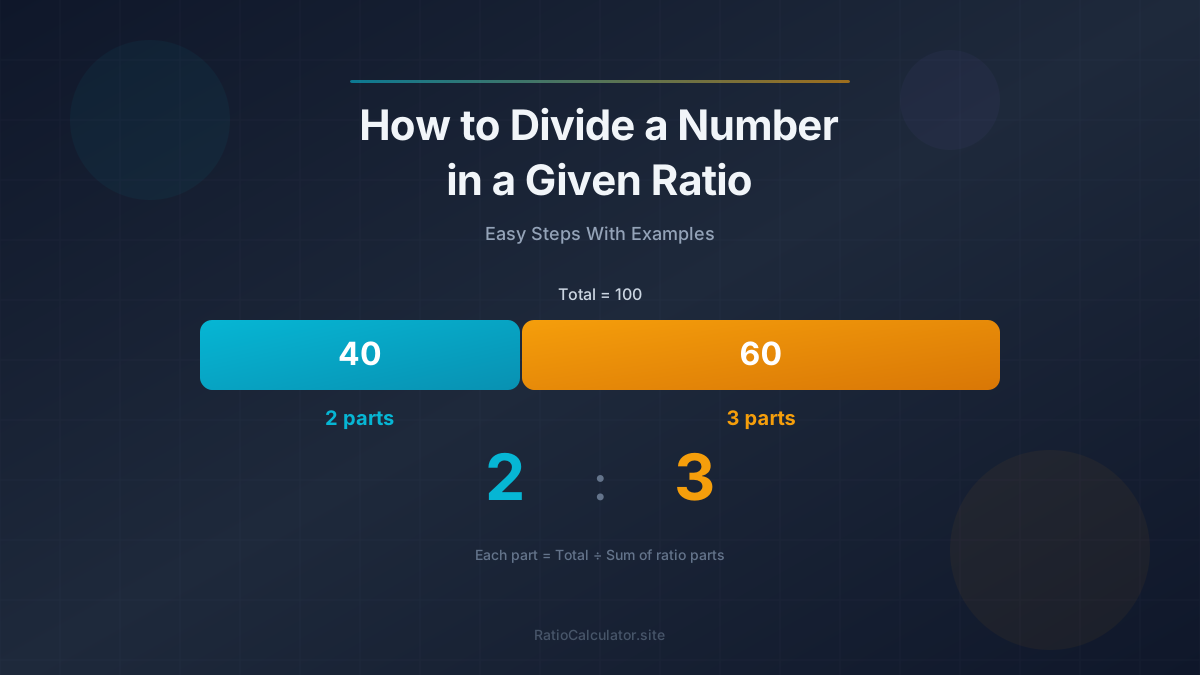
How to Divide a Number in a Given Ratio: Easy Steps With Examples
Dividing a number in a given ratio means splitting a total amount into parts that follow a specific proportional relationship. For example, dividing 100 in the ratio 2 to 3 means breaking 100 into two parts where one part is twice as large as one unit and the other is three times as large.
Here is a quick example. Suppose you have 100 and you want to divide it in the ratio 2 to 3. The total number of ratio parts is 2 + 3 = 5. Each part equals 100 ÷ 5 = 20. So the two shares are 2 × 20 = 40 and 3 × 20 = 60.
This type of calculation appears constantly in everyday situations such as splitting money, sharing food, dividing resources at work, or solving math problems in school. Whether you are working with two parts or more, the method stays the same.
If you want instant answers without manual calculation, the Ratio Calculator on RatioCalculator.site handles ratio division, simplification, and scaling in seconds.
What Does It Mean to Divide a Number in a Ratio?
Quick Answer (Featured Snippet): To divide a total amount in a ratio (such as A:B), add the ratio numbers to find the total parts (A + B), divide the total amount by that sum to find the value of one part, and multiply each ratio number by that one part value. For example, dividing $100 in a 2:3 ratio yields $40 (2 × $20) and $60 (3 × $20).
When you divide a number in a ratio, you are distributing a total quantity into parts that maintain a fixed proportional relationship. The ratio tells you how the parts compare to each other, not how large they are on their own.
Consider the ratio 2 to 3. This tells you that the first part should contain 2 units for every 3 units in the second part. If you divide 100 in this ratio, you are not simply cutting it in half. Instead, you are creating two unequal parts that follow the 2 to 3 relationship.
The key step is to first find the total number of ratio parts. In a 2 to 3 ratio, the total number of parts is 2 + 3 = 5. Once you know the total parts, you can calculate what each single part is worth, and then multiply to find the actual amounts.
This idea of proportional sharing is useful any time you need to distribute a quantity fairly according to agreed proportions, whether that involves money, materials, time, or any other measurable amount.
Formula for Dividing a Number in a Given Ratio
The formula for ratio division is straightforward. For a total amount T divided in the ratio a to b:
Total ratio parts = a + b
Value of one part = T ÷ (a + b)
First share = a × (T ÷ (a + b))
Second share = b × (T ÷ (a + b))
This works because the ratio tells you how many “equal portions” each share contains. By dividing the total by the sum of all ratio parts, you find what one portion is worth. Then you multiply by each ratio number to get the actual shares.
For example, to divide 200 in the ratio 3 to 5:
- Total ratio parts = 3 + 5 = 8
- Value of one part = 200 ÷ 8 = 25
- First share = 3 × 25 = 75
- Second share = 5 × 25 = 125
The same formula extends to three or more parts. For a ratio a to b to c, the total ratio parts are a + b + c, and each share is calculated by multiplying its ratio number by the value of one part.
How to Divide a Number in a Given Ratio
Follow this general process to divide any number in a given ratio.
Step 1: Write the Given Ratio
Identify the ratio you are working with. Make sure it is in its simplest form. For example, if the ratio is 4 to 6, you can simplify it to 2 to 3 before calculating, though the final result will be the same either way.
Step 2: Add the Ratio Parts
Add all the numbers in the ratio together. This gives you the total number of equal parts.
For the ratio 2 to 3: total parts = 2 + 3 = 5
Step 3: Divide the Total by the Sum of Ratio Parts
Take the total amount you are dividing and divide it by the total number of parts. This tells you how much one single ratio part is worth.
For a total of 100 with 5 parts: one part = 100 ÷ 5 = 20
Step 4: Multiply the Value of One Part by Each Ratio Number
Multiply the value of one part by each number in the ratio to find each share.
First share = 2 × 20 = 40
Second share = 3 × 20 = 60
Step 5: Verify Your Answer
Add all the resulting shares together. The total should equal the original number.
40 + 60 = 100 ✓
This five step process works for any ratio, whether it has two parts, three parts, or more.
Example: Dividing 100 in the Ratio 2 to 3
This is one of the most commonly searched examples, so let us work through it in full detail.
Problem: Divide 100 in the ratio 2 to 3.
Step 1: The ratio is 2 to 3.
Step 2: Total ratio parts = 2 + 3 = 5.
Step 3: Value of one part = 100 ÷ 5 = 20.
Step 4: Calculate each share:
- First share = 2 × 20 = 40
- Second share = 3 × 20 = 60
Step 5: Verify: 40 + 60 = 100 ✓
The two amounts are 40 and 60.
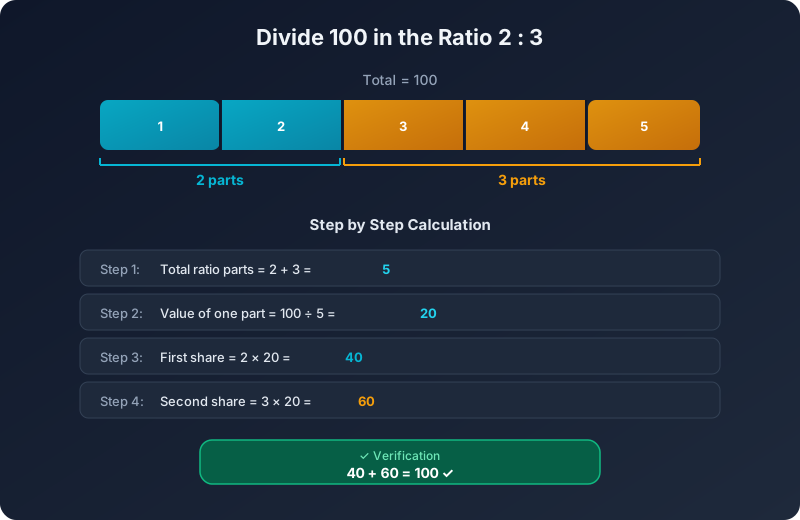
Notice that the two resulting parts maintain the ratio 2 to 3. You can verify this by simplifying: 40 to 60 reduces to 2 to 3 when you divide both by 20.
How to Divide Money in a Ratio
Dividing money in a ratio works exactly the same way as dividing any number. The only difference is that you are working with currency values.
Problem: Two friends, Alex and Sam, contributed to a joint project. They agree to split $450 in the ratio 4 to 5 based on the amount of work each person did.
Step 1: The ratio is 4 to 5.
Step 2: Total ratio parts = 4 + 5 = 9.
Step 3: Value of one part = $450 ÷ 9 = $50.
Step 4: Calculate each share:
- Alex receives = 4 × $50 = $200
- Sam receives = 5 × $50 = $250
Step 5: Verify: $200 + $250 = $450 ✓
This method applies to any situation where money needs to be shared proportionally, such as dividing business profits, splitting bills, distributing an inheritance, or sharing prize money.
For quick profit sharing calculations, try the Profit Sharing Calculator on RatioCalculator.site.
How to Divide a Quantity in a Three Part Ratio
The method extends naturally when you need to divide a total among three or more parts. You simply add all the ratio numbers together and proceed as before.
Problem: Divide 120 in the ratio 2 to 3 to 5.
Step 1: The ratio is 2 to 3 to 5.
Step 2: Total ratio parts = 2 + 3 + 5 = 10.
Step 3: Value of one part = 120 ÷ 10 = 12.
Step 4: Calculate each share:
- First share = 2 × 12 = 24
- Second share = 3 × 12 = 36
- Third share = 5 × 12 = 60
Step 5: Verify: 24 + 36 + 60 = 120 ✓
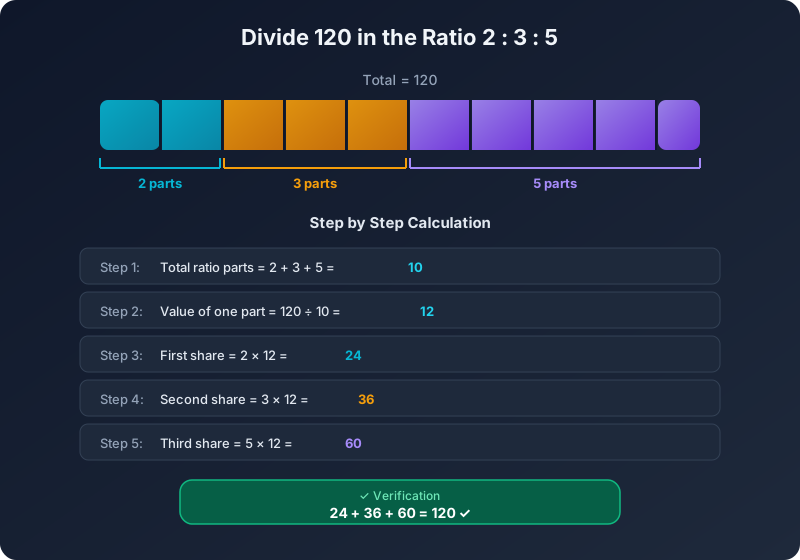
This same approach works for four parts, five parts, or any number of parts. Just add all the ratio numbers together to find the total parts, then divide and multiply as shown.
How to Divide a Number in a Ratio With Fractions or Decimals
Sometimes the ratio includes fractions or decimals instead of whole numbers. The solution is to convert them into whole numbers first, and then apply the standard method.
Handling Decimal Ratios
Problem: Divide 90 in the ratio 1.5 to 3.5.
Step 1: Remove the decimals by multiplying both ratio numbers by 10.
1.5 × 10 = 15 and 3.5 × 10 = 35.
Step 2: Simplify 15 to 35. Both divide by 5, giving 3 to 7.
Step 3: Total ratio parts = 3 + 7 = 10.
Step 4: Value of one part = 90 ÷ 10 = 9.
Step 5: Calculate each share:
- First share = 3 × 9 = 27
- Second share = 7 × 9 = 63
Verify: 27 + 63 = 90 ✓
Handling Fraction Ratios
Problem: Divide 60 in the ratio 1/2 to 1/3.
Step 1: Find a common denominator. The least common denominator of 2 and 3 is 6.
1/2 = 3/6 and 1/3 = 2/6.
Step 2: Use the numerators as your whole number ratio: 3 to 2.
Step 3: Total ratio parts = 3 + 2 = 5.
Step 4: Value of one part = 60 ÷ 5 = 12.
Step 5: Calculate each share:
- First share = 3 × 12 = 36
- Second share = 2 × 12 = 24
Verify: 36 + 24 = 60 ✓
The key idea is the same: convert the ratio into equivalent whole numbers, then apply the standard division method.
How to Check Your Ratio Division Answer
Checking your answer takes only a moment and prevents common errors. There are two things to verify.
Check 1: The Parts Add Up to the Original Total
Add all your calculated shares together. The sum must equal the total amount you started with.
Example: You divided 150 in the ratio 1 to 2 to 3 and got 25, 50, and 75.
25 + 50 + 75 = 150 ✓
If the sum does not match, recheck your division or multiplication.
Check 2: The Parts Maintain the Correct Ratio
Divide all your shares by the smallest share. The results should match the original ratio numbers.
Example: Shares are 25, 50, and 75.
25 ÷ 25 = 1, 50 ÷ 25 = 2, 75 ÷ 25 = 3.
The simplified ratio is 1 to 2 to 3 ✓
If both checks pass, your answer is correct.
Common Mistakes When Dividing a Number in a Ratio
Here are the most frequent errors people make when working with ratio division, along with corrections.
Dividing by Only One Ratio Number
Mistake: Dividing 100 by 2 to get 50, then saying the shares are 50 and 50.
Correction: You must divide by the sum of all ratio parts (2 + 3 = 5), not by a single ratio number. The correct answer is 40 and 60.
Forgetting to Add All Ratio Parts
Mistake: In a three part ratio like 2 to 3 to 5, only adding 2 + 3 = 5 and ignoring the 5.
Correction: Always add every number in the ratio. The correct total is 2 + 3 + 5 = 10.
Multiplying Only One Part
Mistake: Finding one part = 20, then calculating only the first share (2 × 20 = 40) and assuming the other is “the rest.”
Correction: While subtracting can give you the right answer for a two part ratio, it is better practice to calculate each share individually by multiplying. This avoids errors, especially with three or more parts.
Using the Wrong Total
Mistake: Using the ratio total (e.g., 5) instead of the actual amount (e.g., 100) when calculating shares.
Correction: The number you divide is always the actual total quantity, not the sum of the ratio parts.
Not Verifying the Final Answer
Mistake: Accepting the answer without checking that the shares add back to the original number.
Correction: Always add the shares together and confirm they equal the total you started with.
Confusing a Ratio With a Percentage
Mistake: Interpreting a ratio of 2 to 3 as 2% and 3%.
Correction: A ratio of 2 to 3 means the shares are 2/5 and 3/5 of the total, which equals 40% and 60%, not 2% and 3%.
Real Life Examples of Ratio Division
Ratio division appears in many everyday situations. Here are practical examples across different areas.
Money
Three siblings inherit $12,000 to be divided in the ratio 1 to 2 to 3 based on their ages. The total parts are 6, so each part is $2,000. They receive $2,000, $4,000, and $6,000 respectively.
Recipes
A pancake batter recipe uses flour, milk, and eggs in the ratio 3 to 2 to 1. If you need 600 grams of batter, total parts = 6, one part = 100g. You need 300g flour, 200g milk, and 100g eggs.
Classrooms
A school allocates 90 new textbooks between two classes in the ratio 4 to 5 based on student count. Total parts = 9, one part = 10 books. The first class gets 40 books and the second gets 50.
Business Profits
Two partners invested in the ratio 3 to 7. When the business earns $5,000 profit, total parts = 10, one part = $500. The first partner receives $1,500 and the second receives $3,500.
Shopping
You have a budget of $80 and want to split it between groceries and household supplies in the ratio 5 to 3. Total parts = 8, one part = $10. You spend $50 on groceries and $30 on supplies.
Measurements
A gardener needs to mix soil and compost in the ratio 4 to 1. For 25 kilograms of mixture, total parts = 5, one part = 5kg. She uses 20kg of soil and 5kg of compost.
Sports
A coach divides 60 minutes of practice time between drills and scrimmage in the ratio 2 to 1. Total parts = 3, one part = 20 minutes. The team spends 40 minutes on drills and 20 minutes on scrimmage.
Maps
A map uses a scale of 1 to 50,000. A distance of 4 centimeters on the map represents 4 × 50,000 = 200,000 centimeters, or 2 kilometers in real life.
How to Use a Ratio Calculator
The Ratio Calculator on RatioCalculator.site makes ratio division simple and fast. Here is how to use it:
- Visit the calculator at the RatioCalculator.site homepage.
- Select the calculation type you need, such as simplifying a ratio, finding a missing value, or scaling a ratio.
- Enter your numbers in the input fields. The calculator accepts whole numbers, decimals, and fractions.
- Press Calculate to see your result instantly.
- Review the output, which includes the simplified ratio, individual shares, and a breakdown of each calculation step.
Using a calculator saves time and eliminates arithmetic mistakes, especially when working with large numbers, multiple ratio parts, or decimal values. It is particularly useful for repeated calculations in school work, business planning, or recipe scaling. If you also need to compare multiple ratio options to see which gives a higher return, see our tutorial on how to compare ratios.
Frequently Asked Questions
How do you divide a number in a given ratio?
Add all the ratio parts together, divide the total number by that sum to find the value of one part, then multiply one part by each ratio number to get the individual shares.
What is the formula for dividing a number in a ratio?
The formula is: each share equals the ratio number multiplied by (total amount divided by the sum of all ratio parts).
How do you divide 100 in the ratio 2 to 3?
Total parts = 5, one part = 20, so the shares are 2 × 20 = 40 and 3 × 20 = 60.
How do you split money in a ratio?
Apply the same method as any ratio division: add the ratio parts, divide the total money by the sum, then multiply by each ratio number to find each person’s share.
How do you divide a quantity into three parts?
Add all three ratio numbers to get the total parts, divide the quantity by that total, then multiply the result by each of the three ratio numbers individually.
How do you find the value of each ratio part?
Divide the total amount by the sum of all ratio numbers; the result is the value of one ratio part, which you then multiply by each ratio number.
How do you check a ratio division answer?
Confirm that all calculated shares add up to the original total, and verify that the shares simplify back to the original ratio.