This Ratio Calculator computes proportions, simplifies ratios, finds missing values, and scales quantities in real time across 7 modes: ratio scaling, aspect ratio conversion for typical screen and video sizes, golden ratio computation, percentage-to-ratio conversion, equivalent ratio evaluation, divide-by-ratio splitting, and ratio-to-fraction conversion. Each result includes step-by-step solutions, visual ratio bars, and pie chart breakdowns for instant clarity.
Live Ratio Preview
3 : 5
A
B
⚖️
Proportion Solver
A : B = C : D — Enter any 3 values
:
=
:
📊
Results
Visual ratio breakdown
Solved Proportion
—
Simplified
—
Percentages
—
Decimal
—
Fraction
—
Visual Ratio
A
B
Part A: —
Part B: —
✨
Ratio Simplifier
Reduce any ratio to its simplest form
:
📊
Simplified Result
Reduced to lowest terms
Simplified Ratio
—
GCD Used
—
Percentages
—
Decimal Ratio
—
Fraction
—
Visual Ratio
A
B
Part A: —
Part B: —
📐
Ratio Scaler
Multiply a ratio by a scale factor
:
×
📊
Scaled Result
Ratio after scaling
Scaled Ratio
—
Original
—
Factor
—
Percentages
—
Simplified
—
Visual Ratio
A
B
🕐 Recent Calculations
📭
No calculations yet. Start computing above!
What is Ratio?
A ratio is a direct comparison of two or more quantities expressed as A : B, where 2 : 3 indicates 2 parts of quantity A for every 3 parts of quantity B. Ratios serve 5 core purposes: comparing relative sizes, distributing amounts proportionally, scaling measurements between units, converting between formats (fraction, decimal, percentage), and evaluating whether two proportions are equivalent. The ratio 1 : 4 equals the fraction 1/5, the decimal 0.20, and 20% of the whole.
Financial Ratio Analysis (FRA) applies ratios to measure business performance across 5 categories: Liquidity Ratios such as Current Ratio and Quick Ratio, Profitability Ratios including Return on Equity (ROE) and Net Profit Margin, Solvency Ratios like Debt-to-Equity Ratio, Efficiency Ratios such as Inventory Turnover Ratio and Accounts Receivable Turnover, and Market Value Ratios including Price-to-Earnings (P/E) Ratio and Earnings Per Share (EPS). Bloomberg Terminal, Morningstar, and Yahoo Finance apply ratio analysis in real time for Investment Analysis, Financial Modeling, and Business Valuation.
Interactive Parts-to-Whole Diagram
Click each segment to see its proportion
Ratio 2 : 3 — A is 40% of the total, B is 60%
Ratio Formula
The ratio formula compares two quantities A and B using colon notation A : B or fraction form A/B, where A is the antecedent and B is the consequent.
A:B=A/B
To simplify ratios, divide both terms by their Greatest Common Divisor (GCD). The ratio 12 : 8 simplifies to 3 : 2 because GCD(12, 8) = 4 and 12 ÷ 4 = 3, 8 ÷ 4 = 2. This Ratio Calculator Simplify mode reduces any pair of numbers to their lowest terms automatically.
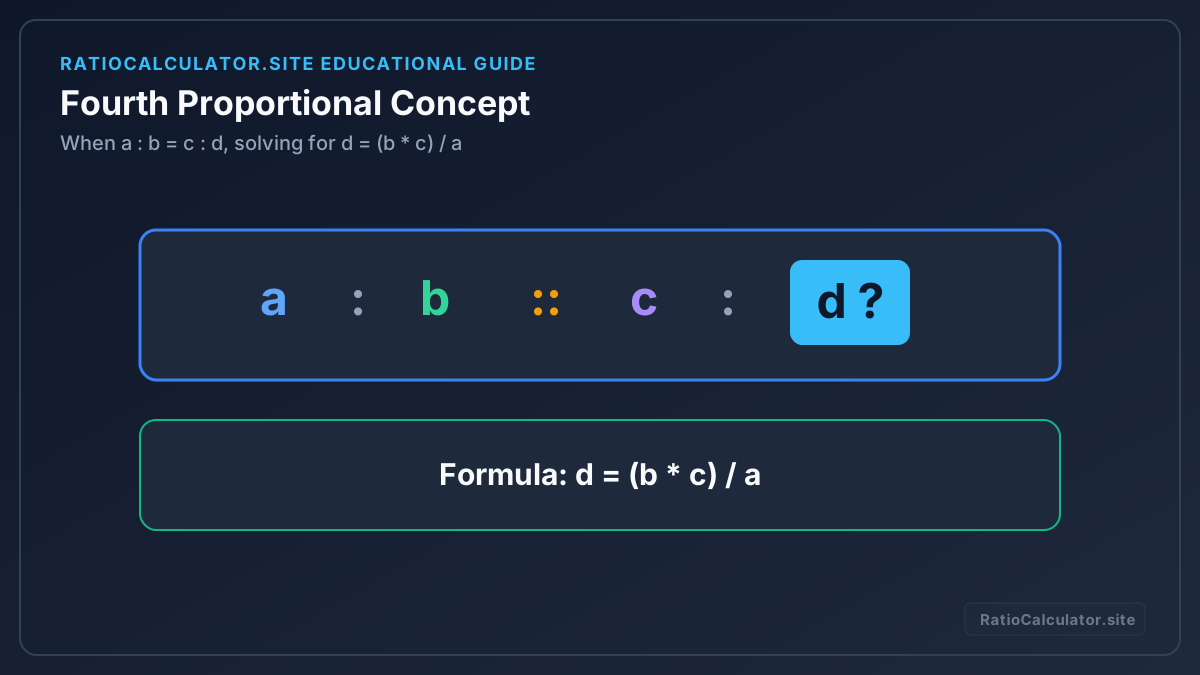
Cross-multiplication solves for the missing ratio value in a proportion. Given A : B = C : X, then X = (B × C) / A. This ratio formula forms the basis of every proportion solver and ratio calculator tool used in math, finance, and engineering.
Cross-Multiplication Visualizer
A
:
B
=
C
:
X
A × X = B × C → X = (B × C) / A
How to Use This Calculator
To use this Ratio Calculator, follow 3 steps:
1
Enter Values
Type known ratio values into the input fields and leave one field empty. The Ratio Calculator solves for the missing ratio value using cross-multiplication — enter 3 of the 4 values in A : B = C : D format.
2
Choose Mode
Select the ratio mode from 3 options: Solve (find the missing value via cross-multiplication), Simplify (reduce to lowest terms using GCD), or Scale (multiply both terms by a factor). Each mode applies a different equation set.
3
Get Results
Click Calculate to display the answer with a visual ratio bar, pie chart, decimal conversion, percentage equivalent, and a step-by-step solution breakdown showing every calculation stage.
How This Calculator Works
This Ratio Calculator processes input through 4 stages: input parsing, number validation, mathematical computation, and visual display rendering. The computation engine applies cross-multiplication for solving the missing ratio value, GCD-based reduction for simplifying ratios, and scalar multiplication for proportional scaling.
Solve mode identifies which of the 4 proportion values (A, B, C, or D) is missing, then applies X = (B × C) / A. Simplify mode divides both terms by GCD(A, B) to produce the lowest-term ratio. Scale mode multiplies both terms by a scale factor while preserving the original proportion. All computations run in the browser — no data leaves the device.
Formula & Equations Used
This Ratio Calculator applies 5 core equations used in example problems, step-by-step solutions, financial ratio analysis, and engineering calculations:
1Cross-Multiplication (Proportion Solving)▼
A / B = C / D → A × D = B × C
Cross-multiplication isolates any unknown in a proportion by multiplying diagonals and dividing. Given 3 known values, the equation solves for the 4th. This formula applies to ratio calculator math problems, financial ratio comparisons (comparing P/E ratios across companies), and chemical titrations during stoichiometric balancing.
2GCD Simplification▼
Simplified = A/GCD(A,B) : B/GCD(A,B)
The Greatest Common Divisor (GCD) reduces a ratio to its simplest form. The ratio 24 : 36 has a GCD of 12, producing 2 : 3 after division. Excel Ratio Functions such as GCD() perform this calculation in spreadsheet-based Financial Modeling and accounting templates used by QuickBooks and Xero.
3Ratio to Percentage Conversion▼
Percentage of A = (A / (A + B)) × 100
This equation converts a ratio to a percentage. A ratio of 3 : 7 becomes 30% for part A and 70% for part B because 3 / (3 + 7) = 0.30. Profitability Ratios like Gross Profit Margin (typically 20%–50%) and Net Profit Margin (5%–20% across industries) use this conversion to express financial performance.
4Ratio Scaling▼
Scaled = (A × Factor) : (B × Factor)
Scaling multiplies both terms by the same factor, keeping the proportion constant. A ratio of 2 : 5 scaled by 4× becomes 8 : 20. Practical applications include recipe scaling when blending spices, map distance conversion (1:50000 topographic maps), model building (1:24 scale cars), and industrial batch processing ratios.
5Ratio to Fraction / Decimal▼
Fraction = A/B | Decimal = A ÷ B
Any ratio converts directly to a fraction and decimal value. The ratio 3 : 4 equals the fraction 3/4 and the decimal 0.75. Financial statements use this conversion — Return on Assets (ROA) of 0.08 represents an 8% return, and Return on Equity (ROE) of 0.15 means 15% net income relative to shareholder equity.
Example Problems & Step-by-Step Solutions
Here are 3 example problems with step-by-step solutions frequently asked by Ratio Calculator users:
Input 1Solve for X in 3 : 5 = 9 : X
1 Write the proportion as fractions: 3/5 = 9/X
2 Cross-multiply both diagonals: 3 × X = 5 × 9
3 Compute the right side: 3X = 45
4 Divide both sides by 3: X = 45 ÷ 3
✓X = 15 — The complete proportion is 3 : 5 = 9 : 15
Input 2Simplify the ratio 48 : 36
1 Find the GCD of 48 and 36 by listing factors
2 Factors of 48: 1, 2, 3, 4, 6, 8, 12, 16, 24, 48
3 Factors of 36: 1, 2, 3, 4, 6, 9, 12, 18, 36
4 Largest common factor is GCD = 12
5 Divide both terms: 48 ÷ 12 : 36 ÷ 12
✓Simplified ratio = 4 : 3
Input 3Scale the ratio 2 : 7 by a factor of 6
1 Multiply the first term: 2 × 6 = 12
2 Multiply the second term: 7 × 6 = 42
✓Scaled ratio = 12 : 42 (equivalent to 2 : 7, confirmed by 12 ÷ 6 = 2 and 42 ÷ 6 = 7)
Ratio Scaling Calculator
The Ratio Scaling Calculator multiplies both terms of a ratio by a single factor to generate an equivalent ratio at a different magnitude. Ratio scaling serves 6 practical areas: recipe scaling for adjusting ingredient amounts when blending spices or changing serving counts, cartographic distance conversion (1:50000 maps), model building proportions (1:24 die-cast cars, 1:72 aircraft models), industrial production batch sizing, audio compression ratios for signal processing, and population migration rate projections in demographic analysis.
:
→
Scaled Ratio6 : 15
A
B
The proportion stays constant at every scale factor
An Aspect Ratio Calculator converts between screen and video dimensions. There are 5 typical aspect ratios for screens and videos: 16:9 (widescreen displays, YouTube, streaming platforms at 1920×1080 or 3840×2160 pixels), 4:3 (classic television and presentation slides at 1024×768 pixels), 21:9 (ultrawide monitors at 2560×1080 or 3440×1440 pixels), 1:1 (square social media posts at 1080×1080 pixels), and 9:16 (vertical mobile video at 1080×1920 pixels). Sizes of screens and videos depend directly on aspect ratio — a 1920-pixel-wide display with 1080-pixel height uses a 16:9 ratio because 1920 ÷ 120 = 16 and 1080 ÷ 120 = 9.
The Golden Ratio equals 1.6180339887, represented by the Greek letter phi (φ). This Golden Ratio Calculator computes golden ratio proportions in both directions: multiply a value by φ (1.618) to get the larger dimension, or divide by φ to get the smaller dimension of a golden rectangle.
The golden ratio appears in 4 design and natural contexts: architectural facade proportions (the Parthenon's front columns follow a 1:1.618 width-to-height relationship), art composition and canvas layouts (the rule of thirds approximates φ), logo and brand identity design (Apple's logo uses circular arcs based on Fibonacci proportions), and natural patterns including nautilus shell spirals during lunar phases, sunflower seed arrangements following Fibonacci sequence numbers (1, 1, 2, 3, 5, 8, 13, 21...), and leaf phyllotaxis angles of 137.5°.
To convert a percentage to a ratio, place the percentage value over 100 and reduce the resulting fraction using GCD. 75% becomes 75/100, GCD(75, 100) = 25, producing 3/4, which gives a ratio of 3 : 4. This Ratio Calculator handles percentage-to-ratio conversion in both directions. Financial ratios commonly expressed as percentages include Gross Profit Margin (20%–50% across industries), Net Profit Margin (5%–20%), and Return on Equity (ROE) of 15%–25% for healthy businesses.
Equivalent ratios share the same proportion at different scales. The ratios 2 : 3, 4 : 6, 6 : 9, and 8 : 12 are all equivalent because each simplifies to 2 : 3 after GCD reduction. To evaluate equivalent ratios, simplify both ratios to lowest terms and compare the results — matching simplified forms confirm equivalence. This method verifies proportions in recipe scaling, architectural scale model accuracy, and in diluted equity rounds where startup investors check whether ownership percentages remain proportional after new funding.
A Scale Ratio Calculator converts between real-world measurements and scaled representations. This calculator handles 4 primary applications: architectural drawings (1:100 floor plans and 1:200 site plans), model building (1:24 model cars and 1:72 aircraft models), cartography (1:50000 topographic maps where 1 cm represents 500 meters), and engineering blueprints (1:10 mechanical drawings).
To calculate the scaled measurement, divide the actual dimension by the scale denominator. A 12-meter (39.37 ft) wall at 1:100 scale measures 12 centimeters (4.72 in) on the drawing. For non-Euclidean spaces in spherical map projections, additional corrections maintain geometric accuracy across curved surfaces.
meters
1 :
12.00 cm
Real: 12 m
Model: 12 cm
Working with model building, cartography, or technical blueprints? Compute scaling factors quickly using our dedicated Scale Factor Calculator.
Divide by Ratio Calculator
The Divide by Ratio Calculator splits a total amount into parts based on a specified ratio. To divide 120 in the ratio 2 : 3, add the ratio parts (2 + 3 = 5 total parts), then compute each share: Part A = 120 × (2/5) = 48 and Part B = 120 × (3/5) = 72. This calculator applies to profit sharing in business partnerships, inheritance distribution among beneficiaries, construction material allocation, and when sizing capacitors in parallel circuits for electrical engineering.
:
Part A: 48
Part B: 72
Dividing business profits, investments, or bonuses among multiple partners? Use our Profit Sharing Calculator for instant equity distribution.
Practical Example: Concrete Mix Ratios
Concrete Mix Ratios set the proportion of cement, sand, and gravel before mixing solutions for construction. A standard M20 concrete mix uses a 1 : 2 : 3 ratio — 1 part Portland cement, 2 parts sand, 3 parts coarse gravel. For 1 cubic meter (35.31 cubic feet or 1.31 cubic yards) of M20 concrete, this ratio requires approximately 300 kilograms (661 pounds) of cement, 600 kg (1323 lbs) of sand, and 900 kg (1984 lbs) of gravel. High-strength M30 concrete uses a 1 : 1.5 : 3 ratio with finer aggregate, and foundation-grade M10 concrete uses a 1 : 3 : 6 ratio for applications where thermal conductivity and mass are prioritized over compressive strength.
Cement
Sand
Gravel
For 1 m³: Cement = 166.67 kg, Sand = 333.33 kg, Gravel = 500.00 kg
Scaling a recipe applies the Ratio Scaling Calculator to cooking and baking. A cookie recipe calls for flour, sugar, and butter in a ratio of 3 : 2 : 1, translating to 300 grams (10.58 oz) flour, 200 g (7.05 oz) sugar, and 100 g (3.53 oz) butter per 12 servings. When blending spices, adjusting portion counts, or converting between metric and imperial units, multiply every ingredient by a uniform scale factor to maintain the correct proportions. A scale factor of 3× yields 900 g (31.75 oz) flour, 600 g (21.16 oz) sugar, and 300 g (10.58 oz) butter for 36 servings.
To convert ratio to fraction, express each term as a fraction of the sum. The ratio 3 : 5 becomes the fractions 3/8 and 5/8 because the total is 3 + 5 = 8 parts. Part A is 3/8 (0.375 or 37.5%) and Part B is 5/8 (0.625 or 62.5%). This ratio-to-fraction conversion method applies to recursive fractions in mathematical series analysis and for audio compression ratio calculations in sound engineering — a 4:1 compression ratio means the compressor reduces 4 dB of input to 1 dB of output.
Simplify ratios to lowest terms, solve proportions via cross-multiplication, convert ratio to fraction and decimal, evaluate equivalent ratios across scales
Gear ratios and RPM conversion, compression ratios for engines, pulley systems for hydraulic leverage, tire aspect ratios, torque splitting in drivetrains
Food & Cooking
Recipe scaling for serving adjustments, coffee-to-water brew ratios, concrete mix ratios for construction, when blending spices for seasoning profiles
Science & Medical
Chemical titrations and stoichiometry, odds ratios in epidemiology, hazard ratios in clinical trials, logarithmic decay in pharmacokinetics
Design & Media
Aspect ratios for screens and videos (16:9, 4:3, 21:9), golden ratio for composition, color gamut mapping between color spaces, pixel density ratios
Financial Ratio Analysis
Financial Ratio Analysis evaluates corporate performance through 5 ratio categories. Liquidity Ratios measure short-term payment capacity — the Current Ratio (Current Assets / Current Liabilities) and Quick Ratio ((Current Assets − Inventory) / Current Liabilities) indicate whether a business can cover immediate obligations. Profitability Ratios including Return on Equity (ROE), Return on Assets (ROA), Gross Profit Margin, and Net Profit Margin quantify earnings relative to invested capital. Solvency Ratios like the Debt-to-Equity Ratio assess long-term financial stability and leverage levels. Efficiency Ratios such as Inventory Turnover Ratio and Accounts Receivable Turnover measure how well a company uses its assets. Market Value Ratios including Price-to-Earnings (P/E) Ratio and Earnings Per Share (EPS) inform Investment Analysis decisions.
Current Ratio = Current Assets / Current Liabilities
A company with $500K in current assets and $250K in current liabilities has a Current Ratio of 2.0
DuPont Analysis decomposes Return on Equity into 3 multiplicative components: Net Profit Margin × Asset Turnover × Equity Multiplier, isolating whether ROE comes from operational efficiency, asset utilization, or financial leverage. The Altman Z-Score combines 5 weighted financial ratios to predict corporate bankruptcy probability — scores below 1.8 indicate distress, 1.8–3.0 represent a gray zone, and above 3.0 signals safety. Bloomberg Terminal, Morningstar, and Yahoo Finance provide real-time ratio data for publicly traded companies. QuickBooks and Xero compute ratio metrics for small business accounting and cash flow tracking. Excel Ratio Functions automate custom Financial Modeling spreadsheets. Corporate Finance Institute (CFI) and Khan Academy Finance publish structured courses on financial ratio interpretation and Business Valuation methodologies.
There are 32 free ratio calculators on this site, organized into 6 categories. Each calculator provides step-by-step solutions, visual breakdowns, and instant results.
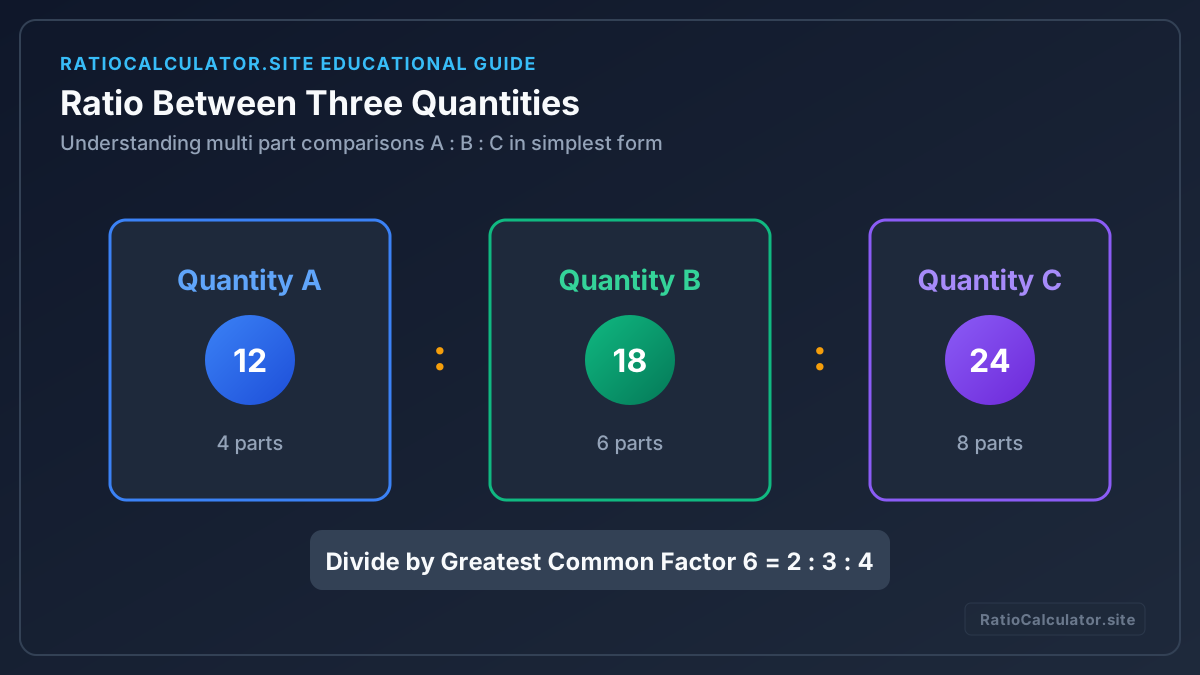
Enter any three quantities (A, B, and C) to immediately reduce them to lowest terms, compute their Greatest Common Divisor (GCD), and view their proportional percentage shares:
Understand the fourth proportional definition, formula, and step by step calculation. Solve missing values with cross multiplication and clear examples.
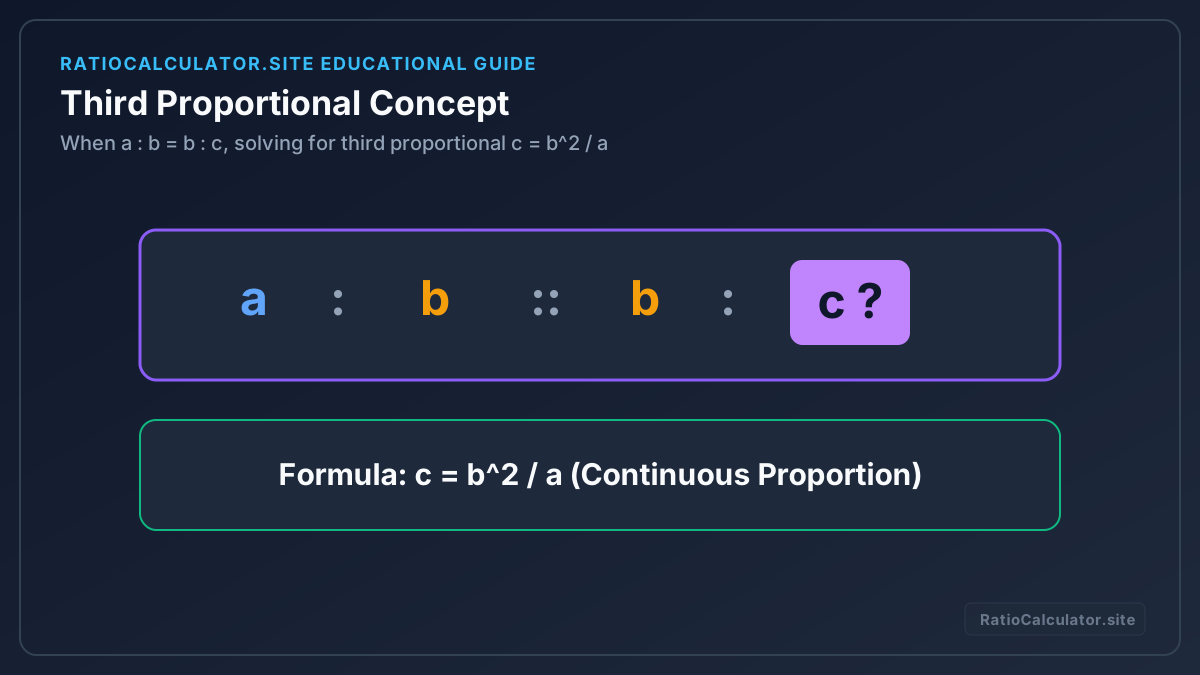
Learn how to find the third proportional of two numbers. Complete guide with continuous proportion definitions, formula c = b squared divided by a, and clear examples.
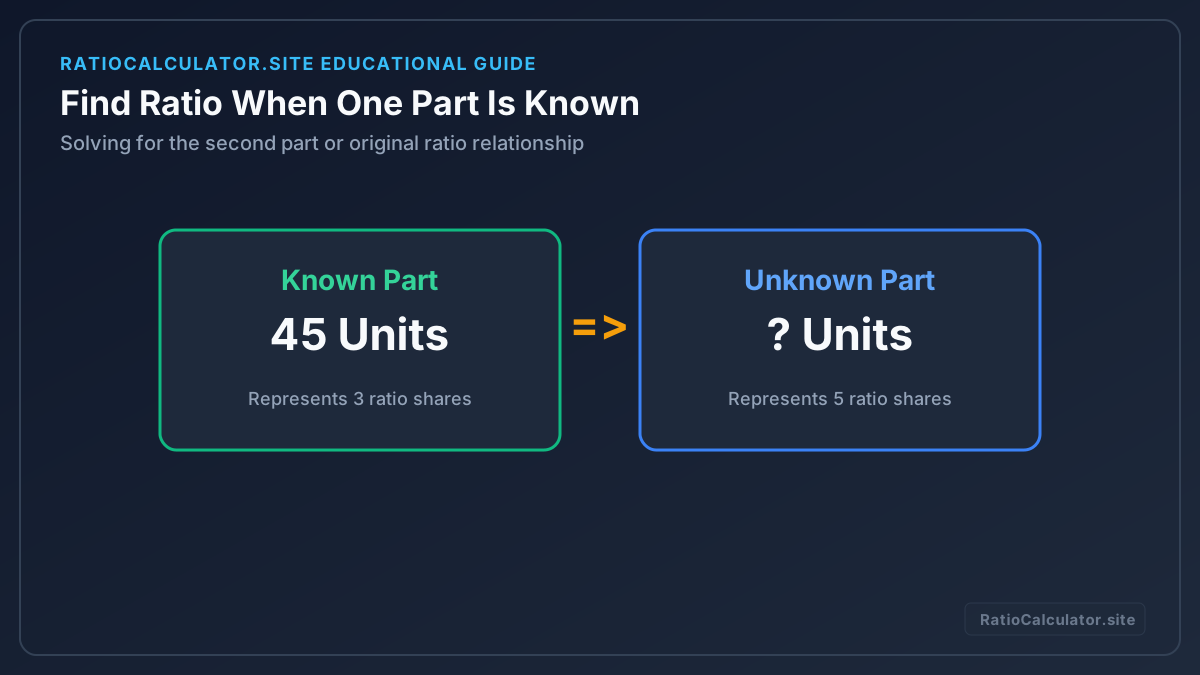
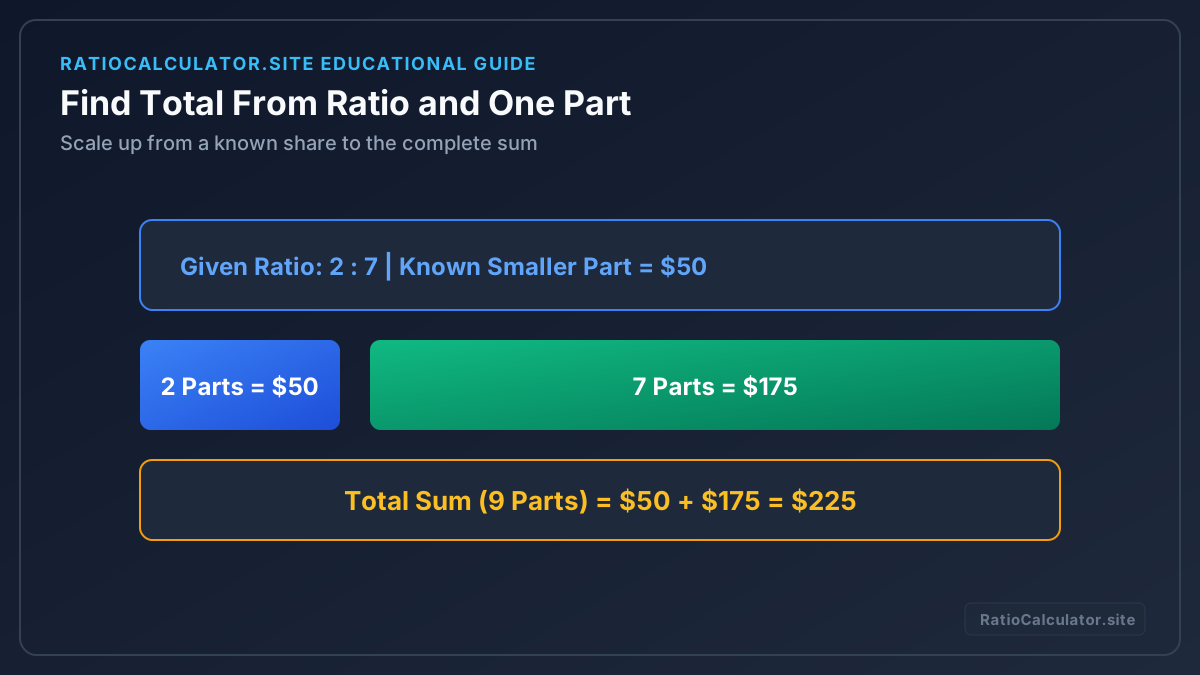
Master calculating the complete total amount from a given ratio and one known part. Complete guide with formulas, unit scaling, and real life money examples.
To calculate Debt-to-Income (DTI) ratio, divide total monthly debt payments by gross monthly income, then multiply by 100. The DTI formula is: DTI = (Total Monthly Debts / Gross Monthly Income) × 100. A borrower with $1,500 (€1,380 or £1,190) in monthly debt payments and $5,000 (€4,600 or £3,960) gross monthly income has a DTI of 30%. Mortgage lenders classify DTI below 36% as favorable, 36%–43% as acceptable with conditions, and above 43% as high-risk for loan approval. QuickBooks and Xero automate DTI ratio tracking for small business loan applications. The Debt-to-Equity Ratio uses a related formula to assess corporate Solvency Ratios in Financial Ratio Analysis.
How to calculate for ratio?
▼
To calculate a ratio between two numbers, divide both values by their Greatest Common Divisor (GCD). For the numbers 150 and 200, GCD(150, 200) = 50, so 150 ÷ 50 : 200 ÷ 50 = 3 : 4. Enter both values into this Ratio Calculator in Simplify mode to get the reduced ratio instantly. For 3 or more numbers, find the GCD across all values — GCD(12, 18, 24) = 6, producing 2 : 3 : 4. Excel Ratio Functions like GCD() and manual division methods produce the same result in spreadsheet-based financial calculations.
How to calculate cholesterol ratio?
▼
To calculate cholesterol ratio, divide total cholesterol by HDL (High-Density Lipoprotein) cholesterol. The formula is: Cholesterol Ratio = Total Cholesterol / HDL Cholesterol. A total cholesterol of 200 mg/dL (5.17 mmol/L) with HDL of 50 mg/dL (1.29 mmol/L) produces a cholesterol ratio of 4.0. The American Heart Association (AHA) considers a ratio below 5.0 acceptable and below 3.5 optimal for cardiovascular health. This health ratio parallels how Liquidity Ratios like Current Ratio (Current Assets / Current Liabilities) measure financial health — both compare a total value against a specific subset.
How can I calculate my body fat ratio?
▼
To calculate body fat ratio, divide body fat mass by total body weight and multiply by 100. The formula is: Body Fat Percentage = (Fat Mass / Total Body Weight) × 100. A person weighing 80 kg (176 lbs) with 16 kg (35.2 lbs) of fat has a body fat ratio of 20%. There are 3 common measurement methods with different accuracy levels: skinfold calipers (±3% margin of error), bioelectrical impedance analysis scales (±5% margin), and dual-energy X-ray absorptiometry or DEXA scans (±1.5% margin). Healthy body fat ranges are 6%–24% for adult men and 14%–31% for adult women, with athletes during sleep cycles and recovery periods maintaining 6%–13% (men) and 14%–20% (women).
How to calculate LTV ratio?
▼
To calculate Loan-to-Value (LTV) ratio, divide the mortgage loan amount by the appraised property value, then multiply by 100. The LTV formula is: LTV = (Loan Amount / Appraised Property Value) × 100. A $180,000 (€165,600 or £142,560) mortgage on a property appraised at $225,000 (€207,000 or £178,200) produces an LTV of 80%. An LTV above 80% typically requires Private Mortgage Insurance (PMI), adding 0.5%–1.5% of the loan amount per year to the borrower's cost. LTV is a Solvency Ratio used by banks alongside the Capital Adequacy Ratio (CAR) for credit risk assessment and regulatory compliance under Basel III standards.
How to calculate debt coverage ratio?
▼
To calculate Debt Service Coverage Ratio (DSCR), divide net operating income by total annual debt service obligations. The DSCR formula is: DSCR = Net Operating Income / Total Debt Service. A commercial property generating $500,000 (€460,000 or £396,000) in net operating income with $400,000 (€368,000 or £316,800) in annual debt payments has a DSCR of 1.25, meaning the property earns 25% more than its debt obligations. Commercial lenders require a minimum DSCR between 1.20 and 1.50 for loan approval. The Altman Z-Score bankruptcy prediction model combines DSCR with 4 other financial ratios — working capital/total assets, retained earnings/total assets, EBIT/total assets, and market value equity/total liabilities — to produce a composite risk score.
How to calculate gear ratio?
▼
To calculate gear ratio, divide the number of teeth on the driven gear by the number of teeth on the driving gear. The gear ratio formula is: Gear Ratio = Teeth on Driven Gear / Teeth on Driving Gear. A driven gear with 60 teeth paired with a 20-tooth driving gear produces a gear ratio of 3:1, meaning the driving gear completes 3 rotations per single rotation of the driven gear, multiplying torque by a factor of 3 while reducing output speed by the same factor. For asymmetric gear ratios in compound gear trains with multiple mesh stages, calculate each individual stage ratio and multiply all stages together for the total compound ratio. RPM output = Input RPM / Gear Ratio — a 3,000 RPM motor with a 3:1 gear ratio drives the output shaft at 1,000 RPM with 3× the torque.
Cookie Policy
We use cookies to optimize your calculator experience, analyze site usage, and improve our services. By clicking 'Accept All', you consent to our use of cookies. Cookie Policy.