How to Solve Three Number Ratio Problems: Step by Step With Examples
Learn how to solve three number ratio problems step by step. Master dividing totals, finding missing values, simplifying ratios, and solving word problems.
How to Solve Three Number Ratio Problems: Step by Step With Examples
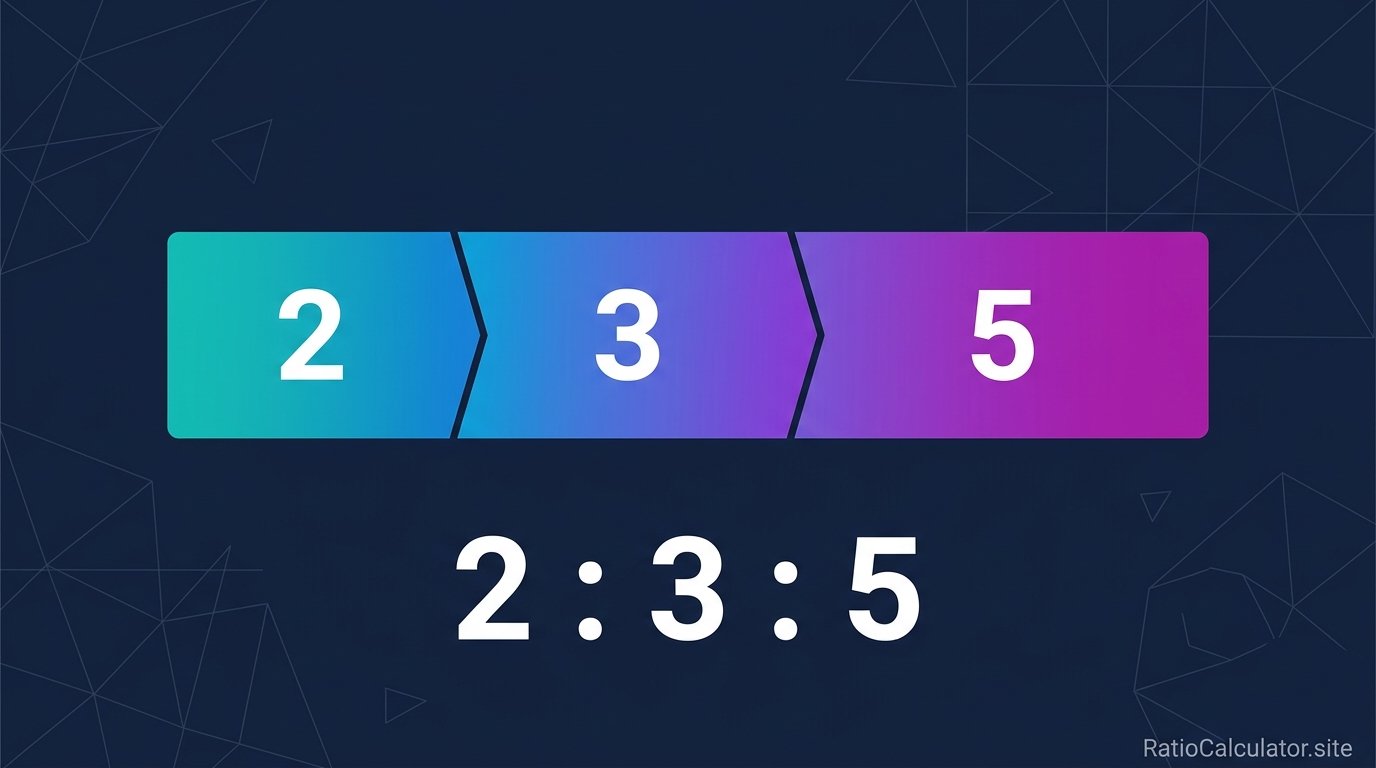
A three number ratio compares three quantities at the same time using the format A:B:C. For example, the ratio 2:3:5 tells you that the first quantity is 2 parts, the second quantity is 3 parts, and the third quantity is 5 parts. These three values are always read in order, and changing the order changes the meaning entirely.
Three number ratios are used in everyday situations such as dividing money among three people, mixing ingredients in a recipe, or comparing scores across three categories. Once you understand the basic method, you can solve any three part ratio problem by following a consistent set of steps.
For quick calculations and instant step by step solutions, you can use the free Ratio Calculator on RatioCalculator.site to verify your answers or explore ratio relationships. For additional educational exercises on ratios and proportional reasoning, explore the Khan Academy ratio lessons.
What Is a Three Number Ratio?
A three number ratio (also called a three part ratio or three way ratio) is a mathematical expression that compares three quantities simultaneously. As described in the formal mathematical definition of ratio, a ratio expresses the quotient of two or more mathematical expressions. A three number ratio is written using two colons, such as 2:3:4, and each number represents the relative size of one quantity compared to the other two.
Consider the ratio 2:3:4. The first number (2) represents the smallest share, the second number (3) represents a slightly larger share, and the third number (4) represents the largest share. Together, these three numbers describe a proportional relationship among three quantities.
Here are some additional examples:
- The ratio 1:2:5 means the first quantity is 1 part, the second is 2 parts, and the third is 5 parts. The total number of parts is 8.
- The ratio 3:4:6 means the three quantities relate as 3, 4, and 6 parts respectively. The total is 13 parts.
- The ratio 5:5:5 means all three quantities are equal, which simplifies to 1:1:1.
The order of the numbers is essential. Writing 2:3:4 is completely different from writing 4:3:2 or 3:2:4. Each arrangement assigns different proportional values to the first, second, and third quantities. Always write the numbers in the same order as the quantities they represent. To learn more about evaluating different proportional relationships, read our guide on How to Compare Ratios.
How to Solve a Three Number Ratio Step by Step
Solving a three number ratio problem follows a clear general method that works for any scenario. Here are the steps:
- Identify the three quantities. Determine which three values or groups are being compared.
- Write the ratio in the correct order. Place the numbers in the same sequence as the quantities they describe, separated by colons.
- Simplify the ratio if necessary. Find the greatest common factor of all three numbers and divide each number by that factor.
- Find the common multiplier when required. If the problem provides a total or a known value, divide the total by the sum of ratio parts to find the value of one part.
- Calculate the unknown or required amounts. Multiply the value of one part by each ratio number.
- Check the final answer. Verify that the calculated amounts maintain the original ratio and, if applicable, add up to the given total.
Example: Dividing 200 in the Ratio 1:3:6
Step 1. The three quantities are the three shares of the total 200.
Step 2. The ratio is 1:3:6 (first share is 1 part, second is 3 parts, third is 6 parts).
Step 3. Check if 1, 3, and 6 share a common factor. The greatest common factor of 1, 3, and 6 is 1, so the ratio is already in simplest form.
Step 4. Add the ratio parts: 1 + 3 + 6 = 10 total parts. Divide the total by the number of parts: 200 divided by 10 = 20. One part equals 20.
Step 5. Calculate each share:
- First share: 1 times 20 = 20
- Second share: 3 times 20 = 60
- Third share: 6 times 20 = 120
Step 6. Check: 20 + 60 + 120 = 200. The answer is correct.
For additional methods and exercises on working through ratios in practical situations, explore our detailed tutorial on How to Solve Ratio Word Problems.
How to Simplify a Three Number Ratio
Simplifying a three number ratio means reducing all three numbers to their smallest possible whole values while preserving the same proportional relationship. To do this, find the greatest common factor shared by all three numbers and divide each number by that factor.
The key rule is that all three numbers must be divided by the same value. If you divide only two of the three numbers, or if you use different divisors for different numbers, the proportional relationship is destroyed and the simplified ratio will be incorrect.
Example 1: Simplifying 12:18:24
- Factors of 12: 1, 2, 3, 4, 6, 12
- Factors of 18: 1, 2, 3, 6, 9, 18
- Factors of 24: 1, 2, 3, 4, 6, 8, 12, 24
- Greatest common factor of all three: 6
- Divide each number by 6: 12 divided by 6 = 2, 18 divided by 6 = 3, 24 divided by 6 = 4
- Simplified ratio: 2:3:4
Example 2: Simplifying 15:25:35
- Factors of 15: 1, 3, 5, 15
- Factors of 25: 1, 5, 25
- Factors of 35: 1, 5, 7, 35
- Greatest common factor of all three: 5
- Divide each number by 5: 15 divided by 5 = 3, 25 divided by 5 = 5, 35 divided by 5 = 7
- Simplified ratio: 3:5:7
Example 3: Simplifying 20:30:40
- Factors of 20: 1, 2, 4, 5, 10, 20
- Factors of 30: 1, 2, 3, 5, 6, 10, 15, 30
- Factors of 40: 1, 2, 4, 5, 8, 10, 20, 40
- Greatest common factor of all three: 10
- Divide each number by 10: 20 divided by 10 = 2, 30 divided by 10 = 3, 40 divided by 10 = 4
- Simplified ratio: 2:3:4
For a deeper explanation of reducing ratios to their lowest terms, read our complete guide on How to Simplify Ratios.
How to Find the Ratio of Three Numbers
When you are given three specific quantities, you can express their relationship as a ratio by writing the numbers in order and then simplifying them.
Example: Finding the Ratio of 45, 60, and 90
Step 1. Write the three numbers in the order given: 45:60:90.
Step 2. Find the greatest common factor of 45, 60, and 90.
- Factors of 45: 1, 3, 5, 9, 15, 45
- Factors of 60: 1, 2, 3, 4, 5, 6, 10, 12, 15, 20, 30, 60
- Factors of 90: 1, 2, 3, 5, 6, 9, 10, 15, 18, 30, 45, 90
- Greatest common factor: 15
Step 3. Divide all three numbers by 15:
- 45 divided by 15 = 3
- 60 divided by 15 = 4
- 90 divided by 15 = 6
Step 4. The ratio of 45, 60, and 90 in simplest form is 3:4:6.
To verify, multiply each part of the simplified ratio by 15: 3 times 15 = 45, 4 times 15 = 60, 6 times 15 = 90. The original values are restored, confirming the ratio is correct. For more on generating proportional equivalents, see our tutorial on How to Find Equivalent Ratios.
How to Divide a Total Amount in a Three Number Ratio
One of the most common three number ratio problems involves splitting a total amount into three parts according to a given ratio. The method uses four clear steps.
Example: Dividing 120 in the Ratio 2:3:5
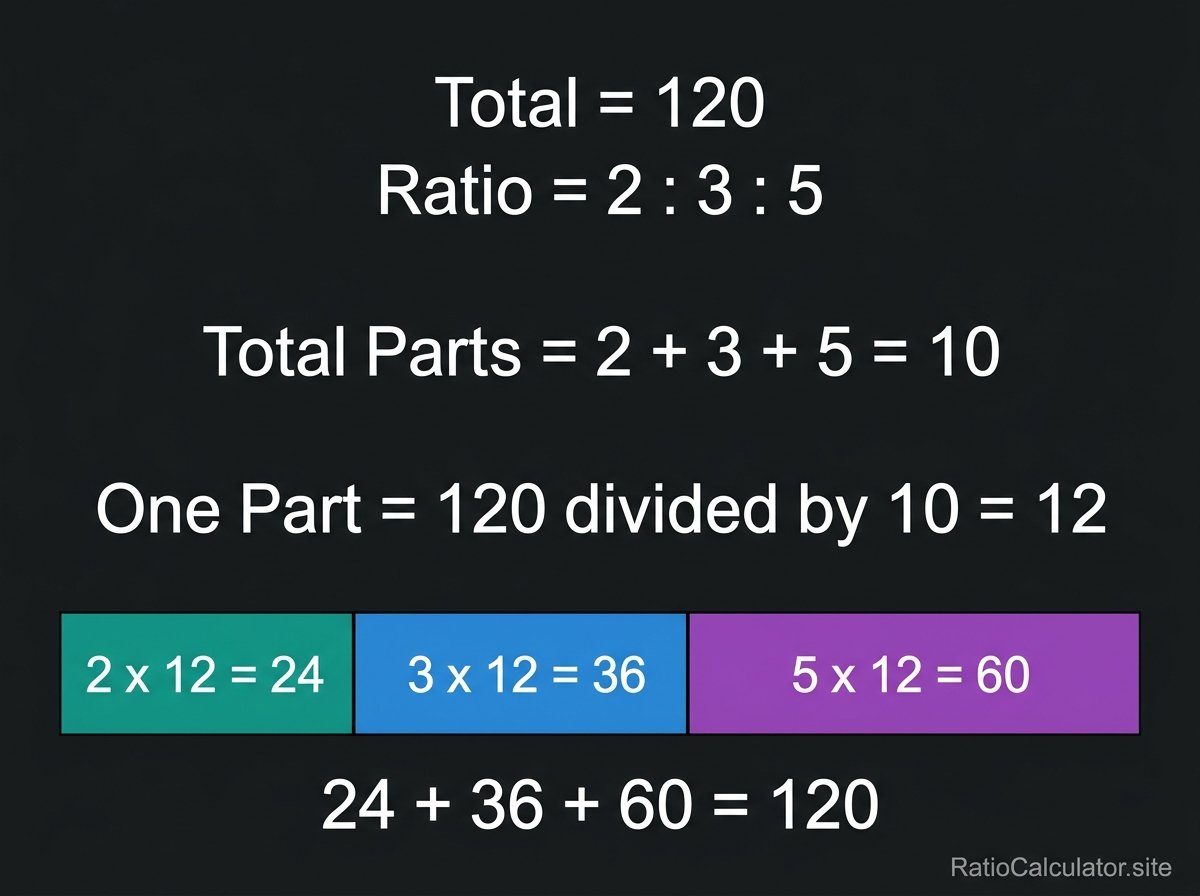
Step 1. Add the ratio parts. 2 + 3 + 5 = 10 total parts.
Step 2. Find the value of one part. Divide the total amount by the total number of parts: 120 divided by 10 = 12. Each single part is worth 12.
Step 3. Multiply one part by each ratio number.
- First amount: 2 times 12 = 24
- Second amount: 3 times 12 = 36
- Third amount: 5 times 12 = 60
Step 4. Verify that the amounts add up to the original total. 24 + 36 + 60 = 120. The calculation is correct.
The three amounts are 24, 36, and 60.
For more practice dividing values proportionally, read our walkthrough on How to Divide a Number in a Given Ratio.
How to Find a Missing Number in a Three Number Ratio
When two ratios are equivalent but one value is unknown, you can find the missing number using a scale factor.
Example: Finding x in 2:3:5 = 8:12:x
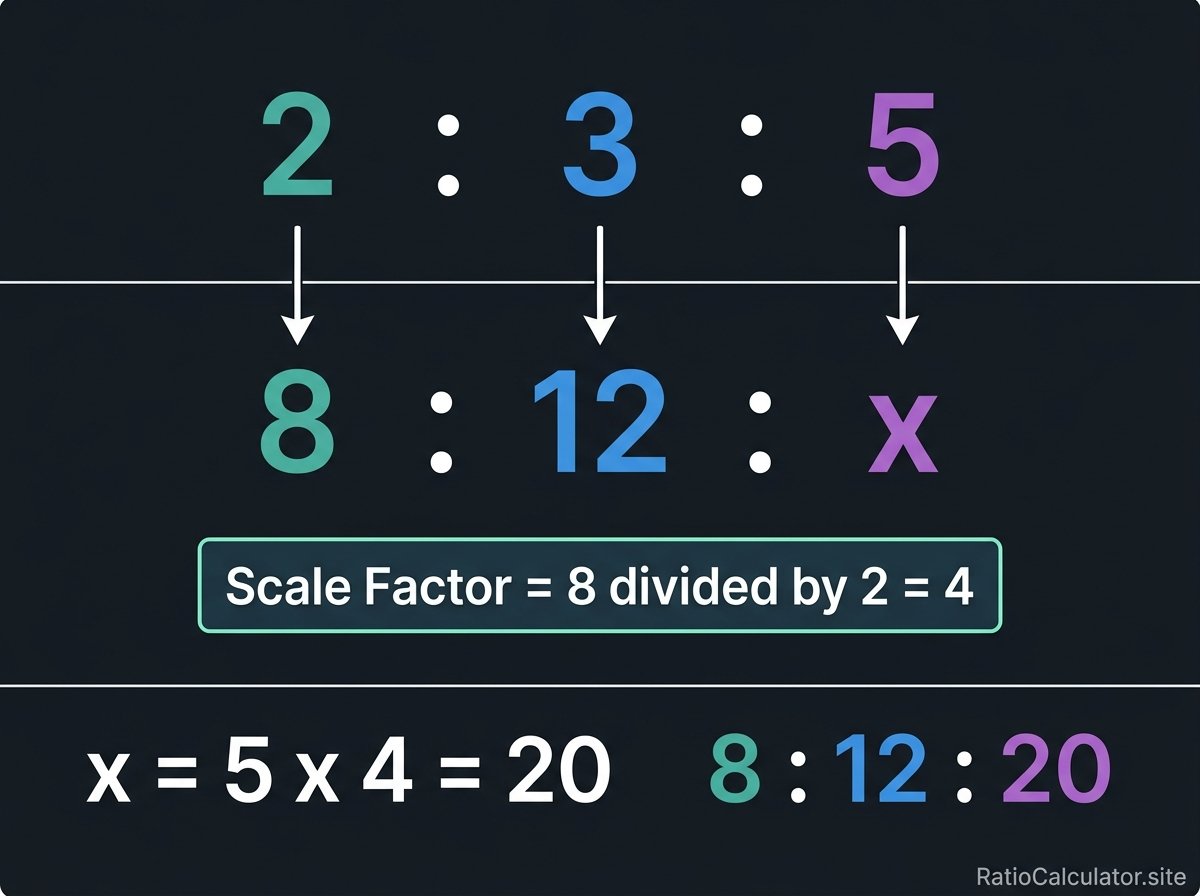
Step 1. Identify the relationship between known corresponding values. Compare the first numbers in both ratios: the original ratio has 2, and the scaled ratio has 8.
Step 2. Find the scale factor. Divide the known scaled value by the corresponding original value: 8 divided by 2 = 4. The scale factor is 4.
Step 3. Verify the scale factor using the second pair. Check: 3 times 4 = 12. This matches the second number in the scaled ratio, confirming the scale factor.
Step 4. Calculate the missing value. Multiply the third number in the original ratio by the scale factor: 5 times 4 = 20. Therefore, x = 20.
Step 5. Write the complete equivalent ratio. 2:3:5 = 8:12:20.
For additional techniques on identifying unknown values, see our guide on How to Find the Missing Number in a Ratio.
How to Solve Three Number Ratios With a Total
When a problem gives you a three number ratio and states the total, you combine the ratio parts to determine the value of a single part, then calculate each quantity.
Example: Three Friends Share 450 Dollars in the Ratio 4:5:6
Step 1. Add the ratio parts: 4 + 5 + 6 = 15 total parts.
Step 2. Find the value of one part: 450 divided by 15 = 30. One part equals 30 dollars.
Step 3. Calculate each person’s share:
- First friend: 4 times 30 = 120 dollars
- Second friend: 5 times 30 = 150 dollars
- Third friend: 6 times 30 = 180 dollars
Step 4. Verify: 120 + 150 + 180 = 450 dollars. Correct.
This method works for any total amount and any three part ratio, as long as you add all the ratio parts first and then divide the total by that sum.
How to Solve Three Number Ratios With Different Units
When the three quantities in a ratio problem are expressed in different units, you must convert them to the same unit before writing the ratio. Failing to do so produces an incorrect comparison because the numbers would represent different scales.
Example: Comparing 2 Meters, 150 Centimeters, and 500 Millimeters
Step 1. Choose a common unit. Centimeters work well here.
Step 2. Convert all measurements to centimeters:
- 2 meters = 200 centimeters
- 150 centimeters = 150 centimeters (already in the target unit)
- 500 millimeters = 50 centimeters
Step 3. Write the ratio: 200:150:50.
Step 4. Simplify by finding the greatest common factor. The greatest common factor of 200, 150, and 50 is 50.
Step 5. Divide each number by 50:
- 200 divided by 50 = 4
- 150 divided by 50 = 3
- 50 divided by 50 = 1
Step 6. The ratio is 4:3:1.
Always ensure that all quantities share the same unit before performing any ratio calculation. This principle applies to lengths, weights, volumes, currencies, and any other measurable quantity.
Three Number Ratio Word Problems
The following original word problems demonstrate how three number ratios apply in practical situations. Each solution is explained step by step.
Problem 1: Students in Three Classrooms
A school has three classrooms. Classroom A has 18 students, Classroom B has 27 students, and Classroom C has 36 students. What is the ratio of students across the three classrooms?
Solution:
- Write the ratio: 18:27:36.
- Find the greatest common factor of 18, 27, and 36. The GCF is 9.
- Divide each by 9: 18 divided by 9 = 2, 27 divided by 9 = 3, 36 divided by 9 = 4.
- The ratio of students is 2:3:4.
Problem 2: Dividing Prize Money
Three contest winners share 900 dollars in the ratio 5:3:1.
Solution:
- Add the ratio parts: 5 + 3 + 1 = 9 total parts.
- One part equals: 900 divided by 9 = 100 dollars.
- First winner: 5 times 100 = 500 dollars.
- Second winner: 3 times 100 = 300 dollars.
- Third winner: 1 times 100 = 100 dollars.
- Check: 500 + 300 + 100 = 900 dollars. Correct.
Problem 3: Baking a Cake
A cake recipe requires flour, sugar, and butter in the ratio 4:2:1. If you need 280 grams of these ingredients in total, how much of each ingredient do you need?
Solution:
- Add the ratio parts: 4 + 2 + 1 = 7 total parts.
- One part equals: 280 divided by 7 = 40 grams.
- Flour: 4 times 40 = 160 grams.
- Sugar: 2 times 40 = 80 grams.
- Butter: 1 times 40 = 40 grams.
- Check: 160 + 80 + 40 = 280 grams. Correct.
Problem 4: Shopping Budget
Maria divides her monthly shopping budget of 360 dollars among groceries, clothing, and entertainment in the ratio 6:3:1.
Solution:
- Add the parts: 6 + 3 + 1 = 10 total parts.
- One part: 360 divided by 10 = 36 dollars.
- Groceries: 6 times 36 = 216 dollars.
- Clothing: 3 times 36 = 108 dollars.
- Entertainment: 1 times 36 = 36 dollars.
- Check: 216 + 108 + 36 = 360 dollars. Correct.
Problem 5: Sports Training
An athlete trains for running, swimming, and cycling in the ratio 3:2:5. If the athlete trains for a total of 20 hours per week, how many hours are spent on each activity?
Solution:
- Add the parts: 3 + 2 + 5 = 10 total parts.
- One part: 20 divided by 10 = 2 hours.
- Running: 3 times 2 = 6 hours.
- Swimming: 2 times 2 = 4 hours.
- Cycling: 5 times 2 = 10 hours.
- Check: 6 + 4 + 10 = 20 hours. Correct.
Problem 6: Measuring Land
A rectangular plot measures 75 meters, 100 meters, and 125 meters along three boundaries. Express these measurements as a simplified ratio.
Solution:
- Write the ratio: 75:100:125.
- GCF of 75, 100, and 125 is 25.
- Divide each by 25: 75 divided by 25 = 3, 100 divided by 25 = 4, 125 divided by 25 = 5.
- The ratio is 3:4:5.
Problem 7: Business Revenue
A company earns revenue from three product lines in the ratio 7:4:3. The total monthly revenue is 28,000 dollars. How much does each product line earn?
Solution:
- Add the parts: 7 + 4 + 3 = 14 total parts.
- One part: 28,000 divided by 14 = 2,000 dollars.
- Product line A: 7 times 2,000 = 14,000 dollars.
- Product line B: 4 times 2,000 = 8,000 dollars.
- Product line C: 3 times 2,000 = 6,000 dollars.
- Check: 14,000 + 8,000 + 6,000 = 28,000 dollars. Correct.
Problem 8: Map Scale
On a map, three cities form a triangle. The distances between them are represented in the ratio 2:3:4. If the shortest actual distance is 50 kilometers, what are the other two distances?
Solution:
- The shortest distance corresponds to the ratio part 2. The scale factor is 50 divided by 2 = 25.
- Second distance: 3 times 25 = 75 kilometers.
- Third distance: 4 times 25 = 100 kilometers.
- The distances are 50 km, 75 km, and 100 km.
How to Check a Three Number Ratio Answer
Verifying your answer ensures accuracy. There are two primary methods for checking three number ratio solutions.
Method 1: Verify the Total
For problems involving a total amount, add all the calculated values together. The sum should equal the original total. For example, if you divided 120 in the ratio 2:3:5 and calculated 24, 36, and 60, check that 24 + 36 + 60 = 120.
Method 2: Verify the Proportional Relationship
Divide each calculated value by the corresponding ratio number. All three results should produce the same value (the multiplier).
Using the same example:
- 24 divided by 2 = 12
- 36 divided by 3 = 12
- 60 divided by 5 = 12
All three divisions produce 12, confirming the values maintain the correct proportional relationship.
Common Mistakes When Solving Three Number Ratios
| Mistake | Why It Happens | How to Fix It |
|---|---|---|
| Putting numbers in the wrong order | The quantities are not matched to their correct ratio positions | Always label each quantity and write the ratio numbers in the same sequence |
| Simplifying only two of three numbers | The third number is overlooked during division | Divide all three numbers by the same common factor every time |
| Using different factors for different parts | Each number is divided by a separate value | Find one greatest common factor and apply it to all three numbers |
| Forgetting to add all three ratio parts | Only two parts are summed when finding the total | Always add all three ratio numbers before dividing the total |
| Using the wrong total | A different value is mistakenly used as the total amount | Re read the problem carefully and confirm the total before calculating |
| Ignoring units | Quantities in different units are compared directly | Convert all quantities to the same unit before writing the ratio |
| Not checking the final result | The answer is assumed correct without verification | Add the calculated values to confirm they equal the total, or divide each by its ratio number to confirm a consistent multiplier |
Three Number Ratio vs Two Number Ratio
Understanding the differences between two part and three part ratios helps you choose the right approach for each problem.
| Feature | Two Number Ratio | Three Number Ratio |
|---|---|---|
| Format | A:B | A:B:C |
| Quantities Compared | Two | Three |
| Example | 3:5 | 2:3:5 |
| Total Parts (from example) | 3 + 5 = 8 | 2 + 3 + 5 = 10 |
| Common Uses | Comparing two groups, simple proportions | Splitting among three groups, recipes, scoring |
| Simplification Method | Divide both by their GCF | Divide all three by their shared GCF |
A two number ratio works when you are comparing exactly two quantities, such as boys to girls or wins to losses. A three number ratio is necessary when three separate quantities must be compared simultaneously, such as dividing a sum among three people or mixing three ingredients. The solving method for both types follows the same logic: add the ratio parts, find the value of one part, and multiply. For a focused explanation of two number ratios, see our guide on How to Calculate a Ratio From Two Numbers.
How to Use a Ratio Calculator
The Ratio Calculator on RatioCalculator.site provides instant solutions for ratio problems, including three number ratio calculations. Here is how to use it:
- Navigate to the Ratio Calculator on RatioCalculator.site.
- Enter your known ratio values into the input fields.
- Click the calculate button to process the ratio.
- View the simplified ratio, the step by step breakdown, and the calculated results instantly.
The calculator handles simplification, equivalent ratio generation, and missing value calculations, saving time and helping you verify your manual work. For a broader understanding of ratio fundamentals, explore our guide on How to Calculate a Ratio.
Frequently Asked Questions
How do you solve a three number ratio?
To solve a three number ratio, add all three ratio parts together, divide the total amount by that sum to find the value of one part, and multiply each ratio number by that value.
How do you simplify a three number ratio?
Find the greatest common factor shared by all three numbers and divide each of the three numbers by that same factor.
How do you divide a total in a three part ratio?
Add the ratio parts to find the total number of shares, divide the total amount by that sum to find the value of one share, then multiply each ratio number by one share.
How do you find a missing number in a three number ratio?
Compare the known corresponding values between the two ratios, calculate the scale factor, then multiply the remaining original ratio number by that scale factor.
How do you find the ratio of three numbers?
Write the three numbers in order separated by colons, find the greatest common factor of all three, and divide each number by that factor to express the ratio in simplest form.
What is the easiest way to solve a three part ratio?
The easiest method is to add the ratio parts, divide the total by the sum, and multiply each part by the result, then check your answer by adding the calculated values.
How do you check a three number ratio answer?
Divide each calculated amount by its corresponding ratio number. If all three divisions produce the same value, the answer is correct. For total division problems, also verify that all amounts add to the original total.
How do you solve a ratio with three numbers and different units?
Convert all three quantities to the same unit first, then write the ratio and simplify by dividing all three numbers by their greatest common factor.