Ratio vs Rate vs Proportion: The Difference My Students Always Mix Up
A math teacher's plain-English guide to the difference between a ratio, a rate, and a proportion, with a three-question test, worked examples, common mistakes, and a quick quiz.
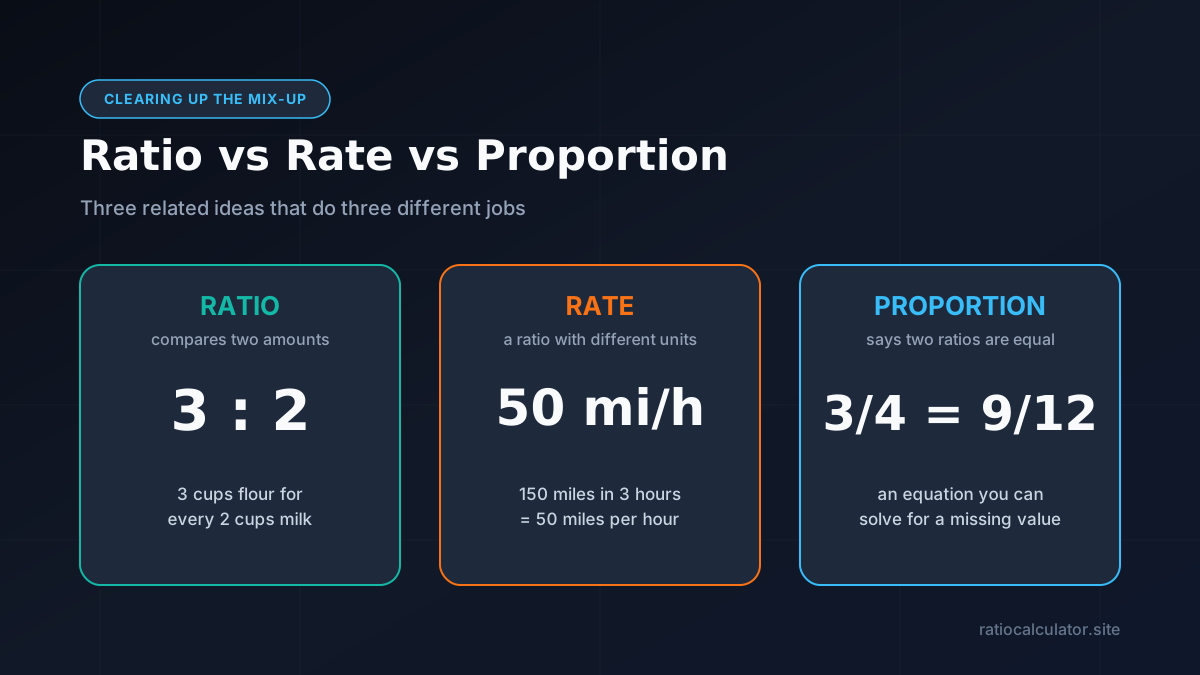
Every year, somewhere around the second week of our ratios unit, I put three things on the board and ask the class to label them:
- 3 : 2
- 50 miles per hour
- 3/4 = 9/12
Most students get the first one. A few get the second one. Almost nobody gets the third one on the first try, and quite a few call all three “ratios.” That’s not a silly answer, by the way. The three ideas are closely related, they use the same notation, and textbooks don’t always agree on the exact wording. But they do different jobs, and once you see what each one is for, word problems get a lot less confusing.
Here’s the short version before we go deeper:
- A ratio compares two amounts.
- A rate is a ratio that compares two amounts measured in different units, like miles and hours.
- A proportion is a statement that two ratios are equal. It’s an equation, not a single comparison.
What Is a Ratio?
A ratio tells you how much of one thing there is compared to another. That’s it. It doesn’t say how many there are in total, and it doesn’t make a claim about anything else.
If a class has 18 girls and 12 boys, the ratio of girls to boys is 18 : 12, which simplifies to 3 : 2. You can also write it as 3/2 or say “3 to 2.” All three mean the same thing: for every 3 girls, there are 2 boys.
A few things worth knowing about ratios:
- Order matters. Girls to boys is 3 : 2. Boys to girls is 2 : 3. Swapping them changes the meaning completely, and this is the single most common mistake I mark on tests.
- Ratios can be part-to-part or part-to-whole. Girls to boys (18 : 12) is part-to-part. Girls to the whole class (18 : 30, or 3 : 5) is part-to-whole. Part-to-whole ratios are the ones that turn neatly into fractions and percentages.
- When the units match, they cancel. A recipe that uses 3 cups of flour for every 2 cups of milk has a ratio of 3 : 2. The “cups” disappear because both sides are measured the same way. What’s left is a pure comparison.
If you need to tidy up a ratio, the Ratio Simplifier will reduce it and show the steps. For a full walkthrough, see What Is a Ratio?.
What Is a Rate?
A rate is a ratio where the two quantities are measured in different units. Because the units are different, they don’t cancel, so you have to keep them in your answer.
Some rates you already use without thinking about it:
- 60 miles per hour
- $4.50 per pound
- 72 heartbeats per minute
- 30 miles per gallon
Notice the word “per.” In my classroom, “per” is the biggest clue that you’re dealing with a rate. It literally means “for each.”
Unit rates
A unit rate is a rate where the second quantity is 1. “150 miles in 3 hours” is a rate. Divide both parts by 3 and you get “50 miles in 1 hour,” which is the unit rate, usually written as 50 miles per hour.
Unit rates are where this topic becomes genuinely useful outside of school. Say one store sells a 6-pack of water for $4.20 and another sells a 10-pack for $6.50. Which is the better deal?
- 6-pack: $4.20 ÷ 6 = $0.70 per bottle
- 10-pack: $6.50 ÷ 10 = $0.65 per bottle
The 10-pack wins. Without unit rates you’d be comparing two prices for two different amounts, which tells you nothing.
So is a rate a ratio or not?
Yes. Every rate is a ratio, but not every ratio is a rate. I tell my students to think of it like squares and rectangles: a square is a special kind of rectangle, and a rate is a special kind of ratio.
You may come across a textbook that defines a ratio as a comparison of quantities with the same units only, and a rate as the different-units version. Other books are looser and call “150 miles to 3 hours” a ratio too. Don’t let that throw you. The practical rule is the same either way: if the units are different, keep them, and you’re working with a rate.
What Is a Proportion?
This is the one that trips people up, and I think it’s partly because of how we use the word in everyday English. When someone says “a large proportion of the class passed,” they mean a share or fraction of the class. That’s a perfectly good use of the word, but it isn’t what “proportion” means in a math problem.
In math, a proportion is an equation that says two ratios are equal:
3/4 = 9/12
That’s the whole idea. A ratio is one comparison. A proportion connects two comparisons with an equals sign and claims they describe the same relationship.
Why proportions matter
Proportions are how you scale things up or down, and how you find a missing number. Suppose your lemonade recipe uses 2 scoops of powder for every 3 cups of water, and you want to make a big batch with 12 cups of water. How many scoops do you need?
Set up a proportion with the same order on both sides (scoops over water):
2/3 = x/12
Cross-multiply:
- 3x = 2 × 12
- 3x = 24
- x = 8
You need 8 scoops. Check it: 8 : 12 simplifies to 2 : 3, which matches the original recipe.
If you want to check your own work, the Proportion Calculator solves for the missing value and shows the cross-multiplication. There’s also a longer lesson on how to solve proportions.
How to tell if two ratios form a proportion
You have two quick options:
- Simplify both ratios. If they reduce to the same thing, they’re proportional. 6 : 9 and 10 : 15 both reduce to 2 : 3, so 6/9 = 10/15 is a true proportion.
- Compare cross products. For a/b = c/d, check whether a × d equals b × c. For 6/9 = 10/15: 6 × 15 = 90 and 9 × 10 = 90. Same answer, so it’s a proportion.
Ratio vs Rate vs Proportion at a Glance
| Ratio | Rate | Proportion | |
|---|---|---|---|
| What it is | A comparison of two quantities | A ratio of quantities with different units | An equation stating two ratios are equal |
| Example | 3 : 2 (girls to boys) | 50 miles per hour | 2/3 = 8/12 |
| Units | Usually the same, so they cancel | Different, so you must keep them | Each side follows the same unit order |
| Clue words | ”to,” “for every,” “compared with" | "per,” “each,” “an hour,” “a pound" | "at the same rate,” “how many would,” “scale up” |
| Has an equals sign? | No | No | Yes |
| Typical question | ”What is the ratio of A to B?" | "How much for one?" | "What is the missing value?” |
The Three-Question Test I Give My Students
When a student is stuck on a word problem and can’t tell which idea applies, I have them ask three questions, in this order:
- Is there an equals sign, or am I being asked to find a missing number that keeps things “at the same rate”? If yes, it’s a proportion.
- Are the two quantities measured in different units? If yes, it’s a rate. Keep the units.
- Otherwise, it’s a ratio. Pay attention to the order the problem names things in.
It’s not fancy, but it works. Most of the confusion I see clears up as soon as students stop looking at the numbers and start looking at the units and the equals sign.
One Problem, All Three Ideas
Here’s a problem I like because it uses all three in a row, and it shows how they connect rather than compete.
A car uses 12 liters of fuel to drive 180 kilometers.
The ratio. Fuel to distance is 12 : 180. Dividing both by 12 gives 1 : 15. On its own, that’s a bare comparison.
The rate. Because liters and kilometers are different units, we should keep them. 180 km ÷ 12 L = 15 kilometers per liter. That’s the unit rate, and it’s the number you’d actually care about when buying a car.
You could also flip it: 12 L ÷ 180 km ≈ 0.067 liters per kilometer. Both are correct. They just answer different questions (“how far on one liter?” versus “how much fuel for one kilometer?”). Students sometimes think one of these must be wrong. Neither is. Just make sure the units in your answer say which one you meant.
The proportion. How much fuel will the car need for a 300 km trip, assuming the same driving conditions?
- 12/180 = x/300
- 180x = 12 × 300
- 180x = 3600
- x = 20
The car needs 20 liters. Quick check with the unit rate: 300 km ÷ 15 km per liter = 20 liters. Same answer.
Mistakes I See Every Single Year
1. Dropping the units on a rate. “The answer is 15.” Fifteen what? Fifteen kilometers per liter and fifteen liters per kilometer are wildly different cars. If the units are different, they belong in the answer.
2. Calling a single ratio a proportion. “3 : 4 is a proportion” isn’t correct in math class. 3 : 4 is a ratio. “3 : 4 = 9 : 12” is a proportion. If there’s no second ratio and no equals sign, there’s no proportion.
3. Mixing up the order inside a proportion. If the left side is scoops over water, the right side has to be scoops over water too. Writing 2/3 = 12/x (scoops over water on one side, water over scoops on the other) gives x = 18, which would make some very strong lemonade. I ask students to write the units next to each number while setting up the equation. It feels slow, but it catches this mistake almost every time.
4. Assuming every relationship is proportional. This is the subtle one, and I think it’s the most important. Proportions only work when the two quantities grow together at a constant rate.
Take a taxi that charges a $3 pickup fee plus $2 per mile:
- 5 miles costs $3 + $10 = $13
- 10 miles costs $3 + $20 = $23
Doubling the distance did not double the cost, because the $3 fee doesn’t change. If you set up 13/5 = x/10, you’d get $26, which is wrong. Before reaching for a proportion, ask yourself: “If one quantity doubles, does the other one double too?” If the answer is no, a simple proportion isn’t the right tool.
Ages are another classic trap. If I’m 30 and my nephew is 10, our ages are in a 3 : 1 ratio. In 10 years we’ll be 40 and 20, which is 2 : 1. Ages don’t stay proportional because we both add the same number of years, not the same multiple.
5. Comparing rates that aren’t in the same units. If one runner goes 400 meters in 80 seconds and another runs 1.2 kilometers in 4 minutes, you can’t compare “5” and “0.3” and call it done. Convert first: the first runner’s rate is 400 ÷ 80 = 5 meters per second, and the second runner’s is 1200 m ÷ 240 s = 5 meters per second. They’re actually running at exactly the same pace.
Quick Check: Ratio, Rate, or Proportion?
Try labeling each of these before you look at the answers.
- A shelter has 14 dogs and 21 cats.
- A printer prints 45 pages in 3 minutes.
- 4/10 = 6/15
- A recipe uses 2 cups of flour for every 1 cup of sugar.
- Three apples cost $1.80.
- Do 5 : 8 and 15 : 24 form a proportion?
- A plant is 4 cm tall after 2 weeks and 7 cm tall after 4 weeks. Is its height proportional to time?
Show answers
- Ratio. Dogs to cats is 14 : 21, which simplifies to 2 : 3. Both quantities are counts of animals.
- Rate. Pages and minutes are different units. The unit rate is 45 ÷ 3 = 15 pages per minute.
- Proportion. It’s an equation with two ratios. It’s true, because both sides simplify to 2/5.
- Ratio. Both amounts are in cups, so the units cancel and you’re left with 2 : 1.
- Rate. Dollars and apples are different units. The unit rate is $1.80 ÷ 3 = $0.60 per apple.
- Yes. 5 × 24 = 120 and 8 × 15 = 120. The cross products match, so 5/8 = 15/24 is a true proportion.
- No. 4 ÷ 2 = 2 cm per week, but 7 ÷ 4 = 1.75 cm per week. The rate isn’t constant, so height isn’t proportional to time here.
If you got number 7, you’re ahead of most of my students. For more practice, try the beginner ratio practice set or the ratio word problems page.
Related Guides
- What Is a Ratio? covers notation, simplifying, and part-to-whole ratios from scratch.
- Ratios vs Fractions is the other mix-up I see a lot, and it’s worth reading next.
- How to Solve Proportions goes deeper on cross-multiplication.
- How to Find Equivalent Ratios explains the scaling idea behind every proportion.
- How to Solve Ratio Word Problems puts all of this to work on longer questions.
Frequently Asked Questions
Is a rate a type of ratio?
Yes. A rate is a ratio that compares two quantities measured in different units, such as miles and hours or dollars and pounds. Every rate is a ratio, but a ratio of two same-unit quantities, like 3 cups to 2 cups, is not usually called a rate.
What is the difference between a ratio and a proportion?
A ratio is a single comparison between two quantities, such as 3 : 4. A proportion is an equation stating that two ratios are equal, such as 3/4 = 9/12. You can solve a proportion to find a missing value, but a ratio on its own has nothing to solve.
What is a unit rate?
A unit rate is a rate where the second quantity is 1, such as 50 miles per hour or $0.65 per bottle. You find it by dividing the first quantity by the second. Unit rates make it easy to compare prices, speeds, and fuel efficiency.
How do I know if two ratios form a proportion?
Simplify both ratios and see if they match, or multiply diagonally and check whether the cross products are equal. For example, 6/9 and 10/15 form a proportion because 6 × 15 and 9 × 10 both equal 90.
Is a percentage a ratio, a rate, or a proportion?
A percentage is a ratio that compares a part to a whole of 100. For example, 40% means 40 out of 100, or 40 : 100. People often say “interest rate” or “tax rate,” but mathematically a percentage is a part-to-whole ratio.
Can a ratio have units?
When both quantities share the same unit, the units cancel and the ratio has no units. When the units are different, you should keep them, and the comparison is usually called a rate.