How to Find the Missing Number in a Ratio (Step by Step Guide)
Learn how to find the missing number in a ratio using cross multiplication and scale factor methods with clear step by step examples and verification techniques.
How to Find the Missing Number in a Ratio: Step by Step With Examples
A missing number in a ratio is an unknown value that you can determine because the relationship between the quantities remains constant. When two ratios are equivalent, the mathematical comparison between the terms on one side matches the comparison on the other side.
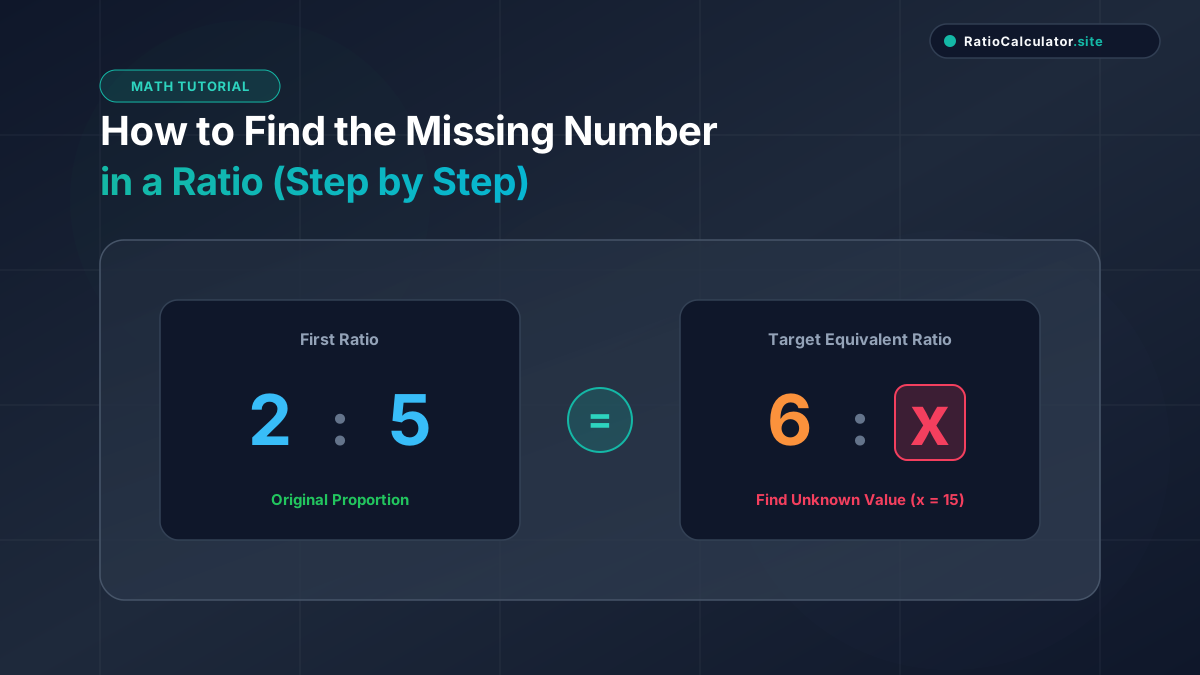
For instance, look at the ratio equation 2:5 = 6:x. The first term increases from 2 to 6 by multiplying by 3. Because both parts must change by the exact same multiplier, the second term 5 must also be multiplied by 3, which gives x = 15.
Finding an unknown ratio term is a fundamental mathematical skill used in classroom tests, cooking measurements, financial forecasting, and scale modeling. If you want to check your calculations quickly or solve complex proportions automatically, you can use the Ratio Calculator on RatioCalculator.site to calculate missing values and verify equivalent ratios in seconds.
What Is a Missing Number in a Ratio?
Quick Answer (Featured Snippet): To find the missing number in a ratio proportion (A:B = C:X), use cross multiplication: multiply the diagonal numbers (B × C) and divide by the remaining known number (A), so X = (B × C) ÷ A. Alternatively, find the scale factor (C ÷ A) and multiply B by that factor.
A ratio represents a proportional comparison between two or more quantities. If you are new to the basics of ratios, reading our guide on How to Calculate a Ratio provides a helpful starting point. In a standard ratio statement comparing two items, you have four positions:
First Term : Second Term = Third Term : Fourth Term
When one of these four positions is unknown, it is called a missing number or an unknown value. In algebra and arithmetic, this missing value is commonly labeled with the variable x, y, or a question mark.
Known Term : Known Term = Known Term : Unknown Term (x)The known numbers define the exact relationship between the quantities. The unknown number is the specific value that maintains the proportional balance. If a car travel ratio shows 60 miles for every 1 hour, written as 60:1, then a trip of 180 miles requires a missing number of hours, written as 180:x. Because 180 is three times 60, the missing value x must be 3 hours.
How to Find a Missing Number in a Ratio
Finding an unknown term in a ratio equation relies on creating Equivalent Ratios. Two ratios are equivalent when they express the same proportional value, even if they use different numbers.
Here is the general step by step method to solve any missing ratio value:
- Write the ratio problem as a proportion equation with two equal ratios.
- Identify the position of the unknown variable x.
- Compare the corresponding known terms on both sides of the equation.
- Calculate the multiplication factor or division factor that links the known terms.
- Apply that exact same factor to the remaining known term to find the missing value.
Example 1: Solving 3:8 = 15:x
- Step 1: Compare the first terms on both sides, which are 3 and 15.
- Step 2: Divide 15 by 3 to find the factor: 15 / 3 = 5.
- Step 3: Multiply the second term 8 by the same factor 5: 8 * 5 = 40.
- Step 4: The missing value x is 40. The full equivalent ratio is 3:8 = 15:40.
Example 2: Solving 7:9 = x:36
- Step 1: Compare the second terms on both sides, which are 9 and 36.
- Step 2: Divide 36 by 9 to find the multiplier: 36 / 9 = 4.
- Step 3: Multiply the first term 7 by the multiplier 4: 7 * 4 = 28.
- Step 4: The missing value x is 28. The completed ratio is 7:9 = 28:36.
How to Find a Missing Number Using Cross Multiplication
Cross multiplication is one of the most reliable and universal techniques for finding an unknown term in a ratio. It works by converting the ratio statement into fractional form and multiplying diagonally across the equal sign.
If a / b = c / d, then a * d = b * cExample: Solving 3:4 = 12:x
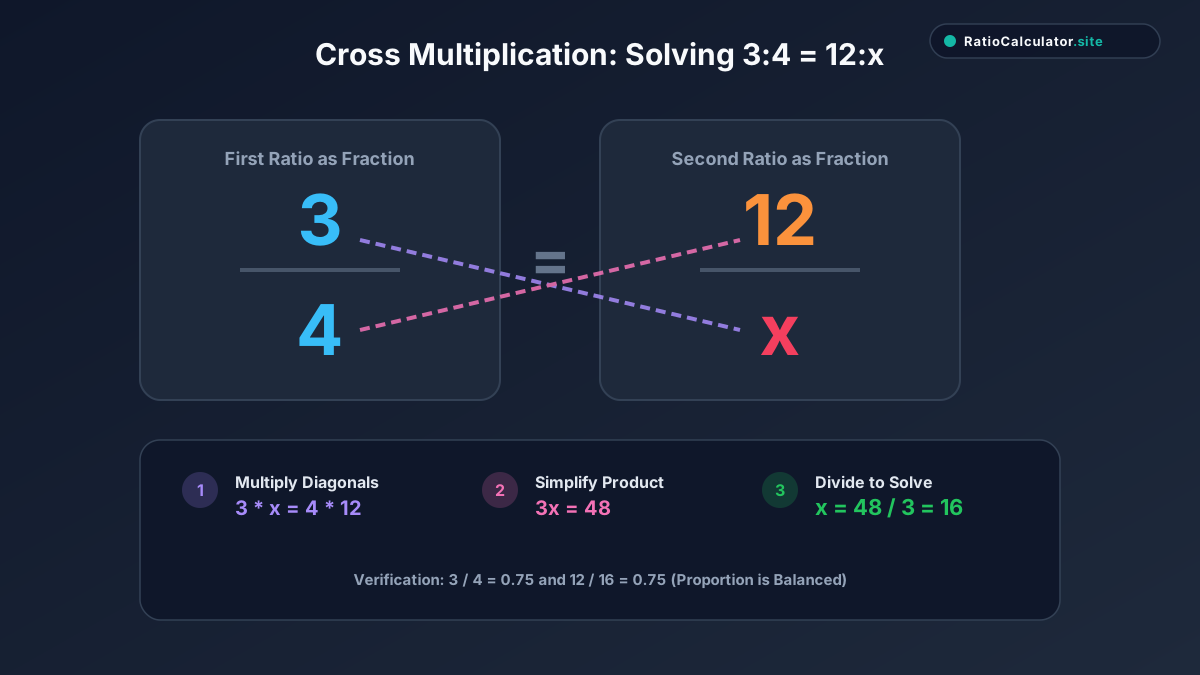
Let us solve the equation 3:4 = 12:x using cross multiplication:
Step 1: Write the ratios as equal fractions
3 / 4 = 12 / x
Step 2: Multiply the diagonal pairs
Multiply the top numerator on the left by the bottom denominator on the right, and set it equal to the product of the other diagonal pair:
3 * x = 4 * 12
3x = 48
Step 3: Solve for x
Divide both sides of the equation by 3 to isolate x:
x = 48 / 3
x = 16
Step 4: Verify the result
Substitute 16 back into the original ratio fraction:
3 / 4 = 0.75
12 / 16 = 0.75
Both fractions simplify to 0.75, which confirms that x = 16 is correct.
Additional Cross Multiplication Example: 5:11 = 35:x
- Convert to fraction format: 5 / 11 = 35 / x
- Cross multiply diagonally: 5 * x = 11 * 35
- Calculate the product: 5x = 385
- Divide by 5: x = 385 / 5 = 77
- Result: 5:11 = 35:77
How to Find a Missing Number by Finding the Scale Factor
The scale factor method identifies the specific multiplier that scales one ratio up or down into the other. This method is exceptionally fast for mental math and everyday problem solving.
Consider the ratio equation:
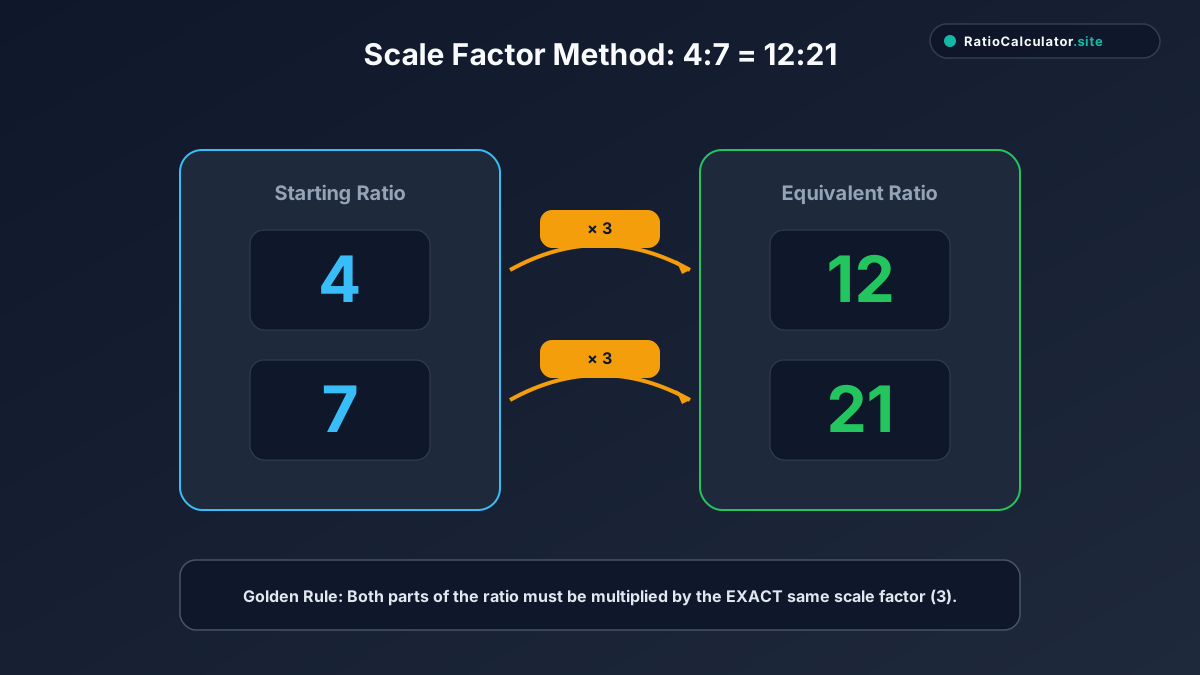
4:7 = 12:x
Step 1: Determine the scale factor between known terms
Look at the first term on both sides, which are 4 and 12. To find how 4 becomes 12, divide the target term by the starting term:
Scale Factor = 12 / 4 = 3
Step 2: Apply the scale factor to the other term
Since 4 is multiplied by 3 to become 12, the second term 7 must also be multiplied by 3 to maintain equality:
x = 7 * 3 = 21
Step 3: State the final answer
The missing number is 21. The completed ratio is 4:7 = 12:21.
How to Solve a Ratio With a Missing First Number
In many ratio problems, the unknown variable appears as the very first quantity. The mathematical process remains identical whether the missing term is in the first, second, third, or fourth position.
Example: Solving x:5 = 12:15
Let us find the value of x when the first term is unknown.
Method A: Using Scale Factor
- Compare the known second terms: 5 and 15.
- Notice that moving from the right ratio to the left ratio involves dividing by 3, since 15 / 3 = 5.
- Apply the same division to the known first term 12: 12 / 3 = 4.
- Therefore, x = 4.
Method B: Using Cross Multiplication
- Write the proportion as fractions: x / 5 = 12 / 15
- Cross multiply the diagonal numbers: 15 * x = 5 * 12
- Simplify the equation: 15x = 60
- Divide both sides by 15: x = 60 / 15 = 4
- The completed ratio is 4:5 = 12:15.
How to Solve a Ratio With a Missing Second Number
When the second position holds the unknown value, you isolate the second term using the same proportional rules.
Example 1: Solving 8:x = 24:33
- Set up the fractional proportion: 8 / x = 24 / 33
- Multiply diagonally: 24 * x = 8 * 33
- Calculate the product: 24x = 264
- Divide both sides by 24: x = 264 / 24 = 11
- The solved ratio is 8:11 = 24:33.
Example 2: Solving 6:x = 30:45
- Find the scale factor between the first terms: 30 / 6 = 5.
- This means the second ratio is 5 times larger than the first ratio.
- To find x, divide 45 by 5: x = 45 / 5 = 9.
- The solved ratio is 6:9 = 30:45. Both simplify to 2:3.
How to Find a Missing Number in a Three Part Ratio
A three part ratio compares three separate quantities simultaneously, written in the format a:b:c. If you need to split an entire total among multiple groups, check our guide on How to Divide a Number in a Given Ratio. To find an unknown value in a three part ratio, find the single common multiplier that links the known terms across both sets.
Example: Solving 2:3:x = 8:12:20
In this problem, the first ratio is 2:3:x and the equivalent second ratio is 8:12:20.
First Part:  2  -->  8   (2 * 4 = 8)
Second Part: 3  -->  12  (3 * 4 = 12)
Third Part:  x  -->  20  (x * 4 = 20)
Step 1: Identify the common scale factor
Compare the known first parts: 8 / 2 = 4. Check the second parts to confirm: 12 / 3 = 4. The universal scale factor for all three parts is 4.
Step 2: Calculate the unknown third term
Since every term in the left ratio is multiplied by 4 to create the right ratio, the third part relationship is:
x * 4 = 20
x = 20 / 4 = 5
Step 3: Verify the three part ratio
The complete ratio equation is 2:3:5 = 8:12:20. Each part in the first ratio multiplied by 4 produces the exact values in the second ratio.
How to Check Your Answer
Checking your work ensures that your calculated missing value is accurate. There are three straightforward ways to verify your answer:
1. Cross Multiplication Verification
Take your completed proportion and multiply diagonally. If the two products are identical, the answer is correct.
For 3:4 = 12:16: 3 * 16 = 48 4 * 12 = 48 Because 48 equals 48, the solution x = 16 is verified.
2. Decimal Conversion Verification
Divide the first term by the second term in both ratios. Both decimal values must match exactly.
3 / 4 = 0.75 12 / 16 = 0.75 Both sides yield 0.75.
3. Simplification Verification
Reduce both ratios to their simplest form by dividing by their greatest common factor. Both simplified ratios must match.
12:16 divided by 4 simplifies to 3:4. Both sides equal 3:4.
Missing Number in Ratio Word Problems
Real world problems often present ratio calculations inside descriptive stories. The key to solving ratio word problems is identifying the known quantities, setting up a clear ratio equation, and solving for the unknown value.
Recipe Example
A baking recipe calls for flour and sugar in a ratio of 5:2. If a baker uses 15 cups of flour, how many cups of sugar are needed?
- Ratio setup: 5 / 2 = 15 / x
- Scale factor: 15 / 5 = 3
- Calculate sugar: x = 2 * 3 = 6 cups of sugar
Classroom Example
The ratio of teachers to students in a school is 1:18. If there are 360 students, how many teachers are employed?
- Ratio setup: 1 / 18 = x / 360
- Cross multiply: 18x = 360 * 1
- Solve: x = 360 / 18 = 20 teachers
Money and Shopping Example
A store offers a discount where every 4 dollars spent earns 10 reward points. How many dollars must a customer spend to earn 150 reward points?
- Ratio setup: 4 / 10 = x / 150
- Cross multiply: 10x = 4 * 150 = 600
- Solve: x = 600 / 10 = 60 dollars
Map Scale Example
On a road map, a scale of 2 centimeters represents 50 kilometers in actual distance. If two cities are separated by 7 centimeters on the map, what is the actual distance?
- Ratio setup: 2 / 50 = 7 / x
- Cross multiply: 2x = 50 * 7 = 350
- Solve: x = 350 / 2 = 175 kilometers
Sports Statistics Example
A basketball player maintains a ratio of 3 successful free throws out of every 4 attempts. If the player attempted 28 free throws in a tournament, how many were successful?
- Ratio setup: 3 / 4 = x / 28
- Scale factor: 28 / 4 = 7
- Calculate: x = 3 * 7 = 21 successful free throws
Common Mistakes When Finding a Missing Ratio Number
Avoiding simple calculation errors will help you solve ratio equations with consistent accuracy:
1. Changing Only One Side of the Ratio
- The Mistake: Multiplying or dividing only one number while leaving the other unchanged.
- The Correction: Always apply the exact same scale factor to every term in the ratio.
2. Using the Wrong Multiplication Factor
- The Mistake: Adding or subtracting a number instead of multiplying or dividing.
- The Correction: Ratios describe multiplicative relationships. Never use addition or subtraction to create equivalent ratios.
3. Cross Multiplying Across the Wrong Positions
- The Mistake: Multiplying terms straight across horizontally instead of diagonally.
- The Correction: Always multiply numerator on the left by denominator on the right, and numerator on the right by denominator on the left.
4. Comparing the Wrong Ratio Parts
- The Mistake: Pairing the first quantity of the first ratio with the second quantity of the second ratio.
- The Correction: Keep the order of categories consistent on both sides of the equals sign.
5. Forgetting to Simplify and Verify
- The Mistake: Accepting an answer without testing whether the final ratios are equivalent.
- The Correction: Substitute the answer back into the equation and verify that both ratios simplify to the exact same value.
How to Use a Ratio Calculator
When dealing with large numbers, decimals, or multi step proportion problems, an online tool helps eliminate manual calculation mistakes.
You can use the Ratio Calculator on RatioCalculator.site to solve any ratio with a missing number:
- Open the calculator on the website homepage.
- Enter the three known values into their corresponding input boxes.
- Leave the input box for the unknown value blank or set to x.
- Click the calculate button to generate the missing number immediately.
- Review the step by step explanation provided beneath the result to understand the exact mathematical method used.
Frequently Asked Questions
How do you find the missing number in a ratio?
You find the missing number by multiplying or dividing the known terms by the common scale factor, or by using cross multiplication.
How do you solve for x in a ratio?
Write the ratio as equal fractions, cross multiply the diagonal numbers, and divide by the remaining number to isolate x.
What is the easiest way to solve a ratio with a missing number?
The easiest way is finding the scale factor between the two corresponding known terms and multiplying the remaining term by that same factor.
How do you find a missing number using cross multiplication?
Set the two ratios as fractions a/b = c/d, multiply diagonal pairs to get ad = bc, and solve the simple linear equation.
How do you find the missing term in an equivalent ratio?
Identify the constant multiplier between the known matching terms and apply that exact multiplier to the other term.
How do you solve a ratio problem with a missing first number?
Write the proportion as x/b = c/d, cross multiply to get dx = bc, and divide both sides by d to get x.
How do you find a missing value in a three part ratio?
Find the single common multiplier that links the known parts across both ratios and apply it to calculate the unknown part.
How do you check if your missing ratio answer is correct?
Substitute your calculated value into the proportion and confirm that cross multiplying produces identical numbers on both sides.