How to Solve Ratio Word Problems (7 Easy Steps With Examples)
Master solving ratio word problems with clear step by step instructions, formulas, missing value techniques, total dividing methods, and practical examples.
How to Solve Ratio Word Problems: Step by Step With Examples
A ratio word problem is a mathematical scenario presented in written language that describes a relationship between two or more quantities. Solving these problems requires translating everyday descriptions into proportional math statements, identifying known and unknown values, and using systematic calculation methods to find the solution.
To solve any ratio word problem, you read the situation carefully, determine which quantities are being compared, and set up a ratio statement in the exact order specified. For example, suppose a fruit basket contains apples and oranges in a ratio of 2 to 3. If the basket holds 6 apples, how many oranges are present? Because 2 multiplied by 3 gives 6 apples, you multiply the 3 oranges by that same factor of 3, which reveals that there are 9 oranges.
Learning how to approach these story problems builds foundational math skills for algebra, physics, chemistry, cooking, and finance. If you want to solve complex proportions instantly or check your manual work, you can use the Ratio Calculator on RatioCalculator.site to calculate missing values, simplify proportions, and verify calculations automatically.
What Is a Ratio Word Problem?
Quick Answer (Featured Snippet): A ratio word problem is a real world math scenario comparing two or more quantities. To solve it: (1) write the ratio in exact order, (2) identify known values and the unknown variable, (3) set up a proportion (A:B = C:X) or unitary part equation, (4) cross multiply or find the scale factor, and (5) verify that your answer maintains proportional balance.
A ratio word problem takes a practical real world situation and expresses the relative quantities as a math problem. Instead of simply presenting numbers such as 2:5, a word problem provides a narrative context involving students in a classroom, money shared among partners, ingredients in a recipe, or dimensions on a scale blueprint.
Understanding how real life scenarios translate into ratios is straightforward:
- Classroom Groups: A problem stating that there are 4 laptops for every 10 students describes a ratio of 4:10, which simplifies to 2:5.
- Cooking Recipes: A recipe requiring 2 cups of sugar for every 5 cups of flour describes a sugar to flour ratio of 2:5.
- Financial Allocations: Two business partners agreeing to split profits in proportion to their investments of 30,000 dollars and 50,000 dollars establish a ratio of 3:5.
- Physical Measurements: A map scale where 1 centimeter represents 50 kilometers in the real world describes a scale ratio of 1:50.
If you are new to the core mechanics of ratios, our foundational tutorial on How to Calculate a Ratio explains how to express and simplify these comparisons.
How to Identify a Ratio in a Word Problem
Extracting the correct mathematical components from a story problem requires identifying key pieces of information systematically:
1. The Quantities Being Compared
Read the question to locate the exact items or groups described. Typical problems compare boys to girls, wins to losses, ingredients in a mixture, or parts of a budget.
2. The Order of the Quantities
Order is critical in ratio calculations. If a problem mentions boys before girls, the number representing boys must be the first term, and the number representing girls must be the second term. Reversing this order produces incorrect results.
3. The Known Values
Locate the specific numbers provided in the text. These include the base ratio numbers, a specific quantity for one category, or a scale factor.
4. The Unknown Value
Identify the question being asked. Are you looking for the missing quantity in one category, the total combined amount, or the difference between two groups?
5. The Total Amount
Determine whether the problem gives an overall total (such as total students, total money, or total volume) that must be distributed among all ratio parts.
6. The Ratio Relationship
Decide whether the problem describes a part to part comparison (comparing one group to another) or a part to whole comparison (comparing one group to the entire collection).
How to Solve Ratio Word Problems Step by Step
Following a structured method ensures that you never miss a step when solving proportion story questions:
- Read the problem carefully: Identify what is given and what question must be answered.
- Identify the comparing quantities: Note the items and their precise order of mention.
- Write the initial ratio: Place the quantities side by side separated by a colon or write them as a fraction.
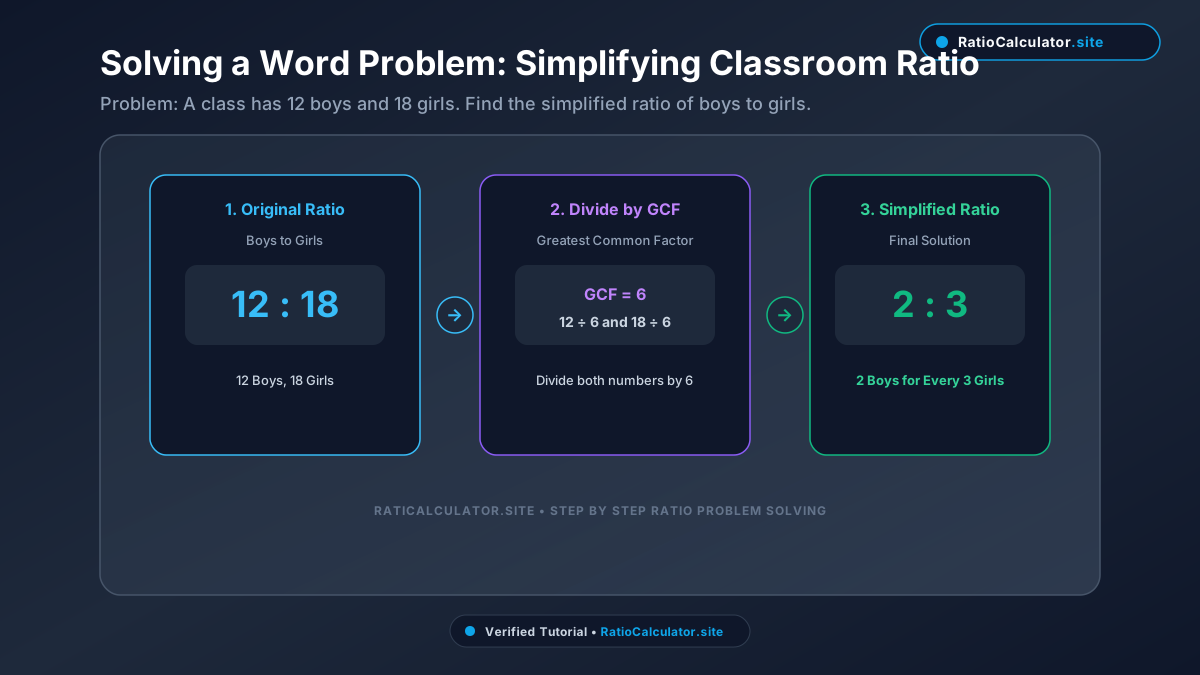
- Simplify the ratio when appropriate: Divide both numbers by their greatest common factor to work with smaller numbers.
- Determine the calculation method: Choose the scale factor method, cross multiplication, or the unitary part value method based on the problem structure.
- Calculate the final answer: Perform the required multiplication or division.
- Check your result: Substitute your solution back into the proportion to confirm that the ratio balance is preserved.
Live Interactive Ratio Word Problem Solver
Use this interactive tool to solve proportion story questions or divide total amounts into ratio parts instantly:
Live Ratio Word Problem Solver
Solve proportion word problems or split totals instantly
Set up a proportion: A : B = C : X
Divide a total sum in ratio Part A : Part B
Example of a Simple Ratio Word Problem
Let us apply the seven step method to a beginner friendly scenario.
The Word Problem
A local library maintains a collection where there are 3 science fiction books for every 7 mystery books. If the library currently has 21 science fiction books on its shelves, how many mystery books are in the collection?
Step by Step Solution
- Step 1 (Identify Quantities): The problem compares science fiction books to mystery books.
- Step 2 (Write Base Ratio): Science Fiction : Mystery = 3 : 7.
- Step 3 (Set Up Proportion Equation): 3 / 7 = 21 / x, where x represents mystery books.
- Step 4 (Find the Scale Factor): Compare the known science fiction numbers: 21 divided by 3 equals 7. The multiplier is 7.
- Step 5 (Calculate Unknown): Multiply the mystery book ratio term by that same multiplier: 7 multiplied by 7 equals 49.
- Step 6 (State Answer): The library has 49 mystery books.
- Step 7 (Verification): Check that 21 / 49 simplifies to 3 / 7 by dividing both numbers by 7: 21 divided by 7 equals 3, and 49 divided by 7 equals 7. The solution is confirmed.
How to Solve Ratio Word Problems With a Missing Number
Many ratio problems present a known ratio and give the value of one part, asking you to find the missing partner value. For in depth techniques on this topic, explore our dedicated tutorial on How to Find the Missing Number in a Ratio.
The Problem
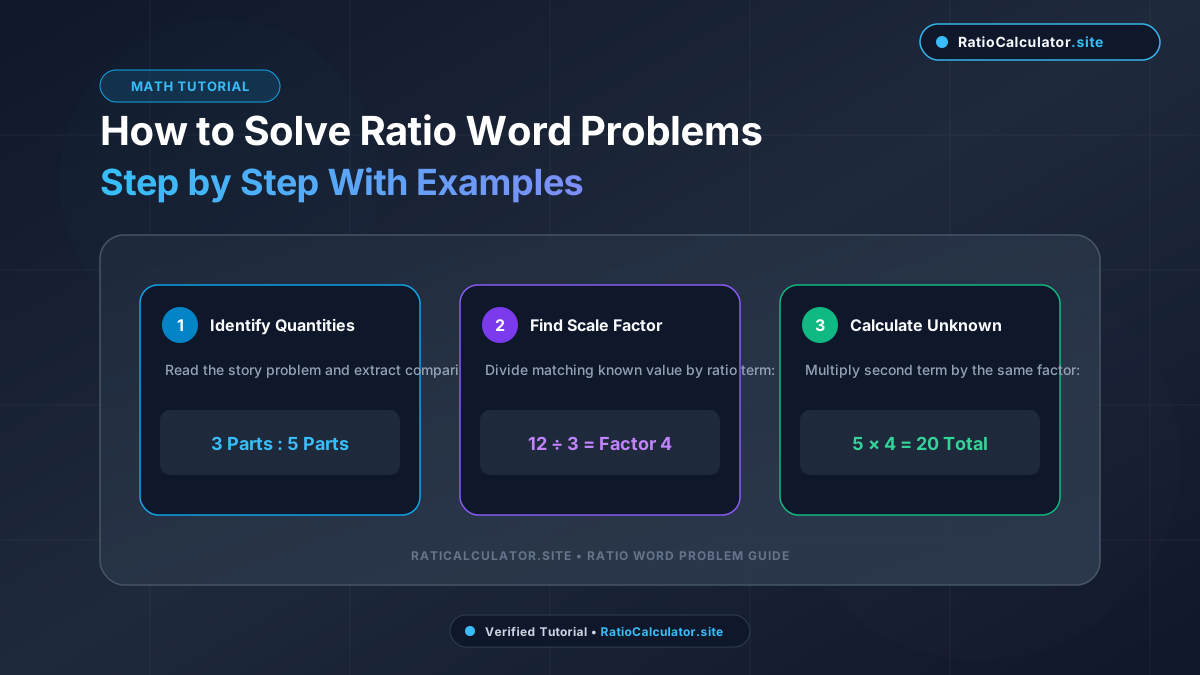
A factory maintains a machine part ratio of 3 to 5 for standard gears compared to heavy duty gears. If a technician counts 12 standard gears, how many heavy duty gears are required?
Method 1: The Scale Factor Method
- Identify the matching known term: Standard gears have a ratio term of 3 and an actual quantity of 12.
- Divide actual quantity by ratio term to find the scale factor: 12 divided by 3 equals 4.
- Multiply the second ratio term (5) by the scale factor (4): 5 multiplied by 4 equals 20.
- Result: 20 heavy duty gears are required.
Method 2: Cross Multiplication
- Set up the two equal fractions: 3 / 5 = 12 / x.
- Cross multiply diagonal pairs: 3 multiplied by x equals 5 multiplied by 12.
- Simplify the equation: 3x = 60.
- Isolate x by dividing both sides by 3: x = 60 divided by 3 = 20.
- Result: x = 20 gears.
Both methods yield the exact same accurate result. The scale factor method is fastest for mental math, while cross multiplication handles large numbers or decimal values reliably.
How to Solve Ratio Word Problems With Total Amounts
When a problem gives you a total sum and asks you to divide it according to a ratio, use the unitary part value method. You can also review comprehensive examples in our guide on How to Divide a Number in a Given Ratio.
The Problem
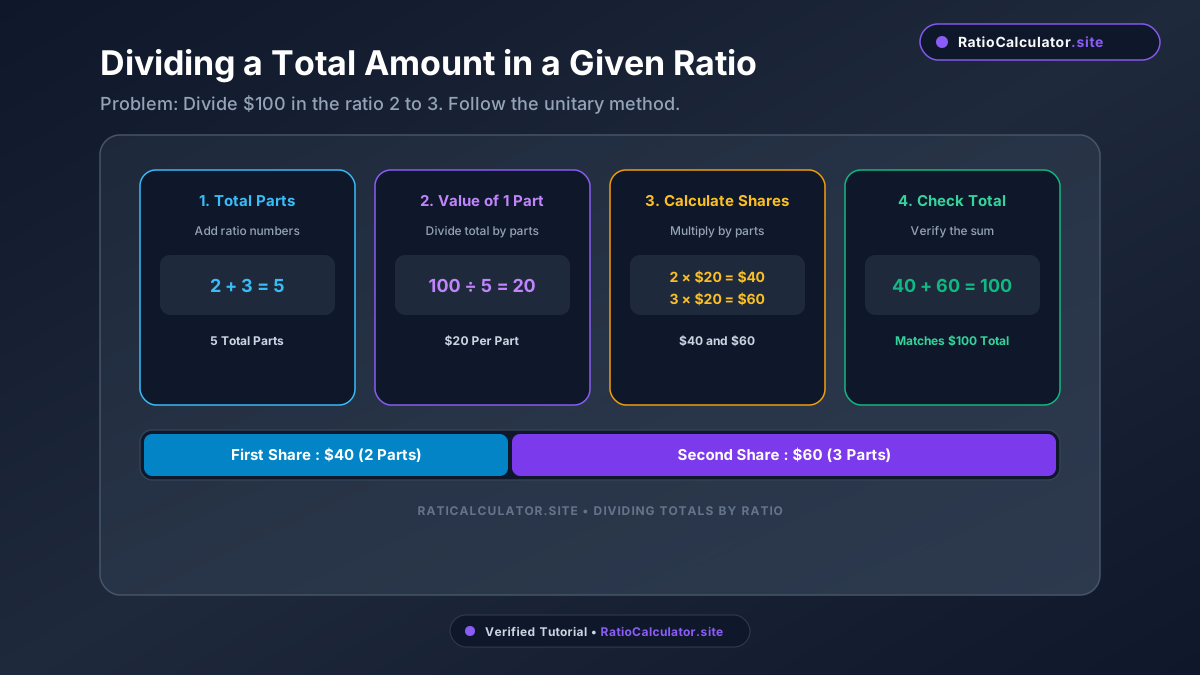
Two coworkers, Alex and Jordan, receive a combined performance bonus of 100 dollars. They agree to split the bonus in the ratio of 2 to 3 based on project hours completed. How much money does each person receive?
The Four Step Unitary Solution
- Step 1 (Find Total Ratio Parts): Add the individual ratio terms together: 2 plus 3 equals 5 total parts.
- Step 2 (Find Value of One Part): Divide the total dollar amount by the total number of parts: 100 divided by 5 equals 20 dollars per part.
- Step 3 (Calculate Each Share):
- Alex receives 2 parts: 2 multiplied by 20 equals 40 dollars.
- Jordan receives 3 parts: 3 multiplied by 20 equals 60 dollars.
- Step 4 (Verify Total): Add the individual shares together: 40 plus 60 equals 100 dollars. The sum matches the original bonus total perfectly.
How to Solve Three Part Ratio Word Problems
Ratios can compare three or more quantities simultaneously (written as a:b:c). The same unitary part value method applies regardless of how many categories are involved.
The Problem
A concrete mixture requires cement, sand, and gravel in the ratio of 2 to 3 to 5 by weight. If a construction worker needs to prepare a total batch weighing 120 kilograms, how many kilograms of each ingredient are needed?
Step by Step Solution
- Step 1 (Add All Ratio Parts): 2 plus 3 plus 5 equals 10 total parts.
- Step 2 (Calculate Value of One Part): 120 kilograms divided by 10 parts equals 12 kilograms per part.
- Step 3 (Calculate Individual Quantities):
- Cement (2 parts): 2 multiplied by 12 equals 24 kilograms.
- Sand (3 parts): 3 multiplied by 12 equals 36 kilograms.
- Gravel (5 parts): 5 multiplied by 12 equals 60 kilograms.
- Step 4 (Verify the Sum): 24 plus 36 plus 60 equals 120 kilograms.
- Step 5 (Verify Proportions): Dividing 24, 36, and 60 by their greatest common factor (12) returns the original ratio 2:3:5.
How to Solve Ratio Word Problems With Fractions or Decimals
Word problems occasionally present ratios with fractional quantities or decimal numbers. Before solving, convert them into clean whole numbers by multiplying all terms by a common factor.
Handling Decimals in Ratios
Suppose a paint mix uses 1.5 liters of blue tint for every 2.5 liters of white base:
- Write the ratio: 1.5 : 2.5.
- Multiply both numbers by 10 to eliminate decimals: 15 : 25.
- Divide both numbers by their greatest common factor (5): 3 : 5.
- The clean simplified ratio is 3:5.
Handling Fractions in Ratios
Suppose a baker uses 1/2 cup of melted butter for every 3/4 cup of whole milk:
- Write the ratio: (1/2) : (3/4).
- Multiply both fractions by the common denominator (4): (1/2 * 4) : (3/4 * 4) = 2 : 3.
- The clean whole number ratio is 2:3.
Once simplified to whole numbers, you can solve missing values or total divisions using standard methods. Learn more about creating simplified forms in our guide on How to Find Equivalent Ratios.
Ratio Word Problems With Percentages
Ratios and percentages are directly connected. When a word problem asks what percentage a specific part represents, find the total sum of parts, create a fraction, and multiply by 100.
For a comprehensive guide on this conversion, see How to Convert a Ratio to a Percentage.
Example
A beverage is mixed using 1 part fruit syrup and 4 parts sparkling water. What percentage of the drink is fruit syrup?
- Add the ratio parts: 1 plus 4 equals 5 total parts.
- Divide syrup parts by total parts: 1 divided by 5 equals 0.20.
- Multiply by 100: 0.20 multiplied by 100 equals 20 percent.
- Result: Fruit syrup makes up 20 percent of the total drink.
Real Life Ratio Word Problem Examples
Here are realistic examples showing how ratio calculations resolve common practical questions across different fields.
1. Cooking and Recipes
A recipe for salad dressing uses 1 part vinegar to 3 parts olive oil. If a chef prepares 200 milliliters of dressing in total, how much olive oil is required?
- Total parts: 1 plus 3 equals 4 parts.
- Value of one part: 200 divided by 4 equals 50 milliliters.
- Olive oil (3 parts): 3 multiplied by 50 equals 150 milliliters.
2. Classroom Teacher Ratios
A school district mandates a teacher to student ratio of 1 to 18. If an elementary school enrolls 360 students, how many teachers must be hired?
- Set up proportion: 1 / 18 = x / 360.
- Scale factor: 360 divided by 18 equals 20.
- Calculate teachers: 1 multiplied by 20 equals 20 teachers.
3. Personal Finance and Savings
A family budgets income between essential expenses and savings in a ratio of 4 to 1. If their monthly take home pay is 5,000 dollars, how much is saved each month?
- Total parts: 4 plus 1 equals 5 parts.
- Value of one part: 5,000 divided by 5 equals 1,000 dollars.
- Savings (1 part): 1 multiplied by 1,000 equals 1,000 dollars per month.
4. Retail Pricing and Markups
A store prices merchandise with a cost to markup ratio of 3 to 2. If an item costs the store 60 dollars, what is the dollar markup added to the price?
- Scale factor: 60 divided by 3 equals 20.
- Markup (2 parts): 2 multiplied by 20 equals 40 dollars markup.
- Retail selling price: 60 plus 40 equals 100 dollars.
5. Corporate Budgeting
A technology startup splits a 90,000 dollar development budget between design and engineering in a ratio of 2 to 7. How much does engineering receive?
- Total parts: 2 plus 7 equals 9 parts.
- Value of one part: 90,000 divided by 9 equals 10,000 dollars.
- Engineering share (7 parts): 7 multiplied by 10,000 equals 70,000 dollars.
6. Sports Shooting Accuracy
A basketball player maintains a ratio of 3 successful baskets out of every 5 shot attempts. If the player attempts 35 shots during a tournament, how many baskets are scored?
- Scale factor: 35 divided by 5 equals 7.
- Successful baskets: 3 multiplied by 7 equals 21 baskets.
7. Road Map Distance Scaling
A roadmap has a scale ratio of 2 centimeters to 25 kilometers. If two cities are 8 centimeters apart on the map, what is the actual driving distance?
- Scale factor: 8 divided by 2 equals 4.
- Actual distance: 25 multiplied by 4 equals 100 kilometers.
8. Construction Mortar Mixing
A builder mixes masonry mortar with 1 part lime, 2 parts cement, and 9 parts sand. If 24 bags of sand are used, how many bags of cement are needed?
- Ratio comparison (Cement to Sand): 2 to 9.
- Scale factor: 24 divided by 9 equals 2.667.
- Cement needed: 2 multiplied by 2.667 equals 5.33 bags.
How to Check Your Ratio Word Problem Answer
Verifying your answers prevents common errors and confirms mathematical accuracy:
- The Cross Multiplication Test: If your answer is part of a proportion equation like a/b = c/d, confirm that a multiplied by d equals b multiplied by c.
- The Simplification Test: Place your calculated final amounts into a ratio and divide by their greatest common factor. The simplified numbers must match the original ratio in the problem statement.
- The Total Sum Test: When dividing a whole amount, add all calculated shares together. Their sum must equal the original total given in the problem.
Common Mistakes When Solving Ratio Word Problems
Avoiding these frequent calculation traps ensures consistent accuracy:
| Common Mistake | Why It Happens | How to Correct It |
|---|---|---|
| Reversing the order of quantities | Writing numbers without checking which term came first in the problem | Write category labels above numbers before calculating (such as Boys / Girls) |
| Forgetting to simplify ratios | Working with unnecessarily large numbers | Divide terms by their greatest common factor first |
| Adding terms instead of multiplying | Assuming linear addition works for proportions | Ratios describe multiplicative scale factors, never additive differences |
| Dividing total by one part | Using a single ratio number as the denominator instead of the sum | Always add all ratio terms together to find total parts before dividing a total |
| Ignoring mismatched units | Comparing meters to centimeters without converting | Convert all quantities to the same unit of measurement first |
| Multiplying by the wrong factor | Pairing the scale factor with the wrong category | Keep corresponding terms strictly aligned across both sides of the equals sign |
| Failing to verify the answer | Assuming arithmetic was error free without testing | Substitute results back into the proportion to confirm balance |
How to Use a Ratio Calculator
When dealing with large numbers, decimals, or multi part proportions, using an online tool helps verify calculations quickly and eliminates manual errors.
You can use the free Ratio Calculator on RatioCalculator.site:
- Navigate to the calculator on the RatioCalculator.site homepage.
- Enter your known ratio terms into the input fields.
- If solving for a missing number, enter the known value and leave the target field blank.
- If dividing a total amount, use the ratio distribution feature to input your total sum and ratio parts.
- Click calculate to receive the exact answer along with detailed step by step calculation breakdowns.
Frequently Asked Questions
How do you solve ratio word problems?
Identify the comparing quantities, write the proportion equation, find the scale factor or value per part, and calculate the unknown value.
What is the easiest way to solve a ratio word problem?
The easiest way is finding the scale factor between known terms and multiplying the target term by that same factor.
How do you find the ratio in a word problem?
Identify the two quantities being compared and write their numerical values in the exact order they are described in the text.
How do you solve a ratio problem with a missing number?
Write the ratio as equal fractions, cross multiply the diagonal numbers, and divide by the remaining number to isolate the unknown.
How do you divide an amount in a ratio?
Add all ratio parts to find the total parts, divide the overall amount by that sum to find the value of one part, and multiply by each part.
How do you solve a three part ratio problem?
Add all three ratio terms together, divide the total sum by that number to find the single part value, and multiply each term by that value.
How do you check a ratio word problem answer?
Substitute the calculated answers into a ratio to confirm that it simplifies to the original ratio, and verify that the parts sum to the total.
What is the formula for solving ratio problems?
The formula for a missing term in a proportion is a / b = c / d, which solves via cross multiplication as a * d = b * c.