How to Split a Total Into Three Parts Using a Ratio
Master dividing any total sum into three parts using ratios. Complete step by step guide with unit value methods, formulas, and money sharing examples.
Dividing a total quantity among three recipients or categories is one of the most practical mathematical calculations in daily life. Whether distributing lottery winnings, allocating annual company budgets, or cutting construction timber into specified lengths, knowing how to split a total into three portions according to a ratio guarantees an equitable and mathematically exact result.
The core technique relies on the unit value method. By determining the worth of a single ratio unit, you can easily calculate each person’s exact share regardless of how large or complicated the numbers appear.
For automated calculations with instant step by step explanations, test the free Ratio Calculator on RatioCalculator.site.
Understanding the Three Part Ratio Split
When a problem states that an amount must be divided in the ratio A : B : C, it means the total quantity is separated into (A + B + C) equal portions. The first recipient receives A of those portions, the second receives B portions, and the third receives C portions.
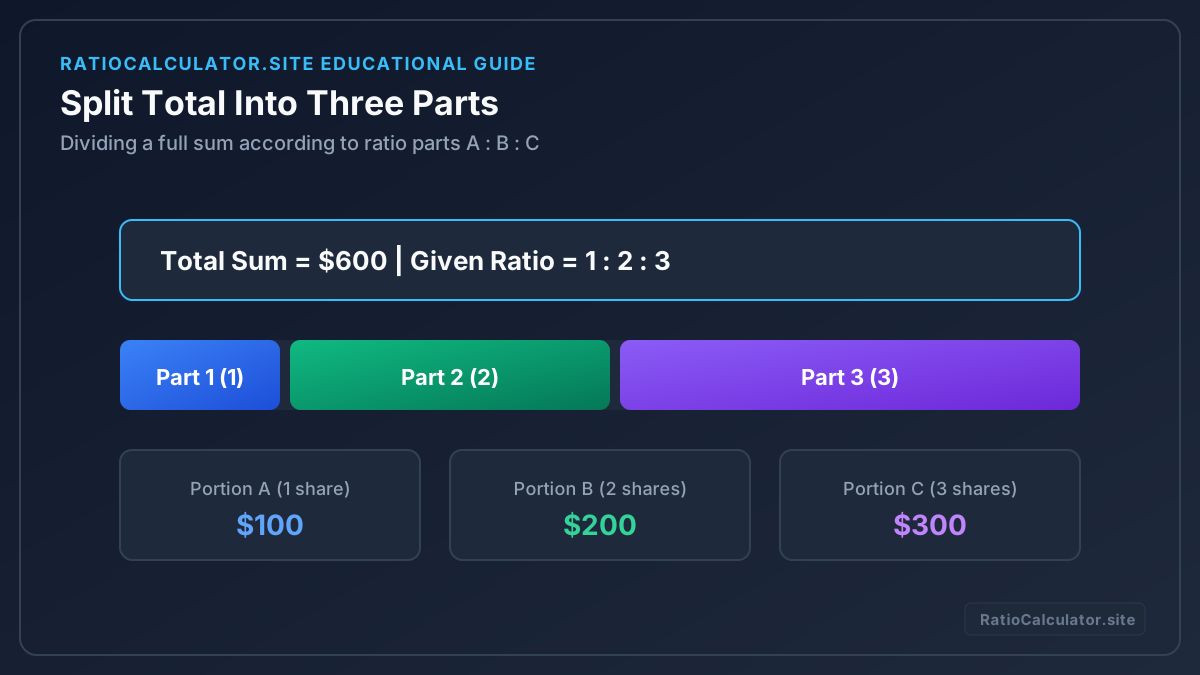
For example, dividing $600 in the ratio 1 : 2 : 3 means:
- Total parts = 1 + 2 + 3 = 6 parts
- Each single part equals $600 / 6 = $100
- Share 1 gets 1 * $100 = $100
- Share 2 gets 2 * $100 = $200
- Share 3 gets 3 * $100 = $300
Notice that the sum of the three portions ($100 + $200 + $300) returns exactly to the original $600 total.
The Three Step Formula for Splitting Any Total
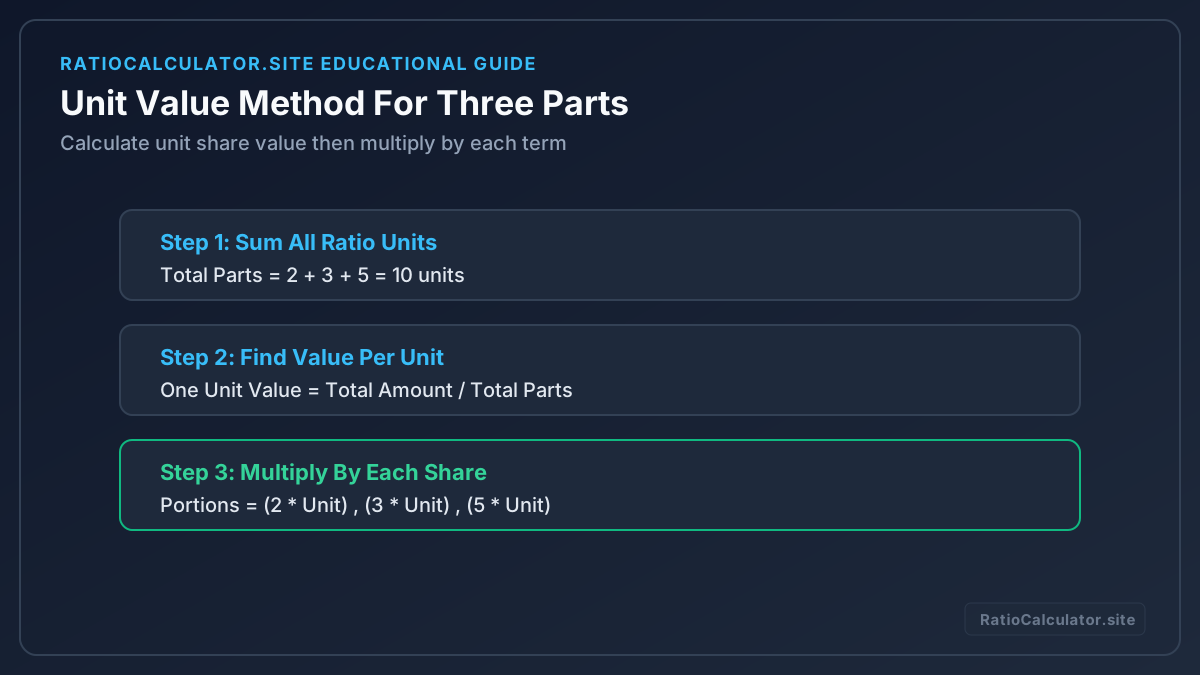
Follow these three reliable steps for any sum:
Step 1: Calculate the Total Number of Ratio Units
Add all three parts of the ratio together: Total Ratio Units = A + B + C
Step 2: Determine the Value of One Ratio Unit
Divide the total amount by the sum of the ratio units: Value of One Unit = Total Amount / Total Ratio Units
Step 3: Compute Each Individual Portion
Multiply the value of one unit by each individual ratio term:
- First Share = A * Value of One Unit
- Second Share = B * Value of One Unit
- Third Share = C * Value of One Unit

Real World Sharing Scenarios
Scenario 1: Distributing Corporate Annual Bonuses
A business allocates an executive bonus pool of $24,000 among three managers in proportion to their team output: ratio 3 : 4 : 5.
- Find total units: 3 + 4 + 5 = 12 units
- Find value per unit: $24,000 / 12 = $2,000
- Calculate each manager’s bonus:
- Manager 1: 3 * $2,000 = $6,000
- Manager 2: 4 * $2,000 = $8,000
- Manager 3: 5 * $2,000 = $10,000
- Verification: $6,000 + $8,000 + $10,000 = $24,000
Scenario 2: Cutting a 180 Centimeter Steel Beam
An engineer needs three pieces of steel in the ratio 2 : 3 : 4 to fabricate a support truss.
- Total units: 2 + 3 + 4 = 9 units
- Length per unit: 180 cm / 9 = 20 cm
- Length of each piece:
- First piece: 2 * 20 cm = 40 cm
- Second piece: 3 * 20 cm = 60 cm
- Third piece: 4 * 20 cm = 80 cm
- Verification: 40 cm + 60 cm + 80 cm = 180 cm
How to Verify Your Final Solution
Always perform a two point check on your answers:
- Sum Check: Add all three calculated values together. They must equal the original total amount exactly.
- Ratio Check: Simplify your three resulting values by dividing by their greatest common divisor. The reduced ratio must match the initial given ratio.
Contextual Internal Resources & Authority References
For further study and automated calculations on proportional sharing, explore these verified resources:
- Interactive Calculators: Use our dedicated Ratio Division Calculator for automated unit-part math, or simplify three-way proportions with the Three-Part Ratio Calculator.
- Related In-Depth Guides: Read How to Find the Ratio Between Three Quantities, review How to Divide a Number in a Given Ratio, and master How to Share Money in a Given Ratio.
- Core Tool: Return to the main Ratio Calculator for instant proportion verification.
- Academic References: For rigorous mathematical foundations of division into parts, reference Wolfram MathWorld Ratio Concepts and Britannica Principles of Ratio Mathematics.
Frequently Asked Questions
What is the first step when splitting a total into three ratio parts?
The first step is adding the three numbers of the ratio together to obtain the total number of parts.
What should you do if the total does not divide evenly by the sum of parts?
Keep the unit value as a fraction or rounded decimal depending on whether currency or continuous measurement is needed.
Can you split a total using a ratio with decimals?
Yes, multiply all ratio terms by ten or one hundred first to turn them into whole numbers before dividing.
How do you check that your calculated shares are correct?
Add the three calculated portions together to confirm that their sum equals the original total amount.
What is the unitary method in ratio division?
The unitary method involves finding the value of a single ratio unit before multiplying by each term.
Why is splitting by ratio better than equal division?
It reflects differing investments, working hours, project sizes, or technical requirements fairly.
Does changing the order of ratio terms affect the split?
Yes, each person receives the share corresponding specifically to their position in the ratio sequence.