How to Solve Distance and Speed Problems Using Ratios
Learn how to solve distance, speed, and time problems using direct and inverse ratios. Step by step physics and math formulas with clear vehicle examples.
Motion problems connecting distance, speed, and time are foundational to physics and practical navigation. While standard algebra solves these scenarios using the formula Distance = Speed * Time, using ratio relationships provides an elegant shortcut that simplifies complex multi vehicle problems into mental calculations.
The key to solving motion problems with ratios lies in recognizing whether the relationship between two variables is directly proportional or inversely proportional.
For instant proportion calculations and verification, test the free Ratio Calculator on RatioCalculator.site.
The Core Proportional Relationships in Motion
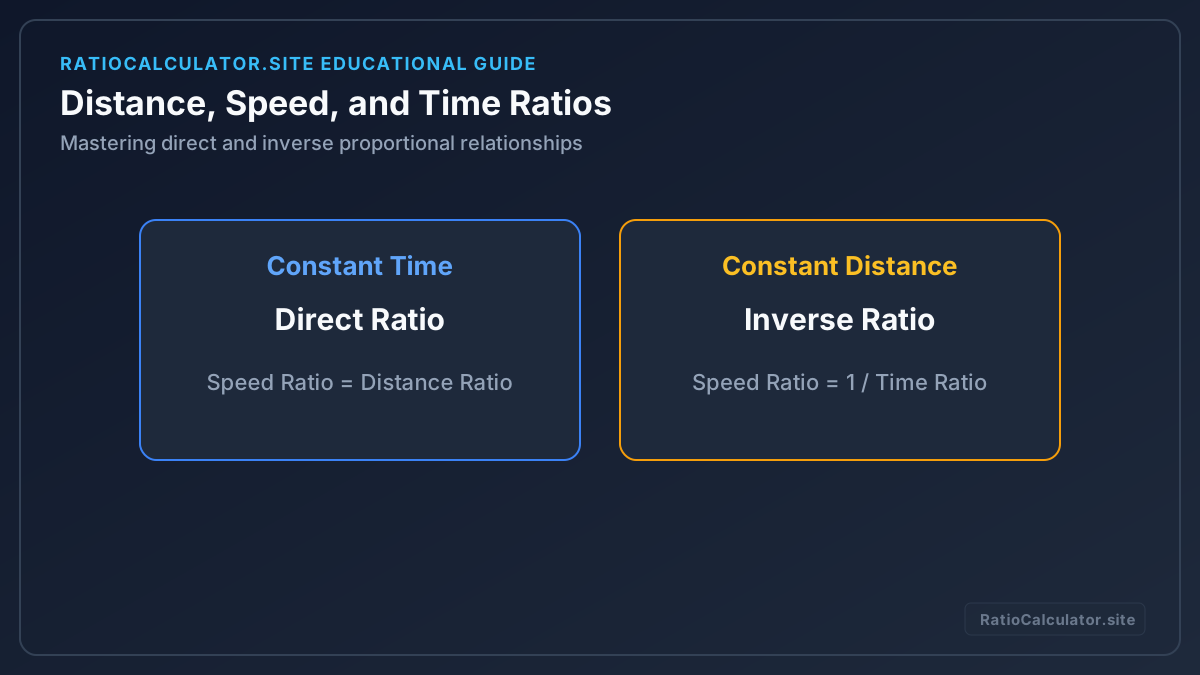
The motion equation Distance = Speed * Time creates two fundamental ratio behaviors depending on which variable is held constant:
1. Constant Time: Direct Proportion
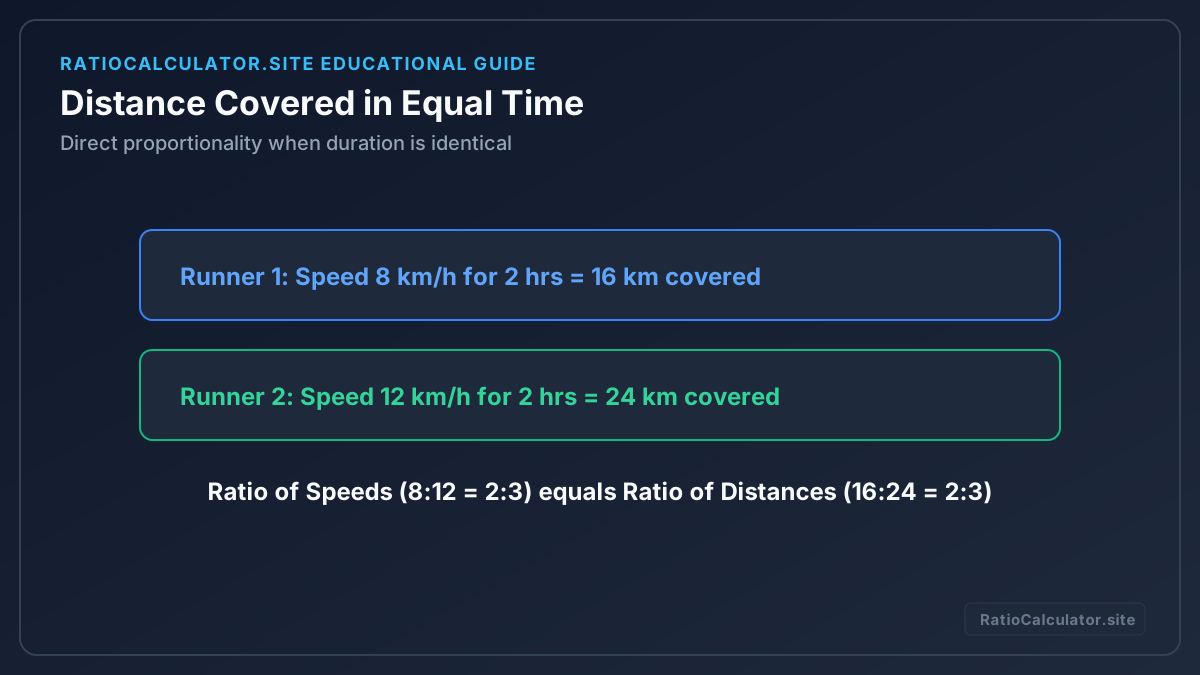
When two travelers move for the exact same amount of time, distance is directly proportional to speed: Distance 1 / Distance 2 = Speed 1 / Speed 2
If Car A travels twice as fast as Car B over identical time durations, Car A will cover exactly twice the distance.
2. Constant Distance: Inverse Proportion
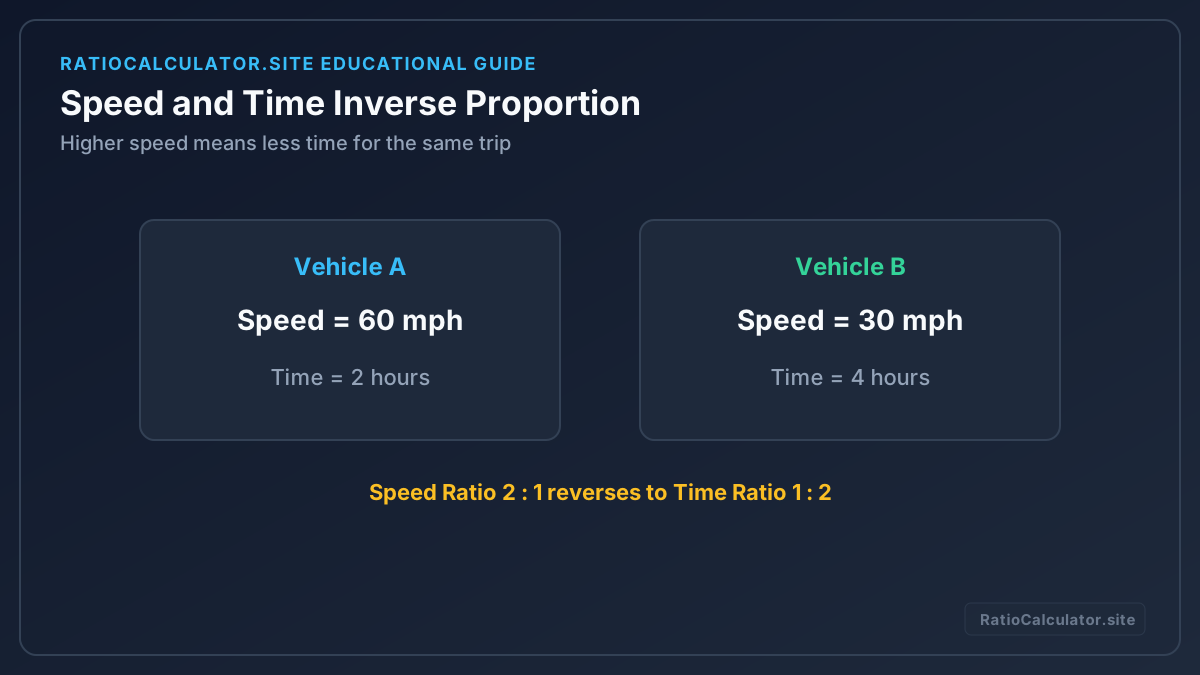
When two travelers cover the exact same distance, speed and time are inversely proportional: Speed 1 / Speed 2 = Time 2 / Time 1
If you double your speed over a fixed journey, your travel time is cut in half. The ratio of speeds reverses to form the ratio of travel times.
Solving Motion Problems Step by Step
Scenario 1: Same Distance, Different Speeds (Inverse Ratio)
A commuter drives to work at 60 miles per hour and returns home along the identical route at 40 miles per hour. The total driving time for both trips combined is 5 hours. What is the one way distance?
- Identify the constant: Distance is identical for both trips.
- Determine speed ratio:
- Speed Outward : Speed Return = 60 : 40 = 3 : 2
- Invert to find time ratio:
- Time Outward : Time Return = 2 : 3
- Split total time (5 hours) in the ratio 2 : 3:
- Total units = 2 + 3 = 5 units
- 1 unit = 5 hours / 5 = 1 hour
- Time Outward = 2 * 1 = 2 hours
- Time Return = 3 * 1 = 3 hours
- Compute distance:
- Distance = Speed * Time = 60 mph * 2 hours = 120 miles
- Verification check: Return distance = 40 mph * 3 hours = 120 miles.
Scenario 2: Same Time, Different Speeds (Direct Ratio)
Two cyclists start simultaneously from the same point traveling in opposite directions. Cyclist A rides at 18 kilometers per hour and Cyclist B rides at 12 kilometers per hour. After a certain time, they are 90 kilometers apart. How far has Cyclist A traveled?
- Identify constant: Both cyclists ride for the exact same duration.
- Direct distance ratio equals speed ratio:
- Distance A : Distance B = Speed A : Speed B = 18 : 12 = 3 : 2
- Split total distance (90 km) in ratio 3 : 2:
- Total units = 3 + 2 = 5 units
- 1 unit = 90 km / 5 = 18 km
- Distance A = 3 * 18 km = 54 km
- Distance B = 2 * 18 km = 36 km
- Verification: 54 km + 36 km = 90 km, and 54 / 36 = 3 / 2.
Limits of Simple Ratios in Motion Problems
Simple ratios apply when motion occurs at constant average speed. If acceleration is variable or traffic conditions alter speeds non linearly, simple proportional scaling must be modified using calculus or piecewise velocity intervals.
Contextual Internal Resources & Authority References
Explore further applications of rate, speed, and distance ratios across physics and everyday modeling:
- Interactive Calculators: Compute map and distance ratios with the Scale Factor Calculator or calculate visual dimensions with the Aspect Ratio Calculator.
- Related In-Depth Guides: Learn How to Use Ratios for Scale Drawings and Maps, explore real world applications in How to Use Ratios in Real Life, and master How to Compare Ratios.
- Core Tool: Calculate inverse and direct proportions effortlessly on the Ratio Calculator.
- Academic References: For motion equations and inverse proportionalities, consult LibreTexts Physics Mechanics and the NIST International Metric Guidelines.
Frequently Asked Questions
How does speed relate to time when distance is constant?
Speed and time are inversely proportional when distance is constant, meaning higher speed requires less time.
How does speed relate to distance when time is constant?
Speed and distance are directly proportional when time is constant, meaning higher speed covers greater distance.
What is the time ratio if two vehicles have a speed ratio of 4 to 5 over the same trip?
The time ratio is the inverse, which is 5 to 4.
Why do you invert the ratio for speed and time problems?
Because speed equals distance divided by time, placing time in the denominator and creating an inverse relationship.
Can ratio methods solve average speed problems for round trips?
Yes, by determining the time ratio between legs first, you can calculate total distance divided by total time accurately.
What unit requirements apply to distance and speed ratios?
All speeds, distances, and times must be converted to compatible matching units before establishing ratios.
When does a simple ratio method fail in motion problems?
Simple ratios fail when acceleration is continuous and non uniform rather than at steady average rates.