How to Find Equivalent Ratios (Fast Formula & Examples)
Learn how to find equivalent ratios with clear steps, real examples, and easy formulas. Check if ratios are equivalent, simplify them, and apply them to everyday problems.
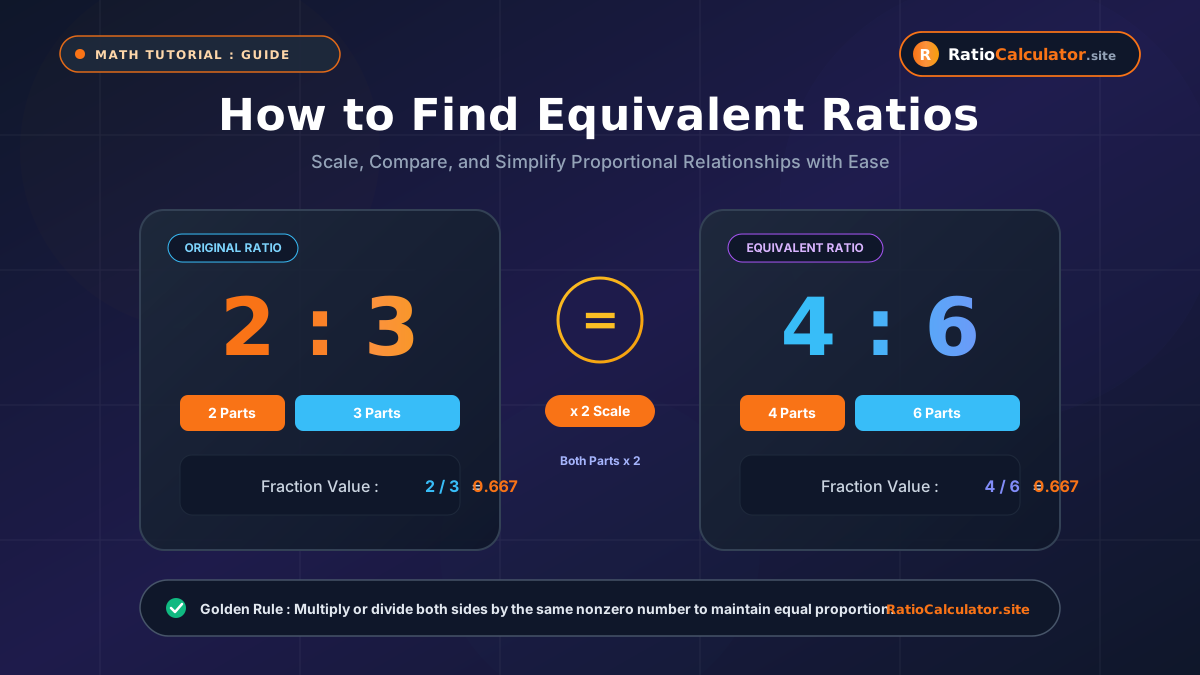
Equivalent ratios are two or more ratios that express the same relationship between numbers, even though the numbers themselves are different. For example, 2:3 and 4:6 are equivalent ratios because they both describe the same proportion. If you double both parts of 2:3, you get 4:6. The relationship stays the same.
To find equivalent ratios, multiply or divide both parts of a ratio by the same nonzero number. That one rule is the foundation of everything in this guide.
If you want to save time and verify your work instantly, try the Ratio Calculator on RatioCalculator.site. It can simplify ratios, solve for missing values, and show each calculation step. If you are starting with two raw numbers and need to reduce them first, read our guide on How to Calculate a Ratio From Two Numbers.
What Are Equivalent Ratios?
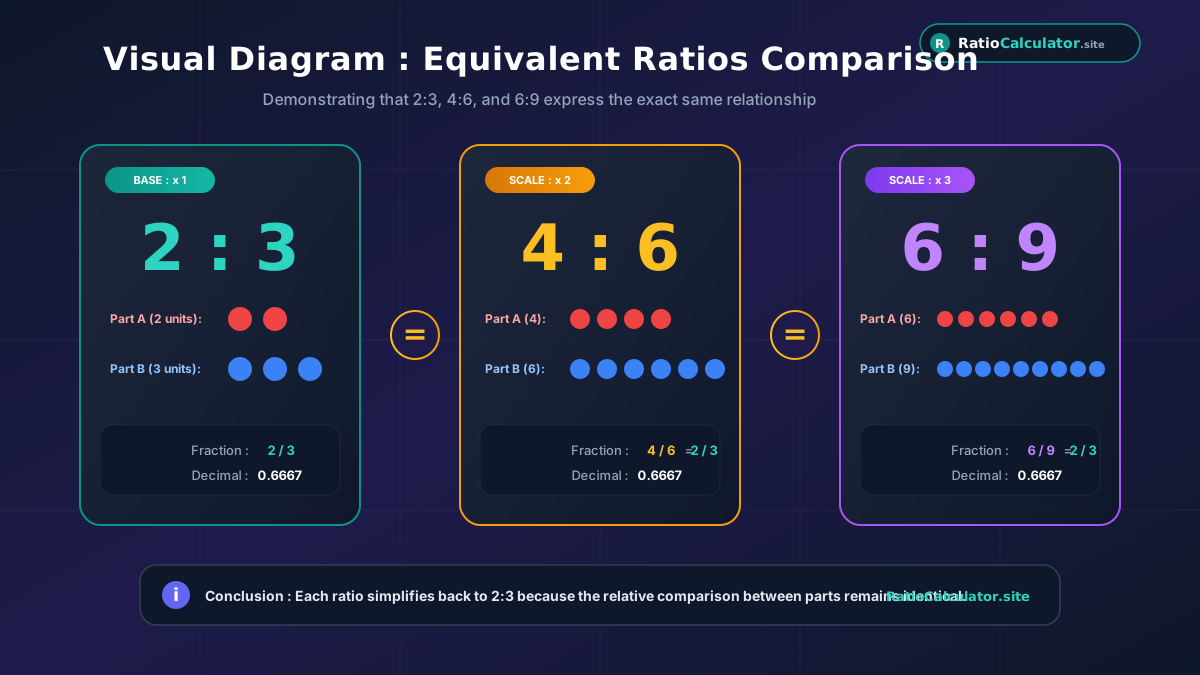
Quick Answer (Featured Snippet): Equivalent ratios are ratios that express the exact same relationship between numbers. To find equivalent ratios, multiply or divide both terms of the ratio by the same nonzero number. For example, multiplying both terms of 2:3 by 2 gives 4:6, and multiplying by 3 gives 6:9.
Equivalent ratios describe the same comparison using different numbers. Think of it this way: if you have 2 red marbles for every 3 blue marbles, and your friend has 4 red marbles for every 6 blue marbles, you both have the same proportion of red to blue. Your ratios look different, but they represent the same thing.
Here are a few pairs of equivalent ratios:
| First Ratio | Equivalent Ratio | Why They Are Equivalent |
|---|---|---|
| 1:2 | 3:6 | Both parts multiplied by 3 |
| 3:4 | 9:12 | Both parts multiplied by 3 |
| 5:10 | 1:2 | Both parts divided by 5 |
| 6:8 | 3:4 | Both parts divided by 2 |
The key principle is simple: when you multiply or divide both parts of a ratio by the same nonzero number, the resulting ratio is equivalent to the original. The proportion does not change. Only the numbers change.
This works because ratios represent a relationship, not fixed amounts. Whether you say “1 cup of sugar for every 2 cups of flour” or “3 cups of sugar for every 6 cups of flour,” the recipe tastes the same.
How to Find Equivalent Ratios
Finding equivalent ratios involves two methods: multiplication and division. Both methods rely on applying the same operation to both parts of the ratio.
Method 1: Multiply Both Parts
Pick any nonzero whole number and multiply both parts of the ratio by that number.
Example: Find three equivalent ratios for 3:7.
- Multiply both parts by 2: 3 × 2 = 6, and 7 × 2 = 14 → 6:14
- Multiply both parts by 3: 3 × 3 = 9, and 7 × 3 = 21 → 9:21
- Multiply both parts by 5: 3 × 5 = 15, and 7 × 5 = 35 → 15:35
So 3:7, 6:14, 9:21, and 15:35 are all equivalent ratios.
Method 2: Divide Both Parts
If both parts of a ratio share a common factor, divide both by that factor to produce a smaller equivalent ratio.
Example: Find a simpler equivalent ratio for 20:30.
- Both 20 and 30 are divisible by 10
- 20 ÷ 10 = 2, and 30 ÷ 10 = 3
- 2:3 is an equivalent ratio
You could also divide by 5 first to get 4:6, then divide by 2 to get 2:3. Either path leads to the same simplified result.
Finding a Specific Equivalent Ratio
Sometimes you need an equivalent ratio where one part equals a target number.
Example: The ratio of boys to girls is 2:5. If there are 20 girls, how many boys are there?
- The second part of the ratio needs to go from 5 to 20
- 20 ÷ 5 = 4, so multiply both parts by 4
- 2 × 4 = 8, and 5 × 4 = 20
- The equivalent ratio is 8:20, so there are 8 boys
Equivalent Ratio Formula
The mathematical relationship behind equivalent ratios is straightforward:
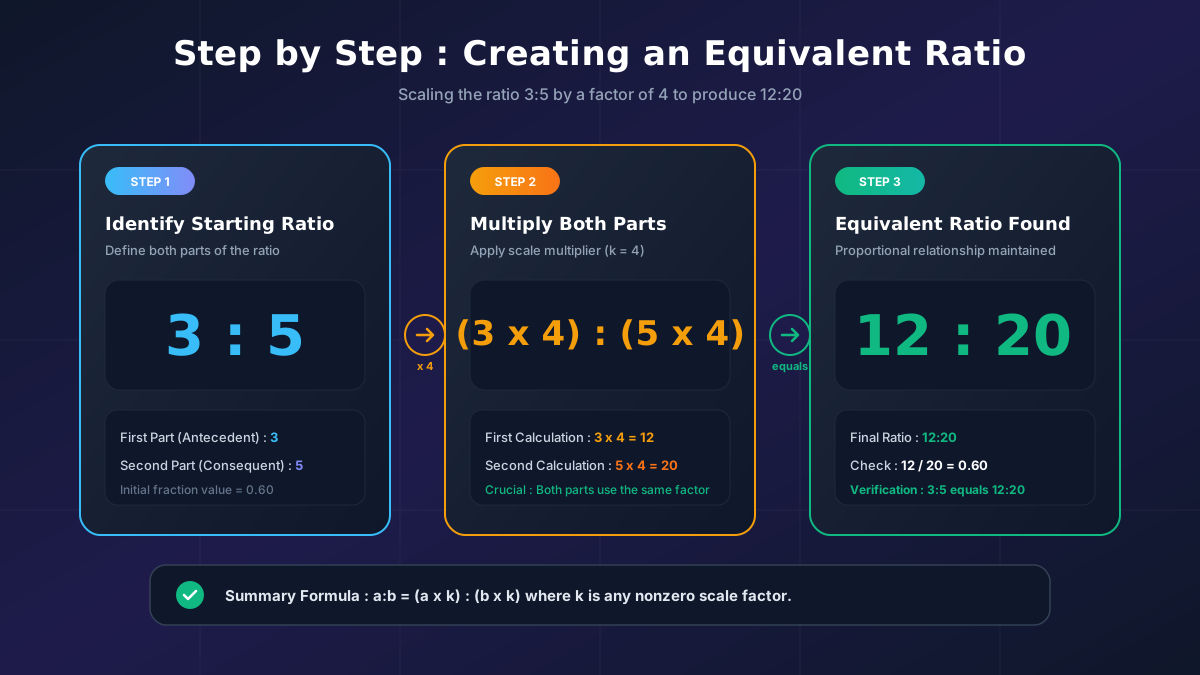
If a:b is a ratio and k is any nonzero number, then (a × k) : (b × k) is an equivalent ratio.
This can also be written using fractions:
a/b = (a × k) / (b × k)
Where:
- a is the first part of the ratio
- b is the second part of the ratio
- k is any nonzero number (the multiplier or divisor)
When k is greater than 1, you scale the ratio up. When k is a fraction between 0 and 1, you scale it down. When k equals 1, the ratio stays unchanged.
Example: Starting with 4:5 and k = 3:
4 × 3 = 12, and 5 × 3 = 15
So 4:5 and 12:15 are equivalent ratios. You can confirm this because 12/15 simplifies back to 4/5.
Examples of Equivalent Ratios
Let’s work through several examples with different starting ratios.
Example 1: Starting with 2:5
| Multiplier | Calculation | Equivalent Ratio |
|---|---|---|
| ×2 | 2×2 : 5×2 | 4:10 |
| ×3 | 2×3 : 5×3 | 6:15 |
| ×4 | 2×4 : 5×4 | 8:20 |
| ×6 | 2×6 : 5×6 | 12:30 |
Example 2: Starting with 3:4
| Multiplier | Calculation | Equivalent Ratio |
|---|---|---|
| ×2 | 3×2 : 4×2 | 6:8 |
| ×3 | 3×3 : 4×3 | 9:12 |
| ×5 | 3×5 : 4×5 | 15:20 |
| ×10 | 3×10 : 4×10 | 30:40 |
Example 3: Starting with 6:7
| Multiplier | Calculation | Equivalent Ratio |
|---|---|---|
| ×2 | 6×2 : 7×2 | 12:14 |
| ×3 | 6×3 : 7×3 | 18:21 |
| ×4 | 6×4 : 7×4 | 24:28 |
Example 4: Starting with 8:12
The ratio 8:12 simplifies first. The greatest common factor of 8 and 12 is 4.
8 ÷ 4 = 2, and 12 ÷ 4 = 3. So the simplest form is 2:3.
Equivalent ratios of 8:12 include: 2:3, 4:6, 16:24, and 24:36.
Example 5: Starting with 12:18
The greatest common factor of 12 and 18 is 6.
12 ÷ 6 = 2, and 18 ÷ 6 = 3. Simplest form: 2:3.
Equivalent ratios: 2:3, 4:6, 6:9, 24:36.
Notice that 8:12 and 12:18 are also equivalent to each other, because they both simplify to 2:3.
How to Check If Two Ratios Are Equivalent
There are two reliable methods to determine whether two ratios represent the same proportion.
Method 1: Cross Multiplication
Cross multiplication is the fastest way to check. For two ratios a:b and c:d, multiply across:
- Calculate a × d
- Calculate b × c
- If a × d equals b × c, the ratios are equivalent
Example: Are 3:4 and 9:12 equivalent?
- 3 × 12 = 36
- 4 × 9 = 36
- 36 = 36 ✓ Yes, they are equivalent.
Example: Are 2:5 and 4:9 equivalent?
- 2 × 9 = 18
- 5 × 4 = 20
- 18 ≠ 20 ✗ No, they are not equivalent.
Method 2: Simplify Both Ratios
Reduce each ratio to its simplest form. If both ratios simplify to the same result, they are equivalent.
Example: Are 15:25 and 6:10 equivalent?
- Simplify 15:25 → divide both by 5 → 3:5
- Simplify 6:10 → divide both by 2 → 3:5
- Both simplify to 3:5 ✓ Yes, they are equivalent.
Example: Are 4:7 and 12:20 equivalent?
- 4:7 is already in simplest form → 4:7
- Simplify 12:20 → divide both by 4 → 3:5
- 4:7 ≠ 3:5 ✗ No, they are not equivalent.
Both methods always give the correct answer. Cross multiplication is quicker for a single comparison. Simplifying is more useful when you are comparing many ratios at once. To learn more about ordering and ranking different ratios by size, read our detailed guide on how to compare ratios.
Equivalent Ratios and Simplified Ratios
Every ratio belongs to a “family” of equivalent ratios, and every family has one simplest member. The simplified ratio (also called the ratio in lowest terms) is the version where both parts share no common factor other than 1.
Example: The ratios 4:6, 6:9, 8:12, 10:15, and 2:3 are all equivalent. Among them, 2:3 is the simplified ratio because 2 and 3 share no common factor except 1.
To simplify any ratio:
- Find the greatest common factor (GCF) of both parts
- Divide both parts by the GCF
Example: Simplify 36:48.
- Factors of 36: 1, 2, 3, 4, 6, 9, 12, 18, 36
- Factors of 48: 1, 2, 3, 4, 6, 8, 12, 16, 24, 48
- Greatest common factor: 12
- 36 ÷ 12 = 3, and 48 ÷ 12 = 4
- Simplified ratio: 3:4
Every equivalent ratio in the 3:4 family (such as 6:8, 9:12, 12:16, 15:20) simplifies back to 3:4. Simplifying is how you find the “root” ratio that represents the entire family.
Ratio vs Equivalent Ratio
A ratio is a single comparison between two quantities. An equivalent ratio is another ratio that expresses the same comparison with different numbers. Here is a clear comparison:
| Feature | Ratio | Equivalent Ratio |
|---|---|---|
| Definition | A comparison of two numbers | A different ratio that represents the same comparison |
| Example | 3:5 | 6:10, 9:15, 12:20 |
| Numbers | Fixed | Different but proportional |
| Simplified form | May or may not be simplified | Always simplifies to the same ratio |
| Purpose | Describes a relationship | Scales that relationship up or down |
Think of it this way: “3:5” is a ratio. “6:10” is also a ratio. Because they represent the same proportion, 6:10 is called an equivalent ratio of 3:5. Every ratio has an infinite number of equivalent ratios because you can multiply both parts by any nonzero number.
Real Life Examples of Equivalent Ratios
Equivalent ratios appear in many everyday situations. Here are practical examples you may encounter.
Recipes
A pancake recipe calls for 2 cups of flour and 1 cup of milk (2:1). If you want to make a triple batch, multiply both by 3: 6 cups of flour and 3 cups of milk (6:3). Both ratios produce pancakes with the same texture and taste.
Maps
A map uses a scale of 1:100,000. This means 1 centimeter on the map equals 100,000 centimeters (1 kilometer) in real life. The equivalent ratio 2:200,000 tells you that 2 centimeters equals 2 kilometers. The scale stays consistent across the entire map.
Classrooms
A school maintains a student to teacher ratio of 25:1. With 4 teachers, the equivalent ratio is 100:4. Both ratios confirm that there are 25 students per teacher.
Money
Two business partners split profits in a 3:2 ratio. If the total profit is $500, the first partner gets $300 and the second gets $200 (300:200 simplifies to 3:2). If the profit grows to $1000, the split becomes $600 and $400 (600:400, still 3:2). You can calculate these splits using the Profit Sharing Calculator.
Shopping
A store advertises “buy 2 get 1 free.” That is a ratio of 3 items for the price of 2, or 3:2. Buying 9 items for the price of 6 (9:6) is the same deal scaled up. Simplifying 9:6 gives 3:2.
Measurements
A paint mixing guide says to use 1 part blue to 4 parts white (1:4). For a larger project, you might mix 3 parts blue and 12 parts white (3:12, which simplifies to 1:4). The color stays identical. For precise mixing, the Mixing Ratio Calculator can help.
Sports
A basketball player makes 7 free throws out of 10 attempts (7:10). Over 50 attempts at the same rate, the player would make 35 out of 50 (35:50, which simplifies to 7:10). Coaches and analysts use equivalent ratios to project performance over different sample sizes.
How to Use a Ratio Calculator
The Ratio Calculator on RatioCalculator.site makes working with equivalent ratios quick and accurate. Here is how to use it:
- Visit the calculator at the RatioCalculator.site homepage
- Enter your ratio values in the input fields
- Choose your calculation type, such as simplifying a ratio or solving for a missing value
- Press Calculate to see the result instantly
- Review the output, which includes the simplified ratio and step by step calculations
The calculator is especially helpful when you are working with large numbers or decimals where manual calculation becomes tedious. It eliminates arithmetic errors and confirms your work in seconds.
Common Mistakes When Finding Equivalent Ratios
These are the most frequent errors students and professionals make, along with quick corrections.
Multiplying Only One Part
Mistake: Starting with 3:5 and multiplying only the first part by 2 to get 6:5.
Correction: Always multiply both parts. The correct result is 6:10.
Adding Instead of Multiplying
Mistake: Starting with 4:7 and adding 3 to both parts to get 7:10, then calling it equivalent.
Correction: Adding the same number does not produce an equivalent ratio. 4/7 does not equal 7/10. You must multiply (or divide), not add.
Dividing Only One Part
Mistake: Starting with 12:8 and dividing only 12 by 4 to get 3:8.
Correction: Divide both parts by 4. The correct result is 3:2.
Using Zero as a Multiplier
Mistake: Multiplying both parts of 5:3 by 0 to get 0:0.
Correction: The multiplier must be a nonzero number. Multiplying by zero destroys the ratio entirely, because 0:0 has no mathematical meaning.
Comparing Without Simplifying
Mistake: Concluding that 4:6 and 6:9 are not equivalent because the numbers look different.
Correction: Always simplify first. 4:6 simplifies to 2:3, and 6:9 also simplifies to 2:3. They are equivalent.
When Should You Use Equivalent Ratios?
Equivalent ratios are useful whenever you need to scale a quantity while keeping the same proportion. Here are common situations:
Scaling recipes up or down for a different number of servings. If a recipe serves 4 and you need to serve 12, you triple every ingredient using equivalent ratios.
Converting measurements between units. Map scales, architectural blueprints, and model building all rely on equivalent ratios to translate between sizes.
Solving proportion problems in school or at work. When you know three of the four values in a proportion (a:b = c:?), equivalent ratios help you find the missing number.
Comparing prices at the store. Converting different package sizes to the same base quantity lets you find the best deal.
Distributing resources fairly. Splitting time, money, or materials among groups in a fixed ratio requires scaling that ratio to match the total available.
Analyzing data in science, sports, and business. Rates like speed (miles per hour), density (grams per milliliter), and batting averages are all ratios that get compared through equivalence.
Understanding equivalent ratios gives you a reliable tool for proportional thinking. Whether you are in a classroom or a kitchen, the logic is the same: multiply or divide both parts by the same number, and the relationship holds.
Frequently Asked Questions
What are equivalent ratios?
Equivalent ratios are ratios that express the same proportional relationship using different numbers, such as 2:3 and 4:6.
How do you find equivalent ratios?
Multiply or divide both parts of a ratio by the same nonzero number to create a new ratio that represents the same proportion.
How do you make an equivalent ratio?
Pick any nonzero number, then multiply both parts of the original ratio by that number to produce an equivalent ratio.
How do you know if two ratios are equivalent?
Use cross multiplication (a × d = b × c) or simplify both ratios to their lowest terms and check if they match.
Can equivalent ratios have different numbers?
Yes, equivalent ratios always have different numbers but represent the same proportional relationship, like 1:4 and 3:12.
How do you simplify an equivalent ratio?
Divide both parts of the ratio by their greatest common factor to reduce it to the simplest form.
What is an example of an equivalent ratio?
The ratio 5:10 is equivalent to 1:2, because dividing both parts of 5:10 by 5 gives 1:2.