How to Find the Ratio Between Three Quantities: Easy Examples
Learn how to calculate and simplify a three quantity ratio step by step. Master greatest common divisors with clear real life examples and formulas.
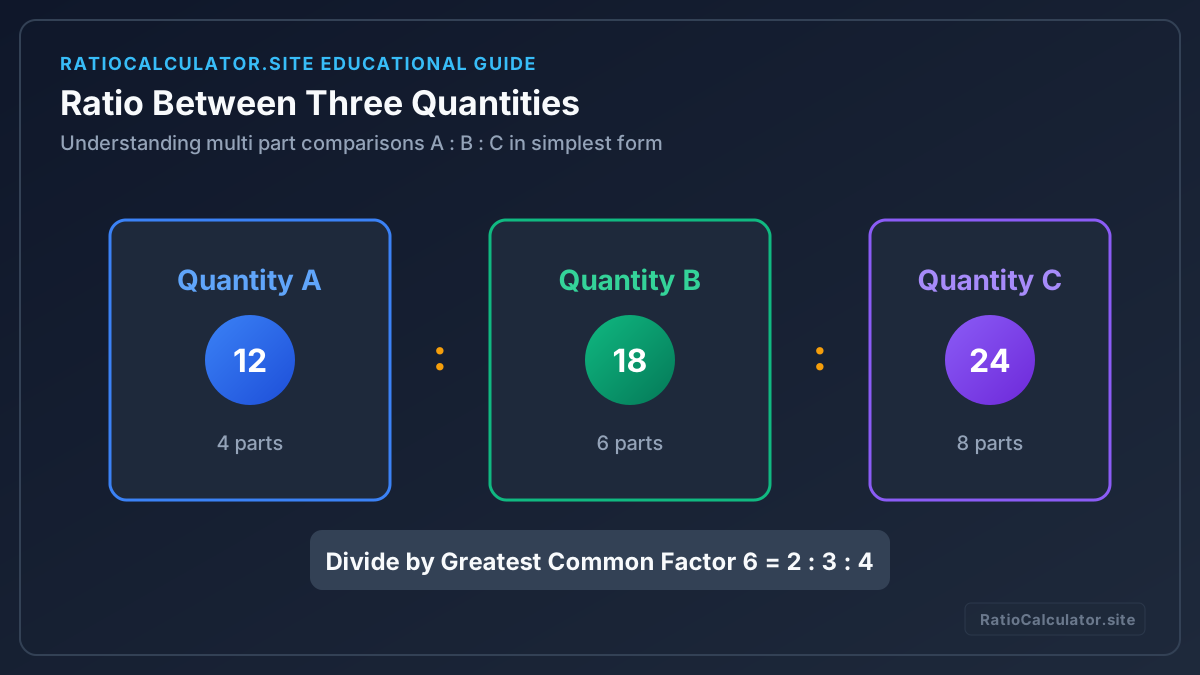
Comparing two quantities is standard practice in mathematics, but many practical tasks require comparing three quantities at the same time. Whether you are blending ingredients for a recipe, mixing concrete for construction, or allocating business resources among three departments, understanding how to express and simplify a three term ratio is an essential foundational skill.
A ratio between three quantities expresses their relative sizes in a single mathematical statement written in the form A : B : C. Just like two term ratios, three term ratios can be scaled up by multiplication or reduced to lowest terms by division without changing the underlying relationship between the values.
If you need fast confirmation of complex proportions, the free Ratio Calculator on RatioCalculator.site allows you to solve, scale, and simplify multi quantity ratios instantly.
What Does a Three Quantity Ratio Mean?
A three quantity ratio compares three separate amounts of the same kind or related components within a system. Unlike a fraction, which traditionally compares a single part to a whole, a three part ratio displays the proportional balance between three distinct items simultaneously.
Consider a baker making bread dough using flour, water, and yeast. If the recipe calls for 500 grams of flour, 300 grams of water, and 10 grams of yeast, the relationship can be written as:
Flour : Water : Yeast = 500 : 300 : 10
This mathematical statement tells anyone working in the kitchen how the three ingredients scale together. If you double the flour, you must double the water and the yeast by the exact same scale factor to preserve the texture and quality of the bread.
Key Characteristics of Three Part Ratios
- Order Matters: The sequence of numbers matches the sequence of items being compared. Swapping positions alters the mathematical meaning.
- Uniform Units: All three numbers must represent measurements in the identical unit before forming the ratio. You cannot directly compare grams with kilograms or inches with feet without prior conversion.
- Proportional Invariance: Multiplying or dividing all three terms by the same positive non zero number keeps the ratio completely equivalent.
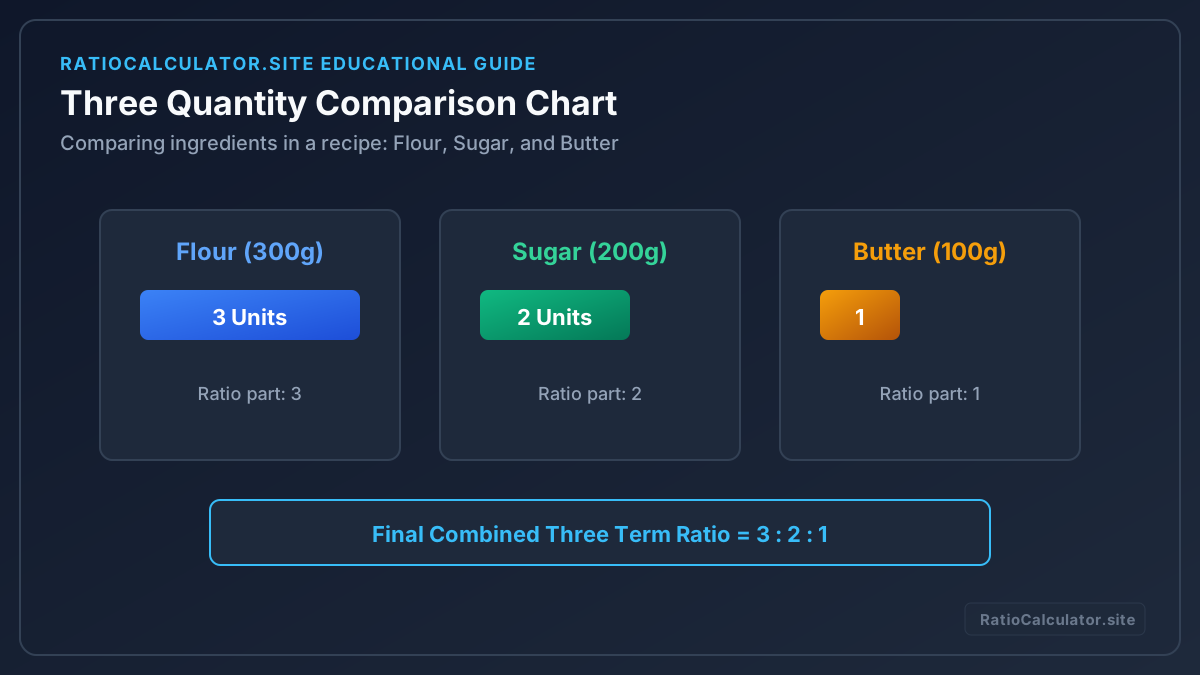
Step by Step Method to Find a Three Quantity Ratio
Finding the ratio between three given quantities follows a systematic four step procedure.
Step 1: Confirm Consistent Units of Measurement
Ensure that every measurement shares the exact same unit. For instance, if you have 2 meters, 150 centimeters, and 500 millimeters, convert all three into millimeters or centimeters first:
- 2 meters = 200 centimeters
- 150 centimeters = 150 centimeters
- 500 millimeters = 50 centimeters
Step 2: Write the Quantities Side by Side
Place the numerical values in order, separated by colons: 200 : 150 : 50
Step 3: Find the Greatest Common Divisor
Identify the greatest common divisor (GCD), also called the greatest common factor (GCF), that divides evenly into all three numbers. For 200, 150, and 50, the greatest common divisor is 50.
Step 4: Divide Each Term by the Greatest Common Divisor
Divide each component by 50:
- 200 / 50 = 4
- 150 / 50 = 3
- 50 / 50 = 1
The simplified three part ratio is 4 : 3 : 1.
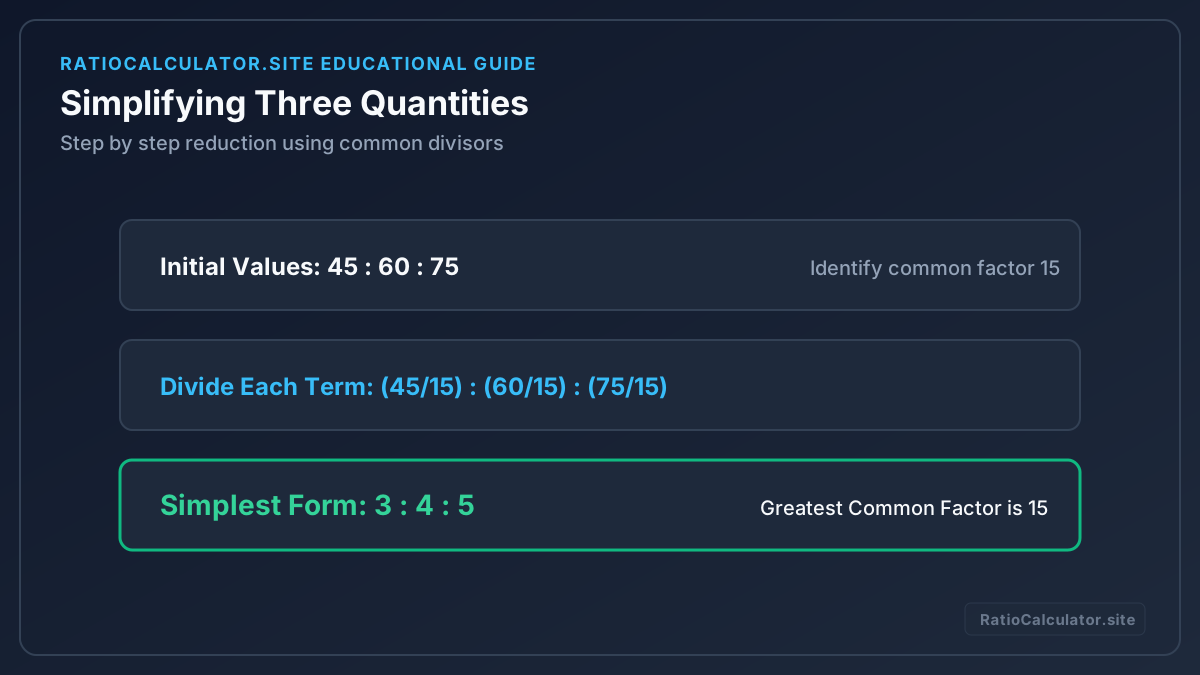
Practical Real Life Examples
Example 1: Concrete Mixing Proportions
A builder prepares concrete using 40 kilograms of cement, 80 kilograms of sand, and 120 kilograms of coarse gravel. What is the ratio in simplest form?
- Write the initial quantities: 40 : 80 : 120
- Identify the greatest common divisor of 40, 80, and 120, which is 40.
- Divide each term:
- 40 / 40 = 1
- 80 / 40 = 2
- 120 / 40 = 3
- The simplest concrete mixture ratio is 1 : 2 : 3.
Example 2: Financial Investment Shares
Three partners, David, Elena, and Farhan, contribute startup capital of $15,000, $25,000, and $35,000 respectively. What is their profit sharing ratio?
- Express the amounts side by side: 15000 : 25000 : 35000
- Divide each term by 1,000: 15 : 25 : 35
- Identify the remaining common factor, which is 5.
- Divide each term by 5:
- 15 / 5 = 3
- 25 / 5 = 5
- 35 / 5 = 7
- The final investment ratio is 3 : 5 : 7.
Common Mistakes to Avoid
- Dividing Only Two Terms: You cannot simplify two terms of a three part ratio while ignoring the third. The divisor must divide all three numbers without remainder.
- Forgetting Unit Conversions: Comparing 1 kilogram to 500 grams as 1 : 500 produces an incorrect result. Always convert to 1000 grams : 500 grams first.
- Altering the Sequential Order: If the problem asks for cement to sand to gravel, writing 3 : 2 : 1 instead of 1 : 2 : 3 reverses the intended proportions.
Contextual Internal Resources & Authority References
To master multi-quantity calculations and explore related proportional mathematics, consult our curated tools and academic references:
- Interactive Tools: Test your numbers instantly with our new Three-Part Ratio Calculator, or split sums of money with the Ratio Division Calculator.
- Related In-Depth Guides: Learn How to Split a Total Into Three Parts Using a Ratio, explore How to Solve Three Number Ratio Problems, and review How to Find Equivalent Ratios.
- Core Calculator: For instant two-part comparisons and scaling, use our primary Ratio Calculator.
- Academic References: For formal curriculum guidelines on continuous proportions, explore the Khan Academy Arithmetic Course and the comprehensive Wolfram MathWorld Ratio Analysis.
Frequently Asked Questions
Can a ratio compare more than two quantities simultaneously?
Yes, ratios can compare three, four, or any arbitrary number of quantities using consecutive colons.
How do you simplify a three part ratio with fractions?
Multiply all three terms by the least common multiple of their denominators to convert them into whole numbers.
What is the greatest common divisor in a three part ratio?
The greatest common divisor is the highest integer that divides evenly into every term of the ratio.
Does the order of terms matter in a three quantity ratio?
Yes, changing the order changes the relative relationship assigned to each specific item.
Can a three quantity ratio have decimal numbers?
Yes, multiply each term by powers of ten until all terms become whole numbers, then divide by their greatest common factor.
How do you verify if two three part ratios are equivalent?
Divide or multiply each term of one ratio by a single constant to see if it produces the other ratio exactly.
Where are three quantity ratios most commonly used?
They are widely applied in recipe scaling, chemical solutions, construction mixtures, and corporate shareholding distributions.