How to Solve Ratio Problems With Decimals: Easy Examples
Learn how to solve ratio problems with decimals by multiplying by powers of ten. Simple method to convert decimal ratios into simplified whole numbers.

Ratios involving decimal numbers are common in science, engineering, currency exchanges, and athletic statistics. When you encounter a ratio like 1.5 : 2.5 or 0.45 : 1.2, presenting the relationship with decimals is considered unsimplified.
In mathematics, a proper ratio must be expressed using the smallest positive whole numbers possible. The easiest way to solve ratio problems with decimals is to eliminate the decimal points by multiplying every term by the appropriate power of ten, then simplifying the integers by their greatest common divisor.
For example, to solve the ratio 1.5 : 2.5, notice that each number has one decimal place. Multiplying both terms by 10 yields 15 : 25. Dividing both integers by 5 gives the simplified ratio 3 : 5.
For complex calculations, multi term comparisons, or percentage breakdowns, the Ratio Calculator on RatioCalculator.site provides instant simplifications.
Interactive Decimal Ratio Solver
Live ToolEnter two decimal values below to scale by powers of ten and simplify to whole numbers:
The Power of Ten Scaling Rule
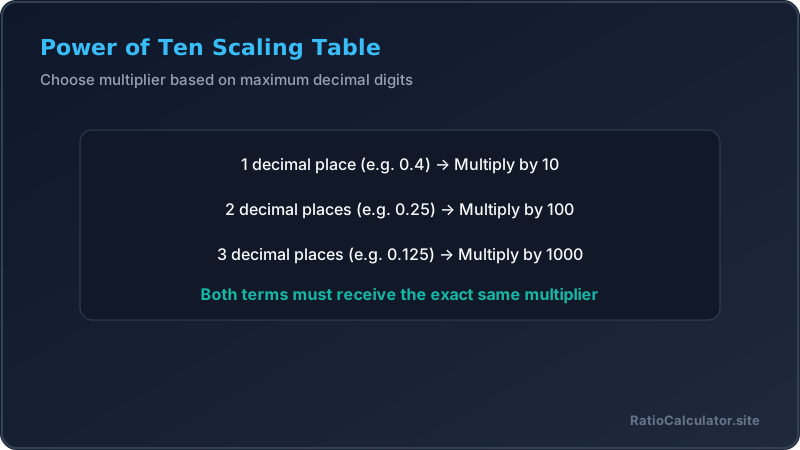
Every decimal represents a fraction based on powers of ten. One decimal place represents tenths (1/10), two decimal places represent hundredths (1/100), and three decimal places represent thousandths (1/1000).
When you multiply a decimal number by 10, the decimal point moves one spot to the right. When you multiply by 100, it moves two spots to the right.
The fundamental rule for decimal ratios is:
Identify the number that has the greatest count of decimal digits. Choose your multiplier based on that term, and multiply every term in the ratio by that exact same power of ten.
| Maximum Decimal Places in Ratio | Required Multiplier | Example Problem | Scaled Whole Numbers | Final Simplified Ratio |
|---|---|---|---|---|
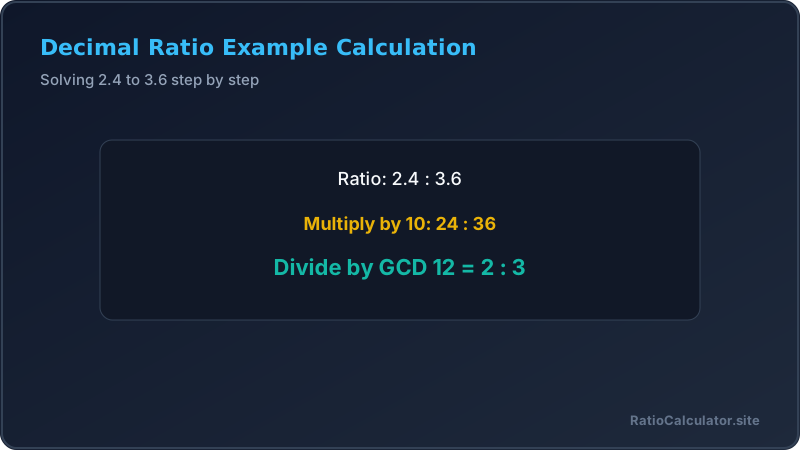
| 1 Decimal Place | Multiply by 10 | 2.4 : 3.6 | 24 : 36 | 2 : 3 |
| 2 Decimal Places | Multiply by 100 | 0.75 : 1.25 | 75 : 125 | 3 : 5 |
| Mixed (1 and 2 Places) | Multiply by 100 | 0.4 : 1.25 | 40 : 125 | 8 : 25 |
| 3 Decimal Places | Multiply by 1000 | 0.125 : 0.5 | 125 : 500 | 1 : 4 |
| Mixed (1 and 3 Places) | Multiply by 1000 | 0.008 : 0.04 | 8 : 40 | 1 : 5 |
Step by Step Method With Worked Examples
Let us walk through four distinct scenarios showing how to handle different decimal patterns.
Example 1: Both Terms Have One Decimal Place
Simplify the ratio 4.2 : 5.6.
- Count decimal digits: 4.2 has one decimal digit, and 5.6 has one decimal digit.
- Choose multiplier: 10.
- Multiply both terms by 10: (4.2 × 10) : (5.6 × 10) = 42 : 56.
- Find greatest common divisor: Factors of 42 include 1, 2, 3, 6, 7, 14, 21, 42. Factors of 56 include 1, 2, 4, 7, 8, 14, 28, 56. The greatest common divisor is 14.
- Divide by 14: (42 ÷ 14) : (56 ÷ 14) = 3 : 4.
- The simplified ratio is 3 : 4.
Example 2: Terms Have Different Counts of Decimal Places
Simplify the ratio 0.6 : 0.15.
- Count decimal digits: 0.6 has one decimal place, while 0.15 has two decimal places.
- The greatest count of decimal places is 2. Therefore, the multiplier must be 100.
- Multiply both terms by 100: (0.6 × 100) : (0.15 × 100) = 60 : 15. Notice that 0.6 × 100 becomes 60, not 6.
- Find greatest common divisor: 15 divides both 60 and 15 evenly.
- Divide by 15: (60 ÷ 15) : (15 ÷ 15) = 4 : 1.
- The simplified ratio is 4 : 1.
Example 3: Decimals Combined With Whole Numbers
Simplify the ratio 3 : 1.2.
- The first term is a whole number (no decimal places). The second term has one decimal place.
- The maximum decimal places is 1. Multiply both terms by 10.
- Multiply: (3 × 10) : (1.2 × 10) = 30 : 12.
- Divide both numbers by their greatest common divisor, 6: (30 ÷ 6) : (12 ÷ 6) = 5 : 2.
- The simplified ratio is 5 : 2.
Example 4: Three Term Decimal Ratio
Simplify the ratio 0.8 : 1.2 : 2.0.
- All three numbers have at most one decimal place. Multiply all three terms by 10.
- Scaling produces: 8 : 12 : 20.
- Find the greatest common divisor among 8, 12, and 20, which is 4.
- Divide all terms by 4: (8 ÷ 4) : (12 ÷ 4) : (20 ÷ 4) = 2 : 3 : 5.
- The simplified ratio is 2 : 3 : 5.
If these numbers represented proportions in an alloy or mixture, you could use our Ratio to Percentage Calculator to see that the parts correspond to 20%, 30%, and 50% of the total mass.
Real World Decimal Ratio Word Problem
A chemical laboratory technician evaluates two fluid samples. Sample Alpha has a density of 1.35 grams per milliliter, and Sample Beta has a density of 0.90 grams per milliliter. What is the simplified ratio of the density of Sample Alpha to Sample Beta?
- Write the initial ratio: 1.35 : 0.90.
- Both values contain two decimal places. Multiply both terms by 100.
- Scaled integers: 135 : 90.
- Find greatest common divisor: 45 divides both 135 (45 × 3) and 90 (45 × 2).
- Divide by 45: (135 ÷ 45) : (90 ÷ 45) = 3 : 2.
- The ratio of density is 3 : 2.
When dividing money or measured decimal totals into specified proportions, our Ratio Division Calculator provides automated step by step allocations.
Common Mistakes to Avoid
- Using different multipliers: Multiplying 0.4 by 10 and 1.25 by 100 produces 4 : 125, which destroys the true proportional balance. Both terms must be multiplied by 100.
- Dropping trailing zeros carelessly: Forgetting that 0.6 × 100 equals 60, not 6, is one of the most common student calculation errors.
- Forgetting final simplification: Converting 0.8 : 1.6 to 8 : 16 is good progress, but it must be simplified further to 1 : 2.
- Rounding decimals prematurely: Never round 0.333 to 0.3 when working with recurring values. If a decimal repeats infinitely, convert it to a fraction like 1/3 instead.
How to Verify Your Answer
Verify your simplified whole number ratio by calculating the decimal quotient of both forms.
For our density example:
- Original values: 1.35 ÷ 0.90 = 1.5.
- Simplified ratio: 3 ÷ 2 = 1.5.
Because both quotients yield 1.5, the simplification is mathematically exact.
Reference standard: Review decimals and proportional reasoning lessons on Khan Academy.
Conclusion
Solving ratio problems with decimals requires just two key actions: determine the largest count of decimal places across all terms, multiply all terms by that power of ten, and divide by the greatest common divisor. This method turns awkward decimals into clean whole number ratios. Practice your calculations or verify answers with our Ratio Calculator.
Frequently Asked Questions
How do you get rid of decimals in a ratio?
Multiply every term in the ratio by 10, 100, or 1000 according to the number with the most decimal places.
What do you do if one number has more decimal places than the other?
Use the multiplier required by the number with the most decimal places and multiply both terms by that number.
Can a simplified ratio contain decimals?
No, mathematical convention requires simplified ratios to consist solely of integers in lowest terms.
How do you solve 0.5 to 2 as a ratio?
Multiply both terms by 10 to get 5 : 20, then divide by 5 to obtain the simplified ratio 1 : 4.
What is the ratio 1.25 to 0.75 in simplest form?
Multiply both numbers by 100 to get 125 : 75, then divide both by 25 to get 5 : 3.
Can you use division instead of multiplication to clear decimals?
Multiplying by powers of ten is standard because it directly shifts the decimal point to create integers.
How do you verify that a decimal ratio was simplified correctly?
Divide the first number by the second in both original and simplified forms; both decimal answers must be identical.