How to Find the Original Amount From a Ratio: Step by Step
Learn how to find the original amount from a ratio step by step. Reverse ratio formulas, scale factor calculation, and clear worked math examples.
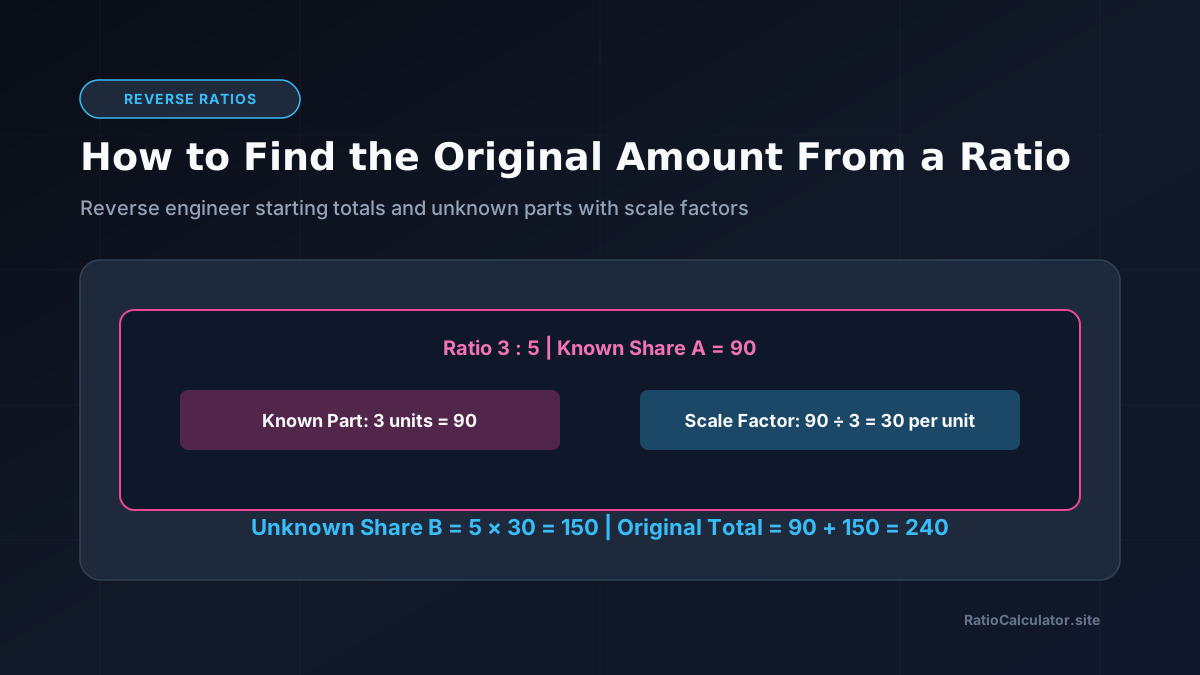
Most basic ratio problems ask you to start with a total amount and divide it into shares. However, advanced math tests, business audits, and real life problems often require the exact opposite: you are given a ratio and the size of one single share, and you must work backwards to find the original total amount.
This process is known as a reverse ratio calculation.
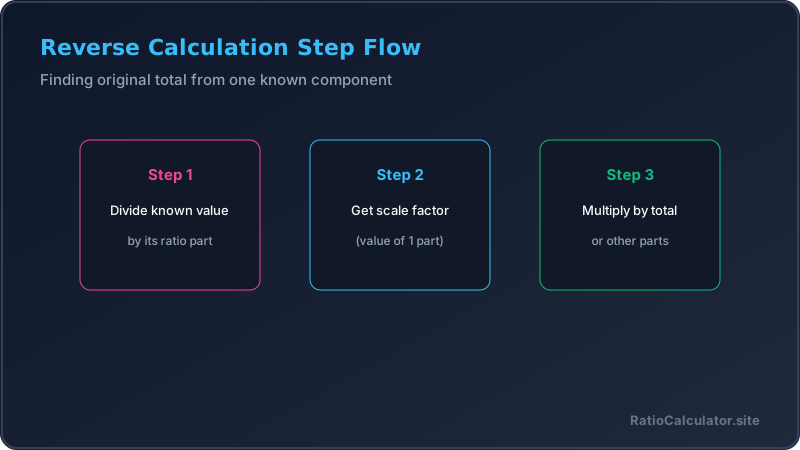
The key to finding the original amount from a ratio is finding the scale factor, also called the value of one ratio part. To find this unit value, divide the known share by its corresponding ratio number. Once you know the value of one part, multiply it by the sum of all ratio parts to find the original total amount.
For example, suppose an amount was divided in a 3 : 5 ratio, and the smaller share is known to be 90. The smaller share corresponds to 3 parts. Dividing 90 by 3 reveals that each part equals 30. The total number of parts is 3 + 5 = 8. Multiplying 8 by 30 gives 240 as the original total amount.
To solve reverse proportions, check equivalent ratios, or find unknown terms automatically, use the Ratio Calculator on RatioCalculator.site.
Interactive Reverse Ratio Calculator
Live ToolEnter a known share value and ratio numbers to work backwards and find the original total amount:
The Reverse Ratio Method Explained
Reverse ratio calculations work through scaling. Every ratio represents a simplified version of larger real quantities. The multiplier that connects the simplified ratio number to the actual real quantity is the scale factor.
Follow these three steps for any single share scenario:
- Calculate scale factor: Divide the known real quantity by its assigned ratio number. Scale Factor = Known Value ÷ Ratio Number.
- Sum the ratio parts: Total Parts = Part A + Part B (+ Part C …).
- Compute original total: Multiply total parts by the scale factor. Original Amount = Total Parts × Scale Factor.
| Given Ratio | Known Share Information | Scale Factor Calculation | Total Parts | Original Total Amount |
|---|---|---|---|---|
| 2 : 5 | Share A = 40 units | 40 ÷ 2 = 20 | 2 + 5 = 7 | 7 × 20 = 140 units |
| 3 : 7 | Share B = 84 units | 84 ÷ 7 = 12 | 3 + 7 = 10 | 10 × 12 = 120 units |
| 4 : 9 | Share A = 64 units | 64 ÷ 4 = 16 | 4 + 9 = 13 | 13 × 16 = 208 units |
| 1 : 3 : 5 | Share B = 45 units | 45 ÷ 3 = 15 | 1 + 3 + 5 = 9 | 9 × 15 = 135 units |
Worked Examples for Different Scenarios
Let us examine three distinct scenarios that require reverse ratio calculations.
Example 1: Finding Total When Smaller Share Is Known
In a manufacturing plant, metal rods and plastic connectors are packaged in the ratio 3 : 8. A storage bin contains 45 metal rods. How many total items are in the bin?
- Identify the given data: Ratio of rods to connectors = 3 : 8. Known rods = 45.
- Rods correspond to 3 parts.
- Compute scale factor: 45 ÷ 3 = 15 items per part.
- Total parts in package: 3 + 8 = 11 parts.
- Compute original total: 11 parts × 15 = 165 total items.
- Check connectors: 8 × 15 = 120 connectors. Rods + connectors = 45 + 120 = 165 items.
Example 2: Finding Total When Larger Share Is Known
Two partners divide company quarterly profits in the ratio 5 : 7 based on capital contributions. Partner Beta receives the larger share of $840. What was the total company profit before division?
- Identify given data: Ratio = 5 : 7. Partner Beta corresponds to 7 parts and received $840.
- Compute scale factor: $840 ÷ 7 = $120 per part.
- Calculate Partner Alpha’s share (5 parts): 5 × $120 = $600.
- Sum the parts: 5 + 7 = 12 total parts.
- Calculate original total profit: 12 × $120 = $1,440.
- Verification check: $600 + $840 = $1,440.
For dividing overall company equity or allocating team earnings, our Profit Sharing Calculator and Ratio Division Calculator provide instant solutions.
Example 3: Finding Total When the Difference Between Shares Is Known
Sometimes a problem does not state the size of any individual share directly. Instead, it provides the difference between two shares.
A lottery prize is shared between two friends in the ratio 4 : 9. Friend Beta receives $250 more than Friend Alpha. What was the total value of the lottery prize?
- Identify given terms: Ratio is 4 : 9, Beta exceeds Alpha by $250.
- Calculate difference in parts: 9 minus 4 = 5 parts difference.
- Calculate single unit part: $250 ÷ 5 parts = $50 per part.
- Calculate total parts: 4 + 9 = 13 parts total.
- Multiply total parts by unit value: 13 parts × $50 = $650 original combined sum.
- Alternatively find individual amounts: Alpha has 4 × $50 = $200, Beta has 9 × $50 = $450. Combined sum is $200 + $450 = $650.
- Verification check: Friend Alpha = 4 × $50 = $200. Friend Beta = 9 × $50 = $450. Difference = $450 minus $200 = $250. Sum = $200 + $450 = $650.
Three Part Reverse Ratio Calculations
When three terms are involved, the process remains identical.
Example 4: Construction Aggregate Batch
A batch of concrete was mixed using cement, sand, and gravel in the ratio 1 : 2 : 4. If the mason used 350 kilograms of gravel, what was the original total weight of the combined dry batch?
- Given ratio: 1 cement : 2 sand : 4 gravel.
- Known component: Gravel = 350 kg, corresponding to 4 parts.
- Compute scale factor: 350 kg ÷ 4 = 87.5 kg per part.
- Total parts: 1 + 2 + 4 = 7 parts.
- Original total batch: 7 × 87.5 kg = 612.5 kilograms.
- Individual ingredients: Cement = 1 × 87.5 = 87.5 kg; Sand = 2 × 87.5 = 175 kg; Gravel = 4 × 87.5 = 350 kg. Sum: 87.5 + 175 + 350 = 612.5 kg.
Common Mistakes to Avoid
- Multiplying the known value by the ratio term: If Share A is 40 in a 2 : 5 ratio, multiplying 40 × 2 = 80 is wrong. You must divide 40 ÷ 2 to find the scale factor (20).
- Matching the known share to the wrong ratio term: Always confirm whether the given amount belongs to the first term, the second term, or the difference between them.
- Forgetting to multiply by total parts: Finding the scale factor is only the halfway mark; you must multiply it by the sum of parts to find the original total.
- Confusing difference with total: When a problem says “one person received 50 more”, that is a difference of parts, not the total sum.
How to Verify Your Answer
To confirm your reverse ratio solution:
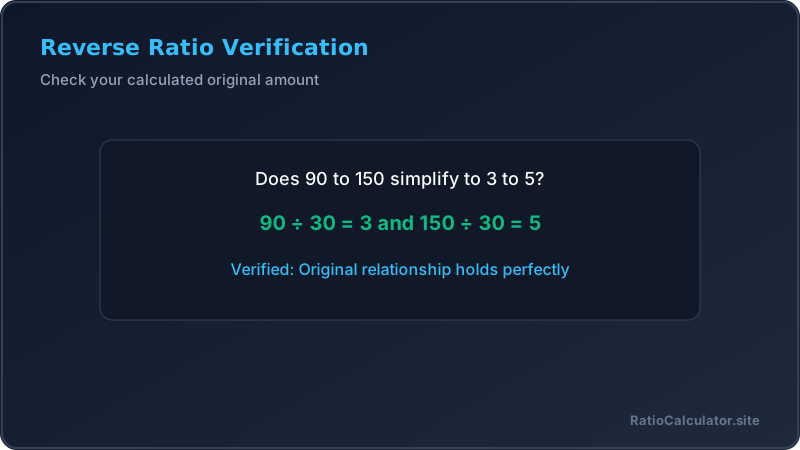
- Forward calculation test: Take your calculated original total amount and divide it using the initial ratio.
- Check the share: Verify that the resulting share matches the exact number provided in the initial problem prompt.
Reference standard: Review solving proportions and inverse operations on Math is Fun Proportions.
Conclusion
Finding the original amount from a ratio requires reversing standard ratio division. By dividing the known share by its ratio number, you unlock the scale factor that powers the entire proportion. Multiplying that scale factor by the total number of parts instantly restores the original starting amount. Verify your calculations or explore missing proportion values using the Ratio Calculator.
Frequently Asked Questions
What is the formula to find the original amount from a ratio?
Original Amount = (Known Share Value ÷ Known Ratio Term) × Sum of All Ratio Parts.
What is a scale factor in reverse ratio problems?
The scale factor is the numerical value of one single ratio part, found by dividing a known share by its ratio term.
How do you find the total when the difference between two shares is given?
Divide the known difference in value by the difference between their ratio parts, then multiply by the total sum of parts.
Can reverse ratios be used for three part problems?
Yes, divide any known component by its assigned ratio number to find the scale factor, then multiply by the sum of all three parts.
What is the difference between forward and reverse ratio problems?
Forward problems divide a known total into shares, while reverse problems deduce the starting total from one known share.
Why do you divide the known share by its ratio number?
Dividing by the ratio number extracts the value of one fundamental unit part.
How do you check your answer in reverse ratio calculations?
Take your calculated original total and perform forward ratio division to ensure it reproduces the exact known share.