How to Find a Ratio When One Part Is Known
Learn how to find missing values in a ratio when one part is known. Step by step unitary calculations, clear examples, and methods to avoid mistakes.
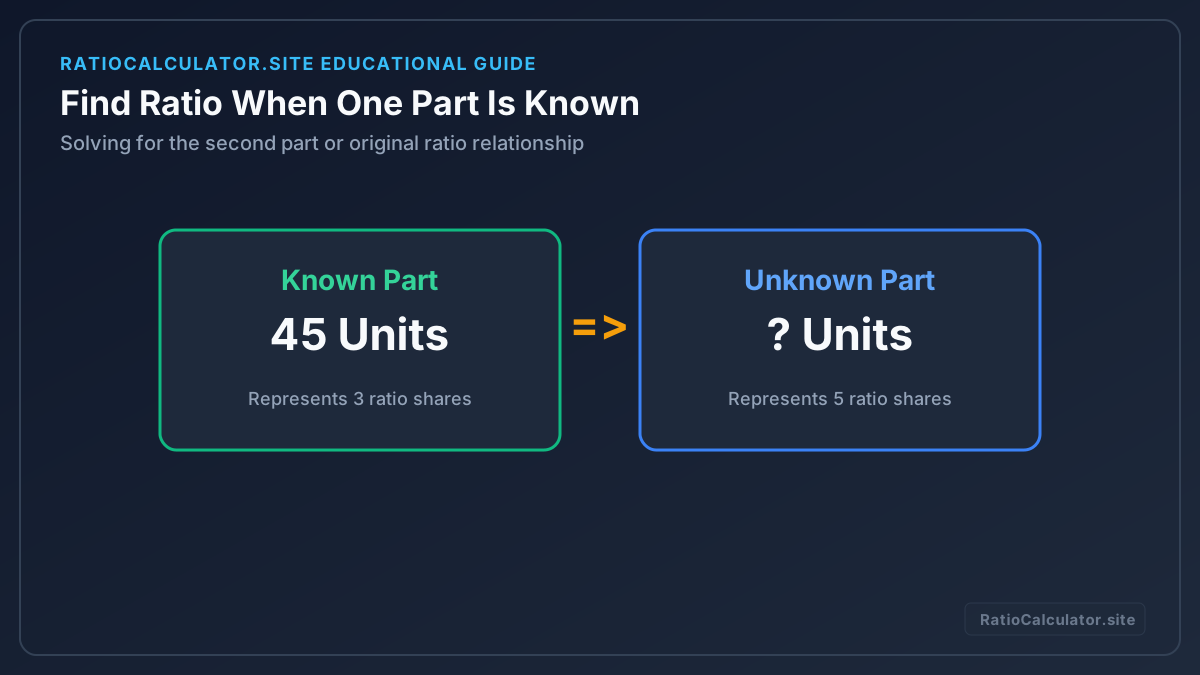
A frequent challenge in algebra and practical proportion work occurs when you know the ratio between two quantities and the actual numerical value of one part, but must determine the missing counterpart. For example, if you know the ratio of boys to girls in a school is 4 : 5 and there are 120 boys, how do you find the number of girls?
Solving these problems relies on finding the value of a single ratio unit. Once you know what one unit represents, calculating the remaining unknown quantity is straightforward.
For rapid problem verification, test the free Ratio Calculator on RatioCalculator.site.
Understanding Known Part Problems
In any ratio problem where one part is known, you are provided with three pieces of information:
- The ratio term corresponding to the known part.
- The actual measured amount of the known part.
- The ratio term corresponding to the unknown part.
The fundamental mathematical principle is that the scale multiplier between the ratio term and the actual amount must remain identical across all terms in the proportion.
The Two Step Unitary Solution Method
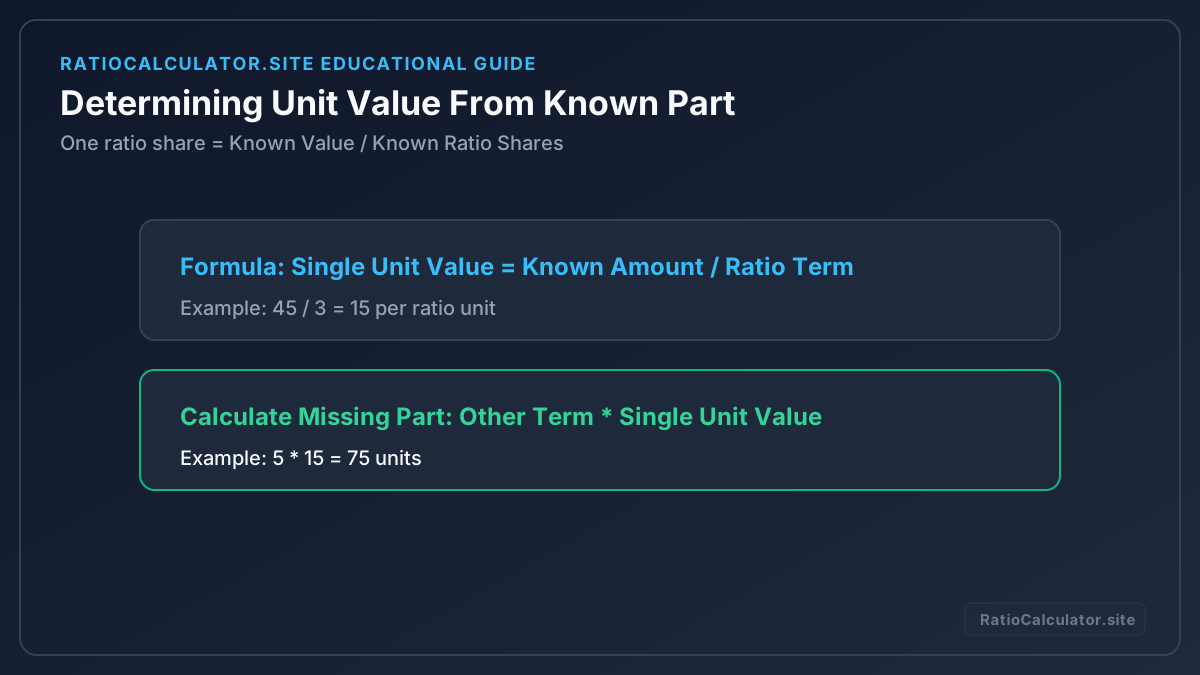
Step 1: Find the Value of One Ratio Unit
Divide the actual known amount by its corresponding ratio term: Value of One Unit = Actual Known Amount / Known Ratio Term
Step 2: Multiply by the Unknown Ratio Term
Multiply the value of one unit by the ratio term representing the unknown quantity: Unknown Amount = Value of One Unit * Unknown Ratio Term
Step by Step Worked Examples
Example 1: Classroom Gender Proportions
The ratio of boys to girls in a sports academy is 4 : 5. If there are 120 boys enrolled, how many girls are enrolled?
- Identify terms:
- Ratio of Boys : Girls = 4 : 5
- Known part (Boys) = 120
- Known ratio term = 4
- Unknown ratio term (Girls) = 5
- Find value of one ratio unit:
- Unit Value = 120 / 4 = 30 students per unit
- Calculate the number of girls:
- Girls = 30 * 5 = 150 girls
- Verification: 120 / 150 reduces to 4 / 5 by dividing both by 30.
Example 2: Paint Mixing by Volume
A painter mixes blue paint and yellow paint in the ratio 3 : 7 to create a custom green shade. If she has exactly 21 liters of yellow paint, how much blue paint must she add?
- Identify terms:
- Blue : Yellow = 3 : 7
- Known amount (Yellow) = 21 liters
- Yellow ratio term = 7
- Blue ratio term = 3
- Find value of one unit:
- Unit Value = 21 / 7 = 3 liters per unit
- Calculate blue paint needed:
- Blue = 3 * 3 = 9 liters
- Verification: 9 liters to 21 liters simplifies to 3 : 7.
Example 3: Three Part Ratio with One Part Known
In a garden, red, white, and yellow roses are planted in the ratio 2 : 5 : 8. There are 40 white roses. How many red and yellow roses are there?
- White roses ratio term is 5, representing 40 roses.
- Unit value = 40 / 5 = 8 roses per unit.
- Red roses (2 units) = 2 * 8 = 16 roses.
- Yellow roses (8 units) = 8 * 8 = 64 roses.
- Verification: 16 : 40 : 64 simplifies to 2 : 5 : 8 by dividing each by 8.
The Most Critical Pitfall: Part vs Whole Confusion
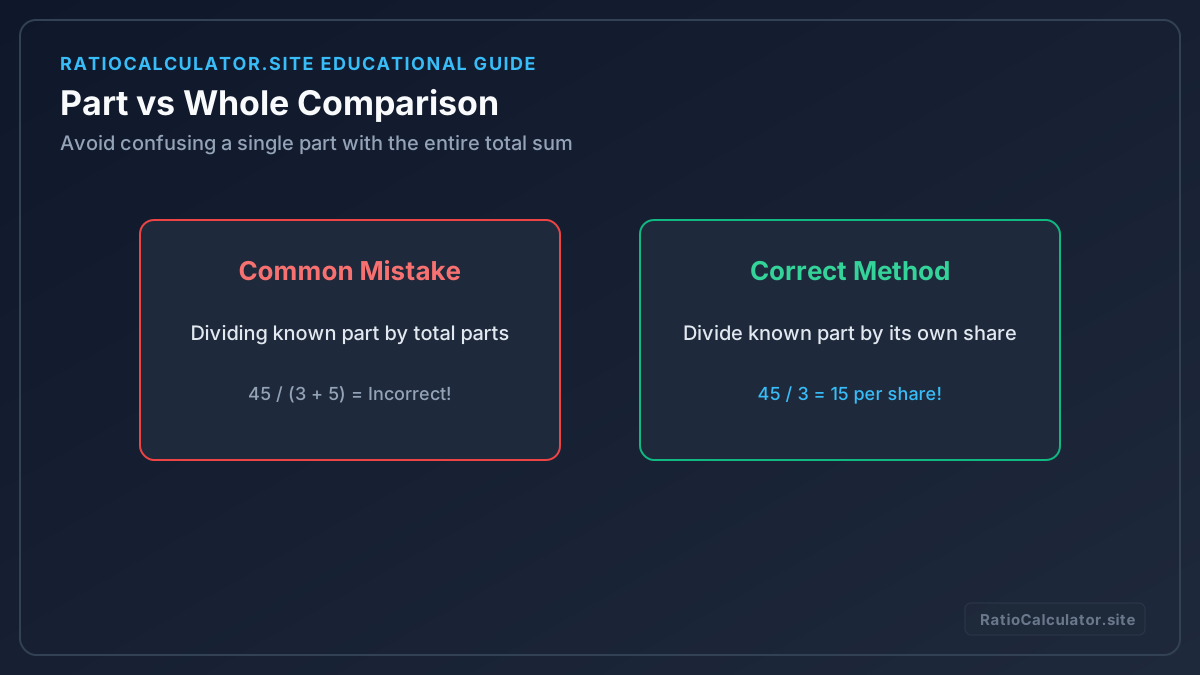
The most frequent mistake in these problems is dividing the known amount by the sum of the ratio parts. For instance, in Example 1, dividing 120 by (4 + 5 = 9) produces an incorrect decimal. You only divide by the total parts when the known number is the entire combined total. When the known number is a single part, you must divide exclusively by that specific part’s ratio term.
Contextual Internal Resources & Authority References
Continue expanding your proportion solving skills with these recommended tools and authoritative mathematics resources:
- Interactive Calculators: Calculate missing shares directly with our Ratio Division Calculator and compute dimensional scaling factors with the Scale Factor Calculator.
- Related In-Depth Guides: Understand the reverse process in How to Find the Total From a Given Ratio and One Part, and review How to Find the Missing Number in a Ratio.
- Core Tool: Solve any missing proportion variable dynamically using our online Ratio Calculator.
- Academic References: For detailed tutorials on single variable proportional equations, consult LibreTexts Prealgebra Resources and the Khan Academy Ratios and Rates Module.
Frequently Asked Questions
What is the first step to find an unknown part in a ratio?
Divide the known part by its corresponding ratio number to find the value of one ratio unit.
When should you divide by the sum of the ratio terms?
Only divide by the sum of the ratio terms when the given number represents the entire combined total.
Can this method work for ratios with three or more parts?
Yes, finding the single unit value from one known part allows you to calculate all other parts immediately.
What should you do if the unit value is a recurring decimal?
Keep the unit value as a simplified fraction to maintain exact mathematical accuracy before multiplying.
How do you check if your calculated missing part is correct?
Form a ratio with the known part and calculated part, then simplify to see if it matches the original ratio.
Can the unknown part be smaller than the known part?
Yes, if the unknown part’s ratio number is smaller than the known part’s ratio number, the result will be smaller.
Why is this called the unitary method?
Because the technique resolves the problem by calculating the value of a single unit first.