How to Compare Ratios (4 Easy Methods With Examples)
Learn how to compare ratios using fractions, decimals, cross multiplication, and equivalent ratios. Clear examples, step by step calculations, and practical tips for beginners.
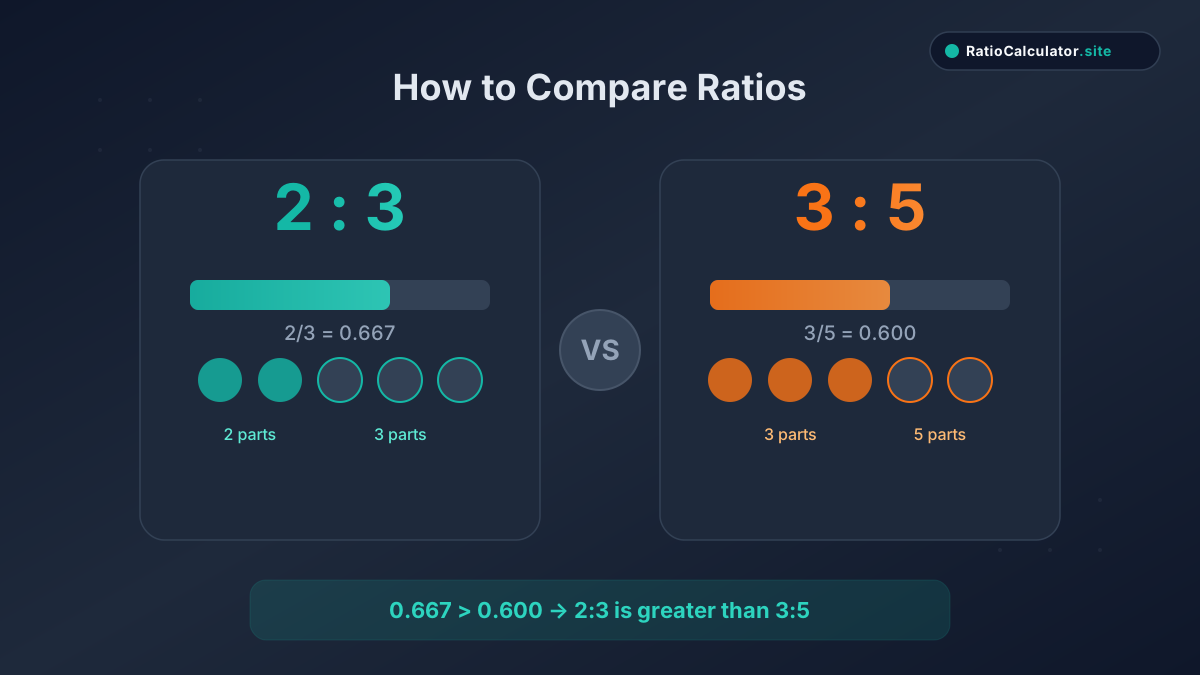
Comparing ratios means figuring out which ratio represents a larger or smaller relationship, or whether two ratios are equal. When you see ratios like 2:3 and 3:5, you need a reliable method to determine which one is greater.
The quickest way to compare two ratios is to convert each ratio into a decimal. Divide the first number by the second number in each ratio, then compare the results. The ratio with the larger decimal value is the greater ratio.
For example, 2:3 becomes 2 ÷ 3 = 0.667, and 3:5 becomes 3 ÷ 5 = 0.600. Since 0.667 is larger, 2:3 is the greater ratio.
If you want to verify your comparison instantly, the Ratio Calculator on RatioCalculator.site can simplify ratios, find equivalent values, and help you compare ratios with accuracy.
What Does It Mean to Compare Ratios?
Quick Answer (Featured Snippet): To compare two ratios, convert each ratio to a decimal by dividing the first term by the second term (A ÷ B and C ÷ D), then compare the decimals. The ratio with the higher decimal value is the larger proportion. For example, 2:3 (0.667) is greater than 3:5 (0.600).
Comparing ratios means determining which ratio expresses a larger proportion, a smaller proportion, or the same proportion as another ratio.
Consider the ratios 2:3 and 3:5. At first glance, 3:5 might seem larger because both of its numbers are bigger. But that reasoning is misleading. The size of a ratio depends on the relationship between its two numbers, not on the numbers themselves.
To understand why, think of it this way. The ratio 2:3 says that for every 2 of one thing, there are 3 of another. That means the first quantity makes up about 66.7% of the second. The ratio 3:5 says that for every 3 of one thing, there are 5 of another, which is 60% of the second. So 2:3 actually represents a larger proportional relationship than 3:5.
This is exactly why you need a structured method to compare ratios. Simply eyeballing the numbers does not work.
How to Compare Ratios
There are several reliable methods to compare ratios. Each method works in every situation, but some are faster depending on the numbers involved.
| Method | How It Works | Best Used When |
|---|---|---|
| Equivalent ratios | Make the second numbers the same, then compare the first numbers | Ratios have small, easy to multiply second numbers |
| Fractions | Convert each ratio to a fraction and find a common denominator | You are comfortable working with fractions |
| Cross multiplication | Multiply across and compare the two products | You want a quick numerical comparison |
| Decimals | Divide the first number by the second number in each ratio | You want the fastest calculation |
All four methods will give you the same answer. Choose the one that feels most natural for the problem you are solving.
Method 1: Compare Ratios Using Equivalent Ratios
This method works by making the second value in both ratios the same number. Once the second values match, you can directly compare the first values.
Example: Compare 2:3 and 4:5
- Find a common multiple of the second values (3 and 5). The least common multiple is 15.
- Scale the first ratio: multiply both parts of 2:3 by 5 to get 10:15.
- Scale the second ratio: multiply both parts of 4:5 by 3 to get 12:15.
- Now compare the first values: 10 and 12.
- Since 12 > 10, the ratio 4:5 is greater than 2:3.
Another example: Compare 3:4 and 5:8
- The least common multiple of 4 and 8 is 8.
- Scale 3:4 by multiplying both parts by 2: 6:8.
- The ratio 5:8 already has 8 as the second value.
- Compare the first values: 6 and 5.
- Since 6 > 5, the ratio 3:4 is greater than 5:8.
This method is especially useful when the second values share a convenient common multiple.
Method 2: Compare Ratios as Fractions
Any ratio can be written as a fraction. The ratio a:b becomes the fraction a/b. Once both ratios are written as fractions, you can compare them using the same techniques you would use for any two fractions.
Example: Compare 2:5 and 3:7
- Write each ratio as a fraction: 2/5 and 3/7.
- Find a common denominator. The least common multiple of 5 and 7 is 35.
- Convert: 2/5 = 14/35 and 3/7 = 15/35.
- Compare the numerators: 14 and 15.
- Since 15 > 14, the ratio 3:7 is greater than 2:5.
Example: Compare 5:6 and 7:9
- Write as fractions: 5/6 and 7/9.
- The least common multiple of 6 and 9 is 18.
- Convert: 5/6 = 15/18 and 7/9 = 14/18.
- Compare numerators: 15 and 14.
- Since 15 > 14, the ratio 5:6 is greater than 7:9.
This method connects ratio comparison directly to fraction comparison, which many students already know how to do.
Method 3: Compare Ratios Using Cross Multiplication
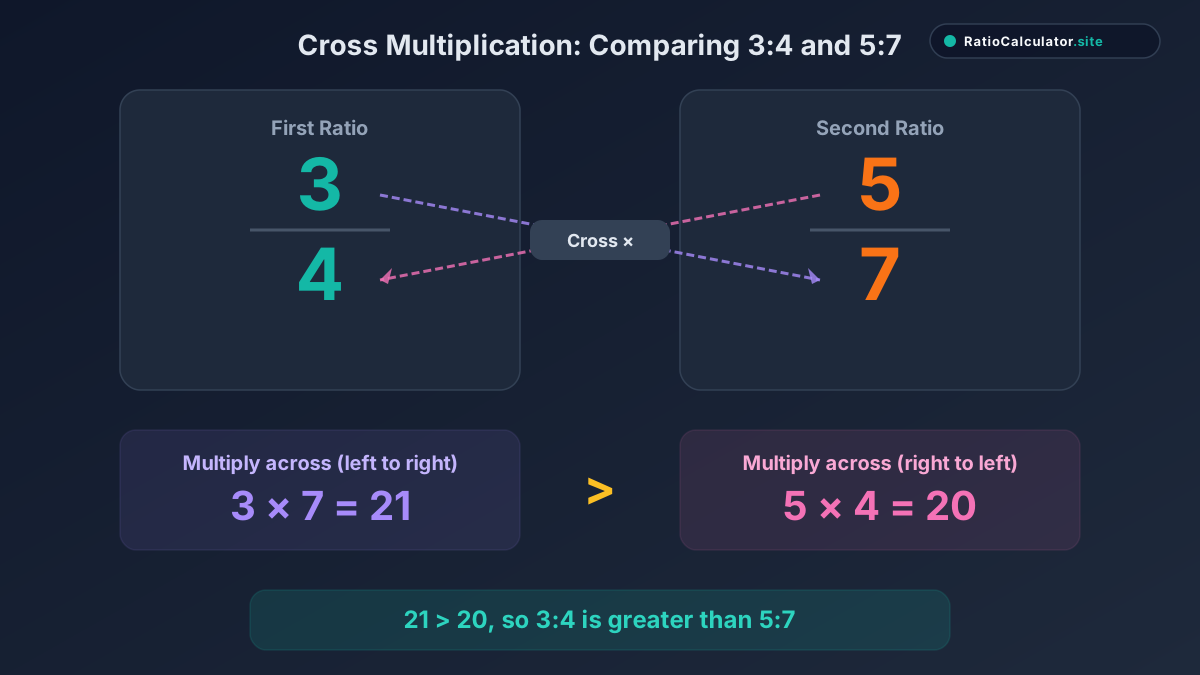
Cross multiplication is one of the fastest ways to compare two ratios. You multiply across the two ratios diagonally and then compare the two products.
How it works: To compare the ratios a:b and c:d, calculate a × d and c × b.
If a × d > c × b, then a:b is the greater ratio. If a × d < c × b, then c:d is the greater ratio. If a × d = c × b, the ratios are equal.
Example: Compare 3:4 and 5:7
- Multiply 3 × 7 = 21 (first ratio’s first number times second ratio’s second number).
- Multiply 5 × 4 = 20 (second ratio’s first number times first ratio’s second number).
- Compare: 21 > 20.
- Therefore, 3:4 is greater than 5:7.
Example: Compare 2:9 and 1:4
- Multiply 2 × 4 = 8.
- Multiply 1 × 9 = 9.
- Compare: 8 < 9.
- Therefore, 1:4 is greater than 2:9.
Cross multiplication is quick because it avoids finding common denominators entirely. It works with any pair of ratios.
Method 4: Compare Ratios Using Decimals
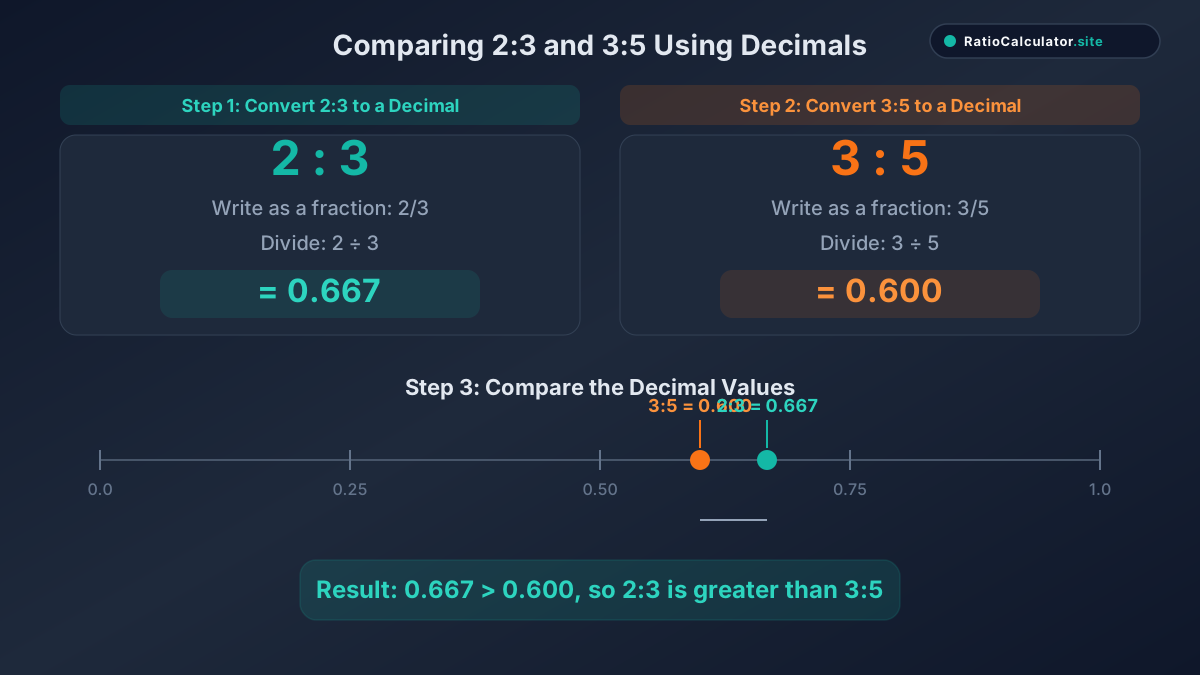
The decimal method is the most straightforward approach. Divide the first number by the second number in each ratio. The ratio with the larger decimal result is the greater ratio.
Example: Compare 2:3 and 3:5
- Divide: 2 ÷ 3 = 0.667 (rounded to three decimal places).
- Divide: 3 ÷ 5 = 0.600.
- Compare: 0.667 > 0.600.
- Therefore, 2:3 is greater than 3:5.
Example: Compare 7:10 and 5:8
- Divide: 7 ÷ 10 = 0.700.
- Divide: 5 ÷ 8 = 0.625.
- Compare: 0.700 > 0.625.
- Therefore, 7:10 is greater than 5:8.
This method works especially well with a calculator, and it gives you a clear numerical value for each ratio that makes comparison immediate.
How to Compare Ratios With Different Denominators
When two ratios have different second values (sometimes called different denominators), direct comparison is not possible. You cannot simply compare 4:7 and 5:9 by looking at the numbers because the “bases” are different.
The solution is to convert both ratios to a common form. You can use any of the four methods described above. Here is an example using the equivalent ratio method.
Example: Compare 4:7 and 5:9
- Find the least common multiple of 7 and 9, which is 63.
- Scale 4:7: multiply both parts by 9 to get 36:63.
- Scale 5:9: multiply both parts by 7 to get 35:63.
- Compare the first values: 36 > 35.
- Therefore, 4:7 is greater than 5:9.
You could also use the decimal method: 4 ÷ 7 = 0.571 and 5 ÷ 9 = 0.556. The same answer: 4:7 is greater.
The key takeaway is that ratios with different second values must be converted to a common basis before you can compare them directly.
How to Compare Three or More Ratios
When you need to compare three or more ratios, the decimal method is usually the most efficient approach. Convert each ratio to a decimal and then rank them.
Example: Compare 3:4, 5:7, and 2:3
-
Convert each ratio:
- 3:4 = 3 ÷ 4 = 0.750
- 5:7 = 5 ÷ 7 = 0.714
- 2:3 = 2 ÷ 3 = 0.667
-
Rank from greatest to smallest: 0.750 > 0.714 > 0.667
-
The order is: 3:4 > 5:7 > 2:3
Example: Compare 1:3, 2:5, 3:8, and 4:9
-
Convert each ratio:
- 1:3 = 0.333
- 2:5 = 0.400
- 3:8 = 0.375
- 4:9 = 0.444
-
Rank from greatest to smallest: 0.444 > 0.400 > 0.375 > 0.333
-
The order is: 4:9 > 2:5 > 3:8 > 1:3
You can also use the equivalent ratio method for three or more ratios by finding the least common multiple of all the second values, but this becomes cumbersome with larger sets. The decimal method scales much better.
How to Tell If Two Ratios Are Equal
Two ratios are equal (also called equivalent) when they represent the same proportional relationship. This means one ratio is simply a scaled version of the other.
Example: Are 2:3, 4:6, and 6:9 equivalent?
Check by simplifying each ratio to its lowest terms:
- 2:3 is already in simplest form.
- 4:6: divide both by 2 to get 2:3.
- 6:9: divide both by 3 to get 2:3.
All three ratios simplify to 2:3, so they are all equivalent.
You can also verify using cross multiplication. To check if 2:3 and 4:6 are equal:
- Multiply 2 × 6 = 12.
- Multiply 4 × 3 = 12.
- The products are equal, so the ratios are equivalent.
Here are more examples of equivalent ratios:
| Ratio | Equivalent Ratio | Simplest Form |
|---|---|---|
| 5:10 | 1:2 | 1:2 |
| 8:12 | 2:3 | 2:3 |
| 15:25 | 3:5 | 3:5 |
| 9:27 | 1:3 | 1:3 |
To learn more about this topic, read the guide on how to find equivalent ratios.
How to Compare Ratios in Real Life
Ratio comparison appears in everyday situations more often than you might expect. Here are practical examples.
Recipes
A cake recipe calls for a flour to sugar ratio of 3:1. A cookie recipe uses 5:2. Which recipe uses more sugar relative to flour?
- Cake: 1 ÷ 3 = 0.333 (sugar per unit of flour)
- Cookies: 2 ÷ 5 = 0.400
The cookie recipe uses a higher proportion of sugar.
Classrooms
School A has a student to teacher ratio of 20:1. School B has 15:1. Which school has more teachers per student?
- School A: 1 ÷ 20 = 0.050
- School B: 1 ÷ 15 = 0.067
School B has more teachers relative to students.
Sports
Player A scored 9 goals in 12 games (ratio 9:12). Player B scored 7 goals in 9 games (ratio 7:9). Who has the better scoring ratio?
- Player A: 9 ÷ 12 = 0.750
- Player B: 7 ÷ 9 = 0.778
Player B has a slightly better scoring ratio.
Shopping
Store A sells 500 grams for $4 (ratio 500:4). Store B sells 750 grams for $5.50 (ratio 750:5.5). Which store offers more product per dollar?
- Store A: 500 ÷ 4 = 125 grams per dollar
- Store B: 750 ÷ 5.50 = 136.4 grams per dollar
Store B offers a better deal.
Maps and Scale
A map uses a scale of 1:50000, meaning 1 cm on the map equals 50,000 cm in real life. Another map uses 1:25000. The 1:25000 map shows more detail because each centimeter represents a smaller real distance.
Currency Exchange
If 1 USD buys 0.92 EUR and 1 USD buys 110 JPY, you can compare purchasing power by converting prices into the same currency using these ratios.
How to Use a Ratio Calculator to Compare Ratios
The Ratio Calculator on RatioCalculator.site can help you work with ratios quickly and accurately. Here is how to use it for ratio comparison.
- Open the Ratio Calculator at RatioCalculator.site.
- Enter the values of your first ratio.
- Use the calculator to simplify the ratio to its lowest terms.
- Repeat with the second ratio.
- Compare the simplified results.
The calculator can also solve for missing values in proportions and evaluate whether two ratios are equivalent. This is especially helpful when working with larger numbers where manual calculation takes more time.
Common Mistakes When Comparing Ratios
Avoid these frequent errors when comparing ratios.
Comparing only the first numbers
Mistake: Looking at 5:8 and 3:4 and concluding that 5:8 is greater because 5 > 3.
Correction: You must consider both numbers together. Using decimals: 5 ÷ 8 = 0.625 and 3 ÷ 4 = 0.750. The ratio 3:4 is actually greater.
Comparing only the second numbers
Mistake: Assuming 2:7 is smaller than 2:5 because 7 > 5.
Correction: Actually, 2 ÷ 7 = 0.286 and 2 ÷ 5 = 0.400. When the first numbers are the same, a larger second number means a smaller ratio value. So 2:7 is indeed smaller, but the reasoning should involve the full relationship.
Adding the numbers together
Mistake: Comparing 3:4 (sum = 7) and 2:5 (sum = 7) and concluding they are equal because both sums are 7.
Correction: The sum of a ratio’s parts has nothing to do with its proportional value. 3 ÷ 4 = 0.750 and 2 ÷ 5 = 0.400. These ratios are not equal at all.
Cross multiplying in the wrong order
Mistake: Mixing up which product belongs to which ratio.
Correction: When comparing a:b and c:d, always calculate a × d for the first ratio and c × b for the second ratio. If a × d is larger, then a:b is the greater ratio.
Forgetting to simplify
Mistake: Comparing 6:10 and 3:5 and treating them as different ratios.
Correction: Always simplify first. 6:10 simplifies to 3:5, so these ratios are actually equal.
Ignoring the complete relationship
Mistake: Comparing the first number of one ratio to the second number of another and drawing a conclusion.
Correction: Each ratio must be evaluated as a complete relationship between its own two values before any comparison can be made.
Frequently Asked Questions
How do you compare two ratios?
Convert both ratios to decimals by dividing the first number by the second, then compare the decimal values to see which is larger.
What is the easiest way to compare ratios?
The decimal method is the easiest: divide the first number by the second in each ratio and compare the results directly.
Can you compare ratios using cross multiplication?
Yes, multiply the first number of one ratio by the second number of the other ratio, then compare the two products to determine which ratio is greater.
How do you compare ratios with different denominators?
Convert both ratios to equivalent ratios with the same second value, or use the decimal method to bypass the need for matching values entirely.
How do you know which ratio is greater?
The ratio that produces the larger value when the first number is divided by the second number is the greater ratio.
How do you know if two ratios are equivalent?
Two ratios are equivalent if they simplify to the same ratio in lowest terms, or if cross multiplication produces equal products.
Can ratios be compared as fractions?
Yes, write each ratio as a fraction (for example, 3:4 becomes 3/4), find a common denominator, and compare the numerators.
How do you compare three ratios?
Convert all three ratios to decimals, then rank the decimal values from largest to smallest to determine the order.