How to Solve Ratio Problems With Percentages
Learn how to convert ratios to percentages and solve combined ratio percentage word problems. Clear formulas, two and three quantity examples, and steps.
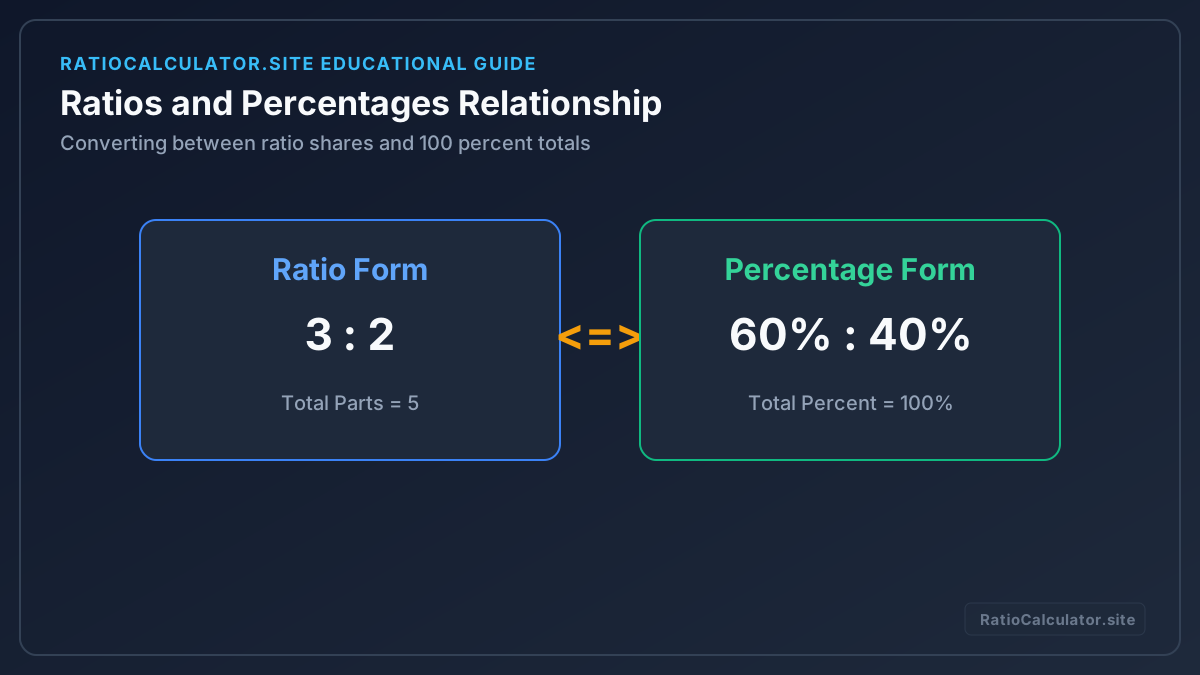
Ratios and percentages are two mathematical ways of expressing proportional relationships. While a ratio compares parts to each other or parts to a whole, a percentage normalizes that comparison to a standardized base of 100. Many real world mathematical problems require converting between ratios and percentages to compare demographic data, investment portfolios, or chemical concentrations.
Mastering the connection between ratios and percentages allows you to switch between relative parts and percentage metrics seamlessly.
To verify conversions or calculate proportional shares instantly, visit the free Ratio Calculator on RatioCalculator.site.
How Ratios and Percentages Are Related
Every ratio expresses relative parts. To convert a ratio into percentages, you must first determine the total number of parts, which represents 100 percent of the whole.
If a group consists of cats and dogs in the ratio 3 : 2:
- Total parts = 3 + 2 = 5 parts
- The cat portion is 3 out of 5 parts = 3 / 5 = 0.60 = 60 percent
- The dog portion is 2 out of 5 parts = 2 / 5 = 0.40 = 40 percent
- Total = 60 percent + 40 percent = 100 percent
Conversely, if an investment portfolio is 70 percent stocks and 30 percent bonds:
- The initial ratio is 70 : 30
- Dividing both numbers by their greatest common divisor (10) gives the simplified ratio 7 : 3
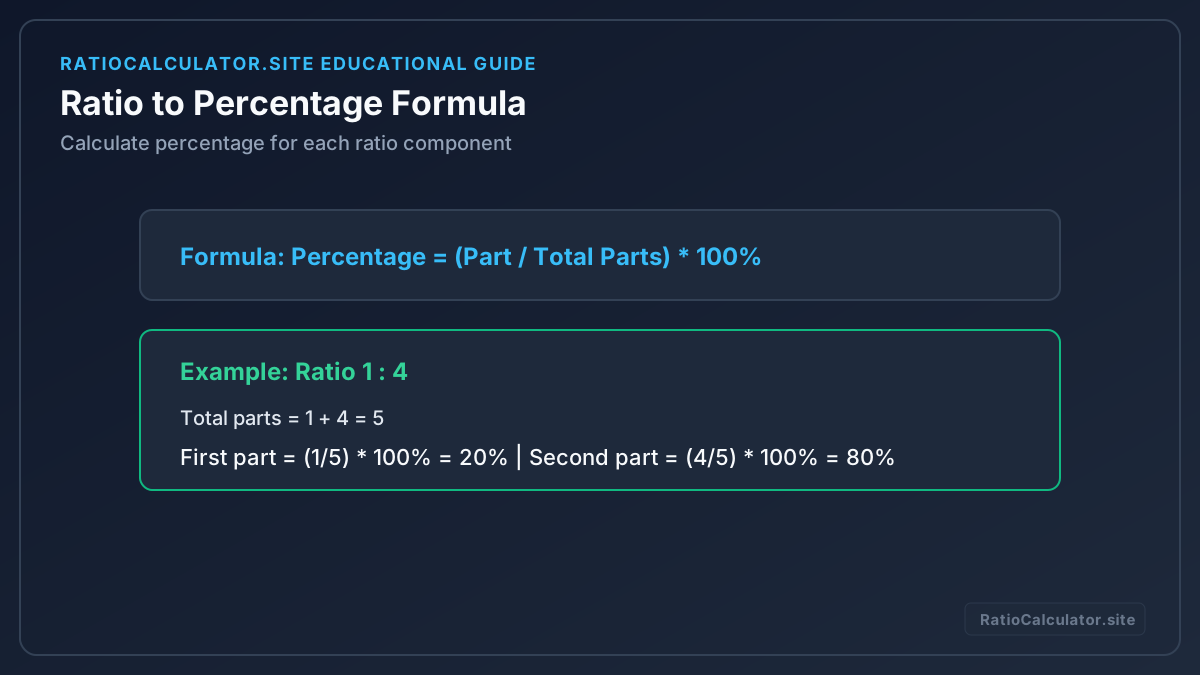
Formula to Convert Any Ratio Term into a Percentage
For a ratio with terms A and B:
- Compute the sum of all parts: Total Parts = A + B
- Percentage of A = (A / Total Parts) * 100 percent
- Percentage of B = (B / Total Parts) * 100 percent
For a three part ratio A : B : C:
- Total Parts = A + B + C
- Percentage of A = (A / Total Parts) * 100 percent
- Percentage of B = (B / Total Parts) * 100 percent
- Percentage of C = (C / Total Parts) * 100 percent
Step by Step Problem Examples
Example 1: Three Component Survey Breakdown
A customer satisfaction survey indicates that responses for Satisfied, Neutral, and Dissatisfied occur in the ratio 5 : 3 : 2. What percentage of respondents gave each rating?
- Sum the ratio parts: 5 + 3 + 2 = 10 parts
- Convert Satisfied: (5 / 10) * 100 percent = 50 percent
- Convert Neutral: (3 / 10) * 100 percent = 30 percent
- Convert Dissatisfied: (2 / 10) * 100 percent = 20 percent
- Verification: 50 percent + 30 percent + 20 percent = 100 percent
Example 2: Finding Quantities from Percentages and Ratios
In an organization of 500 employees, the ratio of technical staff to administrative staff is 7 : 3. During an annual review, 40 percent of the technical staff receive a promotion. How many technical staff members were promoted?
- Find the total ratio parts: 7 + 3 = 10 parts
- Value of one ratio part: 500 employees / 10 = 50 employees
- Total technical staff: 7 * 50 = 350 employees
- Calculate 40 percent of technical staff: 0.40 * 350 = 140 employees
- Result: 140 technical staff members received promotions.
Example 3: Converting Unequal Percentages to Simplest Ratio
An alloy consists of 65 percent copper, 25 percent zinc, and 10 percent nickel. Express the composition as a ratio in simplest terms.
- Write the percentages side by side: 65 : 25 : 10
- Identify the greatest common divisor of 65, 25, and 10, which is 5.
- Divide each number by 5:
- 65 / 5 = 13
- 25 / 5 = 5
- 10 / 5 = 2
- The alloy composition ratio is 13 : 5 : 2.
Common Mistakes to Avoid
- Confusing Part to Part with Part to Whole: In a 1 : 4 ratio, the first part is not 25 percent. The total parts are 1 + 4 = 5, making the first part 1 / 5 = 20 percent.
- Forgetting That Percentages Must Total 100: If the sum of your converted percentages does not equal 100 percent, check for arithmetic or rounding discrepancies.
Contextual Internal Resources & Authority References
Enhance your numerical fluency and verify percent-ratio conversions with these essential guides and tools:
- Interactive Calculators: Instantly convert any ratio to percentages using the Ratio to Percentage Calculator, or split monetary totals using the Ratio Division Calculator.
- Related In-Depth Guides: Follow our foundational tutorial on How to Convert a Ratio to a Percentage, practice How to Solve Ratio Word Problems, and learn How to Solve Age Problems Using Ratios.
- Core Tool: Access multi-part proportions and scaling on the primary Ratio Calculator.
- Academic References: Check Khan Academy Ratios and Percentages Curriculum and the Wolfram MathWorld Percentage Definition.
Frequently Asked Questions
How do you convert a two term ratio into percentages?
Divide each term by the sum of both terms and multiply the resulting fraction by 100 percent.
Why do you need to add ratio parts before calculating percentages?
Adding the parts establishes the total denominator representing 100 percent of the whole.
Can a ratio percentage problem involve more than two quantities?
Yes, three or more quantities follow the identical rule of dividing each term by the sum of all parts.
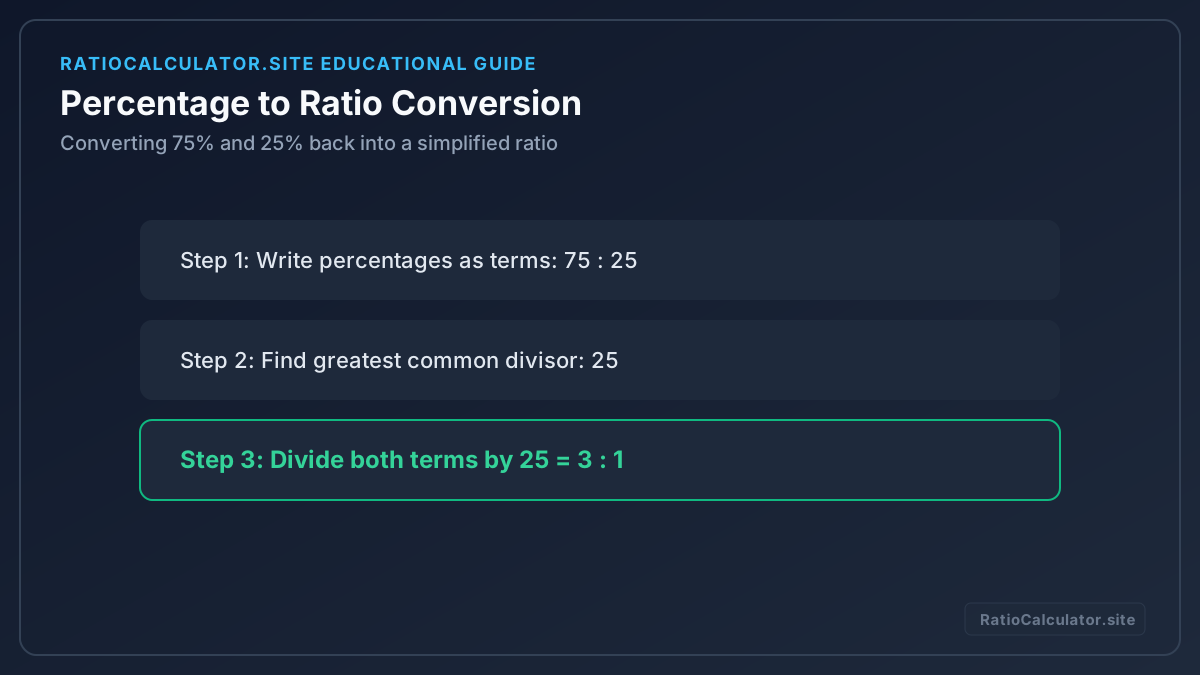
How do you turn percentages back into a ratio?
Write the percentages side by side without percent signs and divide by their greatest common divisor.
What is the most common error when turning ratios into percentages?
Dividing by the other part rather than by the sum of all parts is the most frequent mistake.
Does converting a ratio to percentages change the underlying proportion?
No, ratios and percentages represent the exact same mathematical relationship in different formats.
What is the ratio equivalent of 50 percent and 50 percent?
The ratio is 50 : 50, which simplifies to 1 : 1.