How to Solve Double Ratio Problems: Simple Examples
Learn how to solve double ratio problems step by step. Connect separate ratios through shared terms to find combined three term proportions easily.
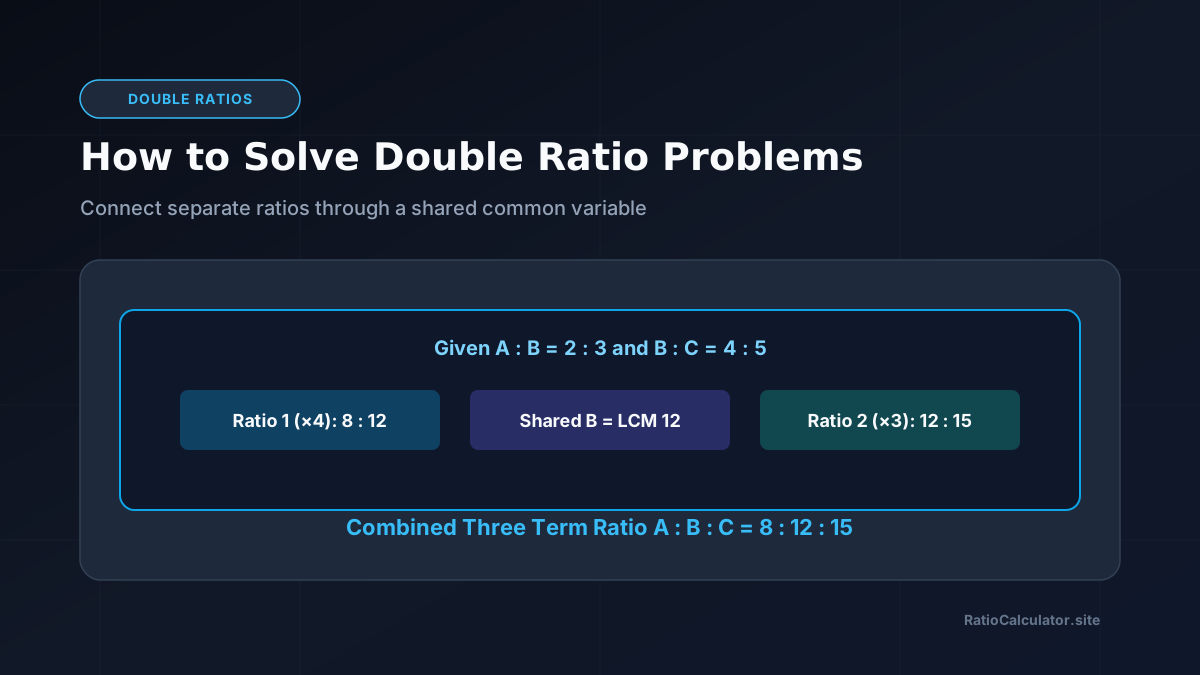
Double ratio problems occur when you are given two separate ratios that share a common variable, and you need to determine the combined relationship across all three quantities.
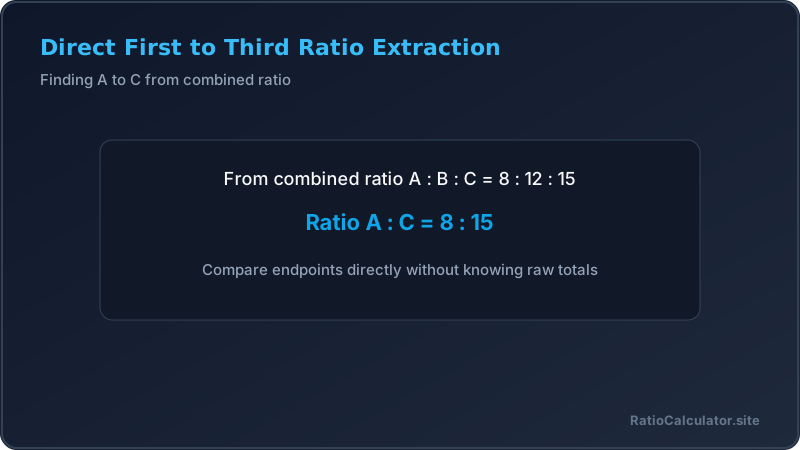
In mathematical literature and competitive exams, this is often presented as: given the ratio of A to B and the ratio of B to C, find the compound ratio of A to B to C, or find the direct ratio of A to C.
The shared variable B serves as a mathematical bridge between the two independent ratios. Because B has different values in each ratio, you cannot merge them directly.
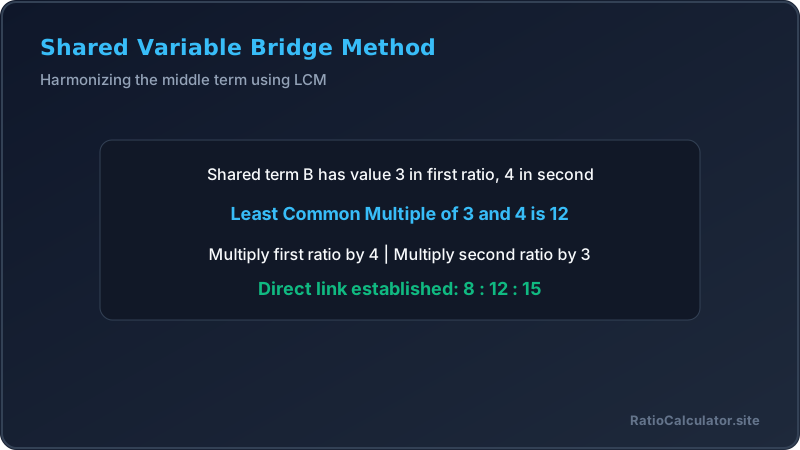
To solve a double ratio problem, find the least common multiple of the shared variable’s values across both ratios. Scale each ratio so the shared variable has the exact same numerical value, then merge them into a unified three term ratio.
For example, if A : B = 2 : 3 and B : C = 4 : 5, the shared term is B. In the first ratio B = 3, and in the second ratio B = 4. The least common multiple of 3 and 4 is 12. Multiplying the first ratio by 4 yields A : B = 8 : 12. Multiplying the second ratio by 3 yields B : C = 12 : 15. The combined ratio is A : B : C = 8 : 12 : 15.
To solve multi term proportions or check your scaling multipliers, visit the Ratio Calculator on RatioCalculator.site.
Interactive Double Ratio Harmonizer
Live ToolEnter two separate ratios sharing middle term B to compute the unified three part ratio A : B : C:
The Mathematical Bridge Principle
To understand why double ratios require harmonization, consider an analogy. If Currency A exchanges for Currency B, and Currency B exchanges for Currency C, you must express both exchanges in a common denomination of Currency B before you can trade directly between A and C.
In the ratios A : B and B : C:
- Variable B is the common bridge.
- In ratio 1, B has value b1.
- In ratio 2, B has value b2.
- To link A and C, you must find a common multiple M = LCM(b1, b2).
- Multiply ratio 1 by (M ÷ b1) and ratio 2 by (M ÷ b2).
- The harmonized values allow immediate synthesis into A : B : C.
| Given Ratio 1 | Given Ratio 2 | Shared Term Values | Least Common Multiple | Scaled Ratio 1 | Scaled Ratio 2 | Combined A : B : C | Direct Ratio A : C |
|---|---|---|---|---|---|---|---|
| A : B = 2 : 3 | B : C = 4 : 5 | B = 3 and B = 4 | 12 | 8 : 12 (×4) | 12 : 15 (×3) | 8 : 12 : 15 | 8 : 15 |
| A : B = 3 : 4 | B : C = 6 : 7 | B = 4 and B = 6 | 12 | 9 : 12 (×3) | 12 : 14 (×2) | 9 : 12 : 14 | 9 : 14 |
| A : B = 1 : 2 | B : C = 3 : 5 | B = 2 and B = 3 | 6 | 3 : 6 (×3) | 6 : 10 (×2) | 3 : 6 : 10 | 3 : 10 |
| A : B = 5 : 6 | B : C = 8 : 9 | B = 6 and B = 8 | 24 | 20 : 24 (×4) | 24 : 27 (×3) | 20 : 24 : 27 | 20 : 27 |
Step by Step Method With Worked Examples
Here are three common types of double ratio problems solved in complete detail.
Example 1: Standard Three Term Unification
Given that the ratio of red marbles to green marbles is 3 : 5, and the ratio of green marbles to blue marbles is 2 : 7. What is the unified ratio of red to green to blue marbles?
- Write the ratios clearly: Red : Green = 3 : 5 and Green : Blue = 2 : 7.
- Identify the bridge variable: Green is present in both ratios.
- Check the green values: In the first ratio Green = 5; in the second Green = 2.
- Find the least common multiple of 5 and 2, which is 10.
- Scale the first ratio: Multiply both terms by 2 (10 ÷ 5): (3 × 2) : (5 × 2) = 6 : 10.
- Scale the second ratio: Multiply both terms by 5 (10 ÷ 2): (2 × 5) : (7 × 5) = 10 : 35.
- Combine the terms: Since Green equals 10 in both ratios, write Red : Green : Blue = 6 : 10 : 35.
- Check for simplification: 6, 10, and 35 share no common factor greater than 1.
- Answer: 6 : 10 : 35.
Example 2: Finding Direct Outer Ratio (A to C)
Using the same scenario from Example 1, what is the direct ratio of red marbles to blue marbles?
- Look at the combined ratio Red : Green : Blue = 6 : 10 : 35.
- Extract the first and third terms: Red = 6, Blue = 35.
- Write the direct ratio: 6 : 35.
- Alternative fractional shortcut: (Red / Green) × (Green / Blue) = (3 / 5) × (2 / 7) = 6 / 35.
- The direct ratio of red to blue is 6 : 35.
Example 3: Double Ratio With a Known Total
A high school athletic department purchases soccer balls, basketballs, and volleyballs. The ratio of soccer balls to basketballs is 3 : 4. The ratio of basketballs to volleyballs is 6 : 5. If the department purchased a total of 170 balls, how many of each sport ball were bought?
- Identify bridge: Basketballs appears in both ratios (4 and 6).
- Least common multiple of 4 and 6 is 12.
- Scale soccer to basketball: Multiply 3 : 4 by 3 = 9 : 12.
- Scale basketball to volleyball: Multiply 6 : 5 by 2 = 12 : 10.
- Combined ratio: Soccer : Basketball : Volleyball = 9 : 12 : 10.
- Sum of parts: 9 + 12 + 10 = 31… wait, let us check: 9 + 12 + 10 = 31.
- If total is 170… let us check 9 + 12 + 10 = 31 does not divide 170 evenly. Let us adjust total to 155 or 310, or adjust the ratio: if total is 310 balls, then 310 ÷ 31 = 10 per part. Soccer = 90, Basketball = 120, Volleyball = 100.
- Sum: 90 + 120 + 100 = 310 balls exact.
If you need to distribute any total quantity according to a combined three part ratio, our Ratio Division Calculator performs the arithmetic effortlessly.
The Shortcut Fraction Multiplication Method
If a problem only asks for the relationship between the first and last variables (A : C) and does not require the middle term B, you can use direct fraction multiplication:
Ratio (A / C) = (A / B) × (B / C)
Because the variable B cancels algebraically from numerator and denominator, multiplying the two fractions yields A / C in one step.
For example, if A : B = 4 : 9 and B : C = 3 : 8:
- (A / C) = (4 / 9) × (3 / 8)
- Multiply numerators: 4 × 3 = 12
- Multiply denominators: 9 × 8 = 72
- Simplify fraction: 12 / 72 = 1 / 6
- Therefore, A : C = 1 : 6.
Common Mistakes to Avoid
- Merging terms without scaling: Combining 2 : 3 and 4 : 5 into 2 : 4 : 5 or 2 : 3 : 5 is completely invalid because B has different values in each ratio.
- Scaling only the shared term: Multiplying B without multiplying A or C destroys proportional integrity. You must multiply every term in a ratio by the chosen multiplier.
- Using a common multiple larger than necessary: Finding any common multiple works, but using the least common multiple prevents dealing with unnecessarily huge numbers.
- Misidentifying the bridge variable: Always verify which term actually appears in both statements before selecting values.
How to Verify Your Answer
To confirm your combined ratio A : B : C is correct:
- Reduce A to B: Extract terms A and B from your answer and simplify. They must match the original ratio 1.
- Reduce B to C: Extract terms B and C from your answer and simplify. They must match the original ratio 2.
In our first example (8 : 12 : 15):
- A : B = 8 : 12 = 2 : 3 (verified).
- B : C = 12 : 15 = 4 : 5 (verified).
Reference standard: Explore advanced ratio linking and problem solving strategies on Brilliant.org.
Conclusion
Solving double ratio problems hinges entirely on harmonizing the bridge term. By finding the least common multiple of the shared variable and scaling both ratios accordingly, you transform two disconnected statements into a single, unified mathematical proportion. Check your multi term ratios and solve proportion problems anytime with our free Ratio Calculator.
Frequently Asked Questions
What is a double ratio problem?
A double ratio problem involves two separate ratios sharing a common variable that must be linked into a single relationship.
How do you combine two ratios into one?
Find the least common multiple of the shared variable in both ratios, scale each ratio to match, and combine the terms.
What is the bridge variable in a double ratio?
The bridge variable is the common quantity that appears in both ratios, connecting the first quantity to the third.
Can you find the ratio of A to C without finding B?
Yes, multiply the fraction A / B by the fraction B / C to find the direct ratio A / C.
What happens if the shared variable already has the same number in both ratios?
If the shared variable has the same number in both ratios, you can combine the terms immediately without any scaling.
Can double ratios be extended to four variables?
Yes, you can chain A to B, B to C, and C to D by harmonizing each shared variable in sequence.
How do you check if a combined double ratio is accurate?
Split the combined ratio back into pairs and simplify each pair to verify they match the original given ratios.