How to Share Money in a Given Ratio: Examples and Methods
Learn how to share money in a given ratio using the unit part method. Clear mathematical examples for two people, three people, and business bonuses.

Dividing a sum of money fairly between individuals or business partners rarely means splitting it into equal halves. More often, money must be allocated according to hours worked, capital invested, or sales achieved. In mathematics and practical finance, this is known as sharing money in a given ratio.
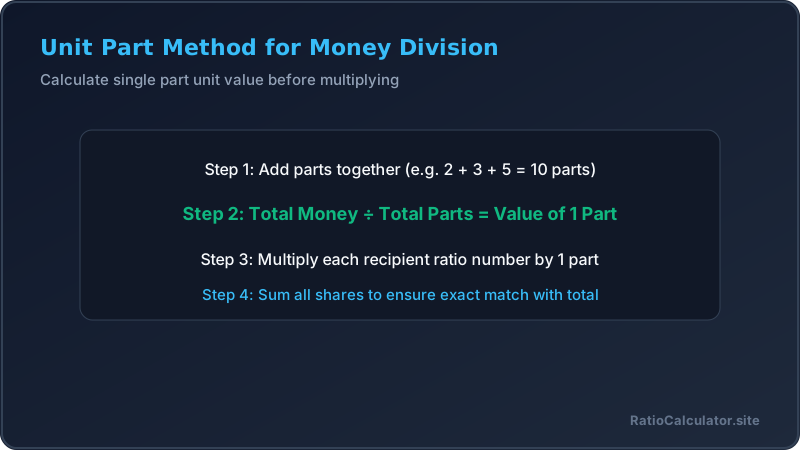
The standard method to share money in a given ratio is the unit part method. First, add all the ratio numbers together to determine the total count of parts. Second, divide the total sum of money by this number of parts to calculate the cash value of one single part. Third, multiply each person’s ratio number by this unit value to determine their individual share.
For example, if two partners share $700 in a 4 : 3 ratio, the total number of parts is 4 + 3 = 7. Dividing $700 by 7 gives $100 per part. The first partner receives 4 × $100 = $400, and the second partner receives 3 × $100 = $300.
To calculate complex profit splits or divide sums among many participants, try our free Ratio Division Calculator or explore the Profit Sharing Calculator.
The Unit Part Method Explained
The unit part method is the foundation of proportional division. It relies on the concept that a ratio expresses how many equal slices each party receives from a shared pie.
Here is the three step mathematical sequence:
- Sum of parts: Add all terms of the ratio together. Total Parts = Part A + Part B (+ Part C …).
- Value of one part: Divide the total cash pool by the sum of parts. Unit Value = Total Cash ÷ Total Parts.
- Distribution: Multiply each recipient’s ratio term by the unit value. Individual Share = Ratio Term × Unit Value.
| Total Money Pool | Sharing Ratio | Total Parts | Value of One Part | Final Allocated Shares |
|---|---|---|---|---|
| $500 | 2 : 3 | 2 + 3 = 5 | $500 ÷ 5 = $100 | Share A = $200 | Share B = $300 |
| $800 | 3 : 5 | 3 + 5 = 8 | $800 ÷ 8 = $100 | Share A = $300 | Share B = $500 |
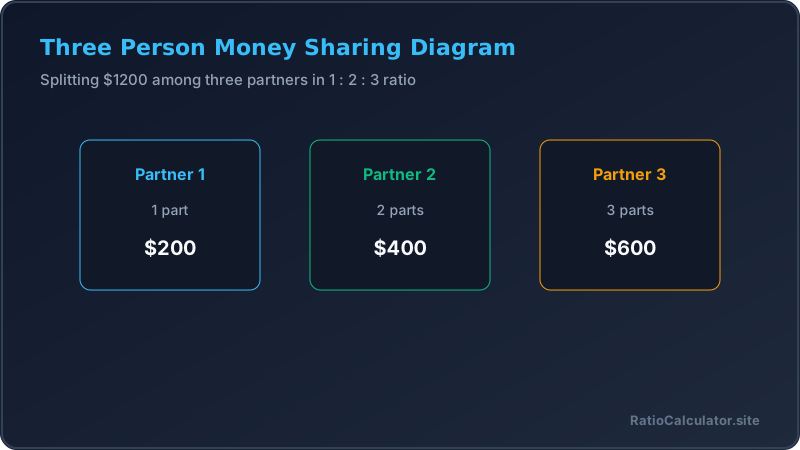
| $1,200 | 1 : 2 : 3 | 1 + 2 + 3 = 6 | $1,200 ÷ 6 = $200 | P1 = $200 | P2 = $400 | P3 = $600 |
| $2,500 | 2 : 3 : 5 | 2 + 3 + 5 = 10 | $2,500 ÷ 10 = $250 | P1 = $500 | P2 = $750 | P3 = $1,250 |
Two Person Sharing Examples
Let us examine two typical scenarios involving two individuals.
Example 1: Unequal Investment Dividend
Maya and Liam invest in an online storefront. Based on their initial seed funding, they agree to split their first dividend of $900 in the ratio 5 : 4. How much money does each person receive?
- Add the ratio parts: 5 + 4 = 9 total parts.
- Find the value of one part: $900 ÷ 9 = $100 per part.
- Calculate Maya’s share (5 parts): 5 × $100 = $500.
- Calculate Liam’s share (4 parts): 4 × $100 = $400.
- Check total: $500 + $400 = $900.
Example 2: Unequal Task Completion
Two freelance writers collaborate on an instructional eBook and earn a bonus of $350. Elena wrote 3 chapters, and Marcus wrote 4 chapters. They divide the money in the ratio 3 : 4.
- Add the ratio parts: 3 + 4 = 7 parts.
- Find the unit value: $350 ÷ 7 = $50 per part.
- Elena’s payment: 3 × $50 = $150.
- Marcus’s payment: 4 × $50 = $200.
- Check total: $150 + $200 = $350.
Three Person Sharing Examples
When three or more people share money, the unit part method works exactly the same way. Simply sum all three parts together before dividing.
Example 3: Performance Bonus for Three Employees
A software firm allocates a quarterly team bonus of $3,600 among three developers based on tickets resolved, in the ratio 1 : 2 : 3.
- Sum all ratio parts: 1 + 2 + 3 = 6 total parts.
- Calculate the value of one part: $3,600 ÷ 6 = $600 per part.
- Developer Alpha receives 1 part: 1 × $600 = $600.
- Developer Beta receives 2 parts: 2 × $600 = $1,200.
- Developer Gamma receives 3 parts: 3 × $600 = $1,800.
- Verify the total: $600 + $1,200 + $1,800 = $3,600.
To see each developer’s portion as a percentage of the total bonus (16.7%, 33.3%, 50.0%), consult our Ratio to Percentage Calculator.
Handling Decimals and Cents in Money Division
In real financial applications, total sums of money do not always divide evenly into whole dollars. When cents or recurring decimals occur, round individual shares to two decimal places, ensuring that rounding does not create a surplus or deficit in the total sum.
Consider dividing $100 in a 1 : 2 ratio:
- Total parts = 1 + 2 = 3 parts.
- Value of one part: $100 ÷ 3 = $33.3333… per part.
- First share: 1 × $33.33 = $33.33.
- Second share: 2 × $33.3333… = $66.67 (rounded to the nearest cent).
- Check sum: $33.33 + $66.67 = $100.00 exact.
Common Mistakes to Avoid
- Dividing by the count of people instead of total parts: Dividing $900 by 2 people ($450 each) ignores the 5 : 4 ratio completely. You must divide by the sum of parts (9).
- Mismatched names and ratio order: Assigning the first number to the second person reverses the intended distribution.
- Incomplete checks: Failing to sum the final payouts to confirm they equal the original total pool.
- Rounding individual shares in isolation: Rounding down all shares can leave unallocated cents; always reconcile the final cent to ensure an exact balance.
How to Verify Your Answer
Always perform two quick checks after sharing money:
- Sum test: Add all individual dollar shares together. Their sum must equal the exact initial cash pool.
- Ratio reduction test: Form a ratio with the calculated amounts and simplify by dividing by the unit value. For example, $500 : $400 divided by $100 yields 5 : 4, which matches the original agreement.
Reference standard: Read educational guides on sharing amounts in ratios from BBC Bitesize.
Conclusion
Sharing money in a given ratio is an essential real world skill that ensures fairness and transparency in financial transactions. By finding the value of one single ratio part, you can distribute any sum among two, three, or more parties with complete accuracy. For automated calculations, utilize our Ratio Division Calculator or explore the universal Ratio Calculator for general proportion problems.
Frequently Asked Questions
What is the easiest way to share money in a ratio?
Add the ratio parts together, divide the total money by that sum to find the value of one part, and multiply each ratio number by that unit value.
Can you share money in a three part ratio?
Yes, add all three ratio numbers together to determine total parts, then multiply each term by the unit value.
How do you check if money was divided in the correct ratio?
Add all the distributed shares together; the total must equal the original starting sum of money.
What should you do if the money does not divide into whole dollars?
Round each share to two decimal places for cents and adjust the final cent if necessary so the sum equals the exact total.
How do you find the percentage share of each person?
Divide each person’s ratio number by the total sum of parts and multiply by 100.
Why do we divide the total money by the sum of parts?
Dividing by the sum of parts reveals the monetary value of one single proportional unit.
Can a ratio part be zero?
No, practical ratio sharing requires positive numbers so every recipient receives a defined proportion.