How to Find the Third Proportional: Easy Step by Step Guide
Learn how to find the third proportional of two numbers. Complete guide with continuous proportion definitions, formula c = b squared divided by a, and clear examples.
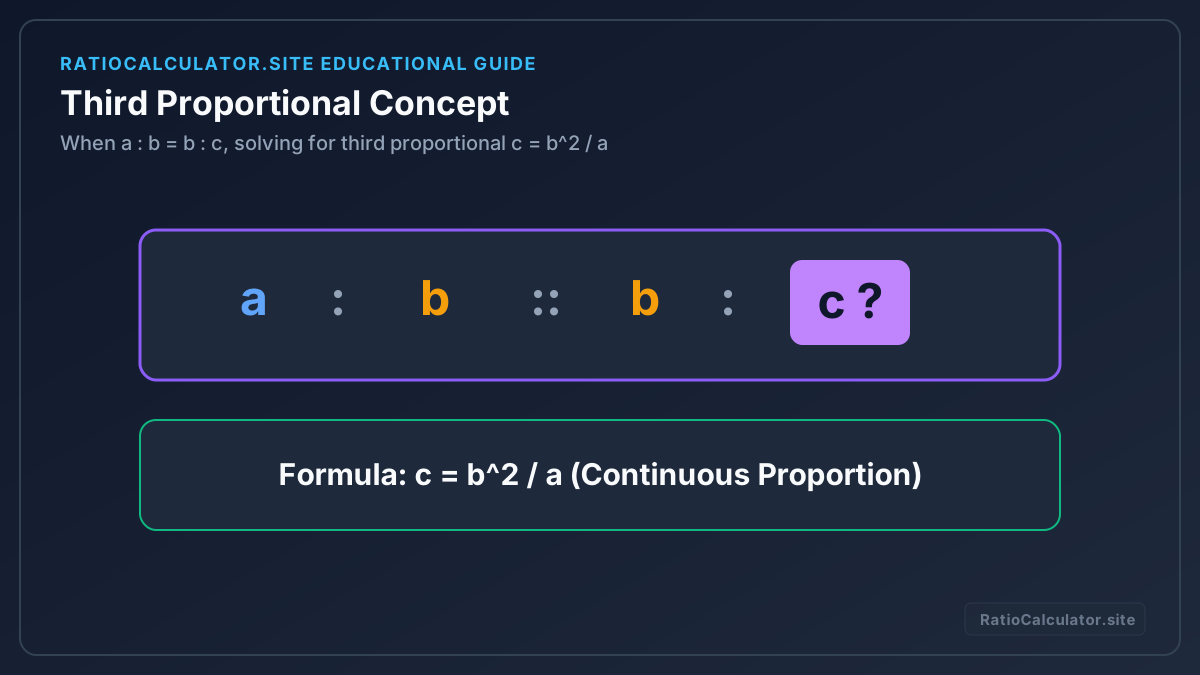
In arithmetic and classical proportion theory, continuous proportions describe relationships where the second term of one ratio serves as the first term of the next ratio. When two numbers are provided in continuous proportion, the missing third value is known as the third proportional.
Finding the third proportional is a standard problem in algebra exams, geometry scaling, and financial compounding models. Once you learn how continuous proportion structures work, finding the third proportional requires only one straightforward formula.
To verify your proportional calculations instantly, utilize the free Ratio Calculator on RatioCalculator.site.
Definition of the Third Proportional
Three quantities a, b, and c are said to be in continuous proportion if the ratio between the first two quantities equals the ratio between the second and third quantities:
a : b = b : c
Expressed as equal fractions:
a / b = b / c
In this arrangement:
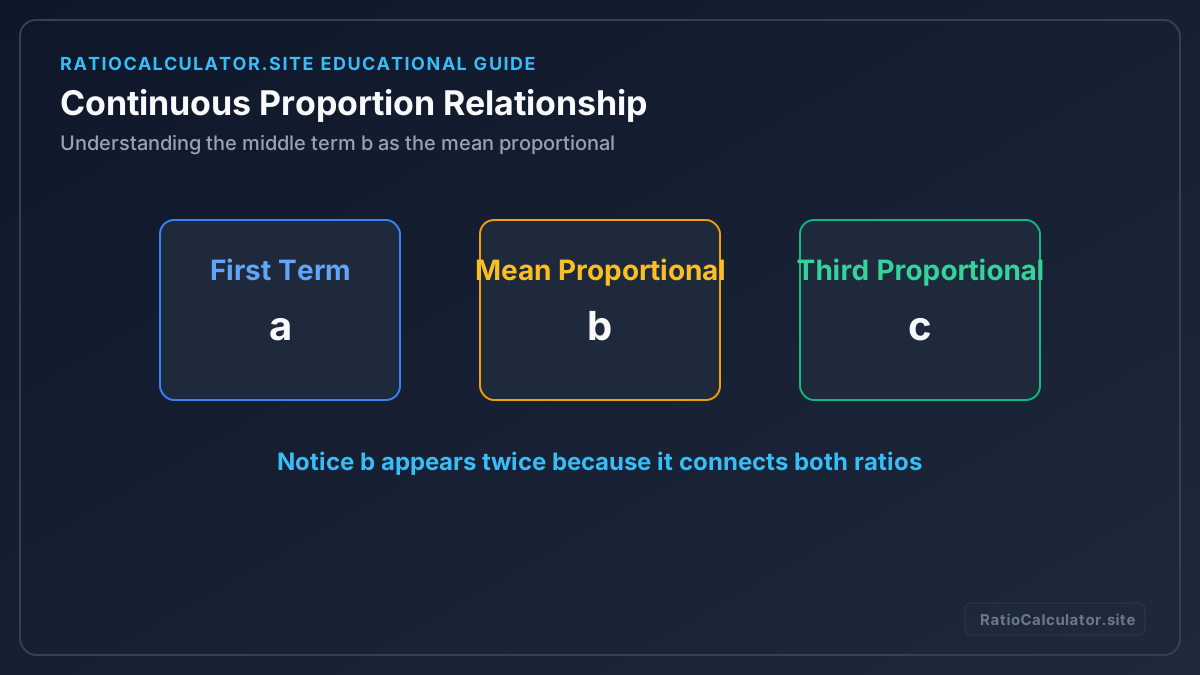
- a is known as the first proportional.
- b is known as the mean proportional (or geometric mean) between a and c.
- c is defined as the third proportional to a and b.
Notice that although there are four positions in the proportion, there are only three distinct numerical values because the middle value b repeats in both inner positions.
Deriving the Third Proportional Formula
Using cross multiplication on the fractional statement a / b = b / c:
a * c = b * b
a * c = b^2
Solving for c by dividing both sides by a yields the third proportional formula:
c = b^2 / a
To calculate the third proportional to two numbers a and b:
- Square the second number (multiply b by itself).
- Divide the result by the first number (a).
Step by Step Examples
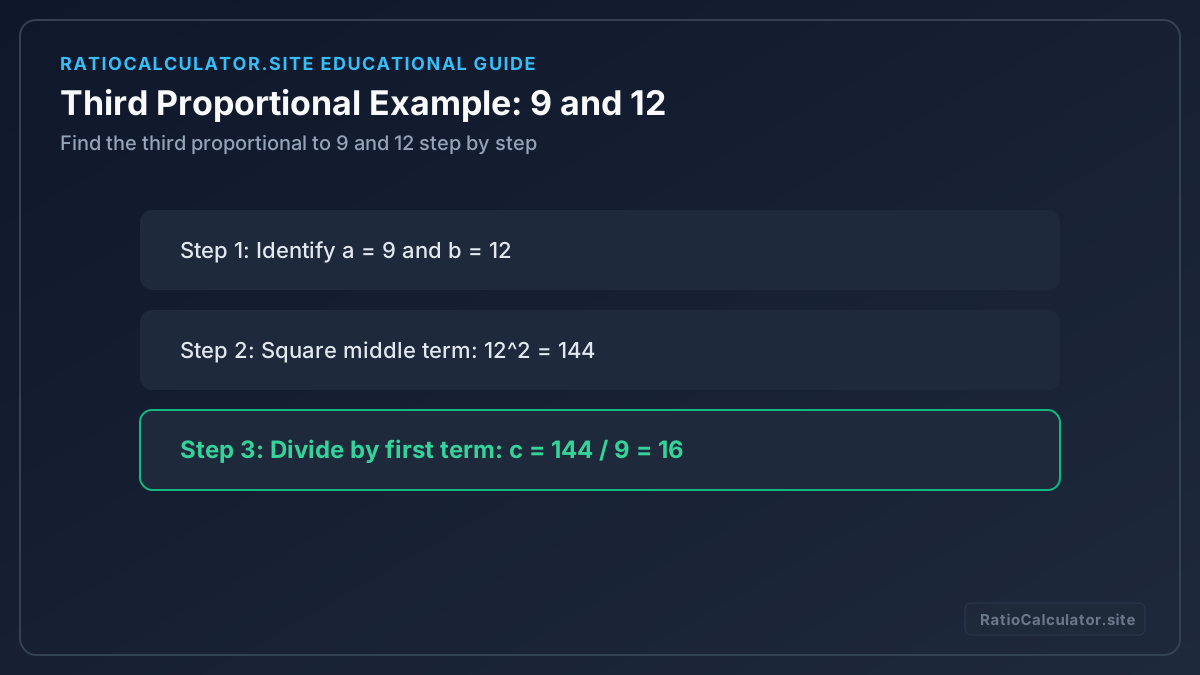
Example 1: Third Proportional to 9 and 12
Find the third proportional to 9 and 12.
- Identify the values: a = 9, b = 12
- Square the second value: 12^2 = 144
- Divide by the first value: 144 / 9 = 16
- Solution: The third proportional is 16.
- Verification: Check if 9 / 12 = 12 / 16. Both reduce to 3 / 4, confirming the answer is correct.
Example 2: Third Proportional to 16 and 24
Find the third proportional to 16 and 24.
- Assign variables: a = 16, b = 24
- Square 24: 24 * 24 = 576
- Divide by 16: 576 / 16 = 36
- Solution: The third proportional is 36.
- Verification: 16 / 24 simplifies to 2 / 3, and 24 / 36 simplifies to 2 / 3.
Example 3: Fractional Numbers
Find the third proportional to 4 and 6.
- a = 4, b = 6
- b^2 = 36
- c = 36 / 4 = 9
- The proportion 4 : 6 = 6 : 9 holds true with constant multiplier 1.5.
Distinguishing Third Proportional from Fourth Proportional
- Input Count: Third proportional problems give you two numbers (a and b). Fourth proportional problems give you three numbers (a, b, and c).
- Middle Term: In third proportional problems, the middle term b appears twice. In fourth proportional problems, all four terms are generally distinct.
- Formula Difference: Third proportional uses c = b^2 / a. Fourth proportional uses d = (b * c) / a.
Contextual Internal Resources & Authority References
Continue your investigation into continued proportions and geometric scaling with these verified tools and guides:
- Interactive Calculators: Model dimensional transformations using our Scale Factor Calculator or explore design proportions on the Golden Ratio Calculator.
- Related In-Depth Guides: Expand from three terms to four in How to Find the Fourth Proportional, discover How to Find Equivalent Ratios, and master How to Find the Missing Number in a Ratio.
- Core Tool: Solve continued proportions with the comprehensive Ratio Calculator.
- Academic References: For mathematical proofs of continuous proportions and geometric means, read Wolfram MathWorld Geometric Mean & Continuous Proportions and Britannica Principles of Proportion.
Frequently Asked Questions
What does third proportional mean in math?
The third proportional is the third term c in a continuous proportion a : b = b : c.
What is the formula for finding the third proportional?
The formula is c = b^2 / a, where b is the second term and a is the first term.
Why does a third proportional problem only provide two numbers?
Because the second number acts as both the second and third positions in continuous proportion.
Can the third proportional be smaller than the first two numbers?
Yes, if the second number is smaller than the first number, the third proportional will be smaller still.
What is the middle term called in a continuous proportion?
The middle term b is called the mean proportional or the geometric mean between a and c.
How do you check if your third proportional answer is correct?
Confirm that the ratio of a to b simplifies to the exact same value as the ratio of b to c.
Can the third proportional be a negative number?
If real positive quantities are being compared, the third proportional must be positive since b^2 is always non negative.