How to Find the Ratio of Two Quantities: Simple Method With Examples
Learn how to find the ratio of two quantities with simple steps and clear examples. Compare numbers, measurements, money, and students in lowest terms.
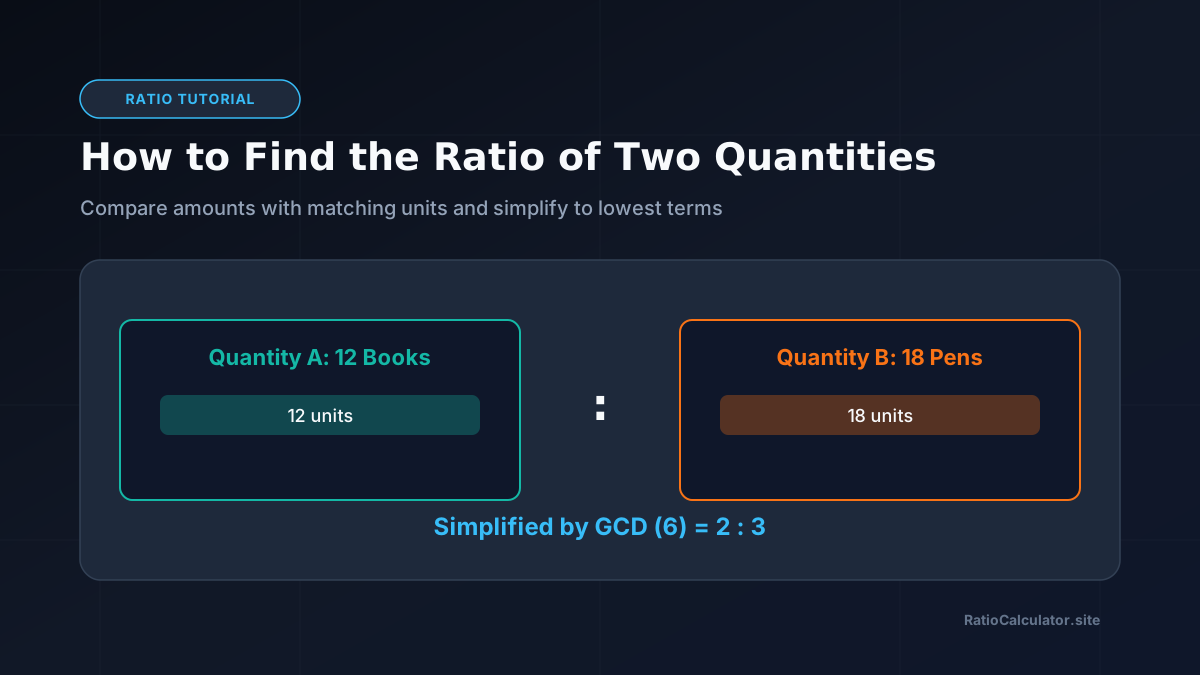
A ratio compares two quantities by division, showing how many times one value contains another or how two amounts relate to each other. When you compare amounts such as students in a classroom, ingredients in cooking, or distances on a route, understanding how to calculate a ratio gives you immediate mathematical clarity.
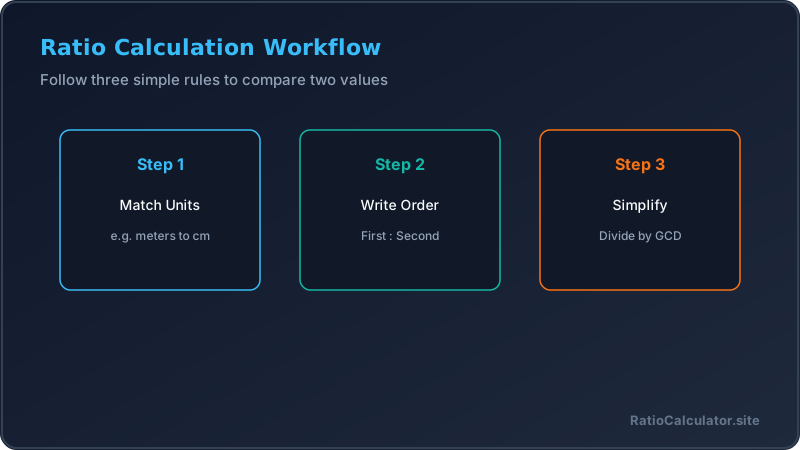
The simplest way to find the ratio between two quantities is to write the two numbers in the order requested, ensure both quantities use the same unit of measurement, and divide both terms by their greatest common divisor.
For example, if a library shelf holds 12 fiction books and 18 nonfiction books, the ratio of fiction to nonfiction books is 12 : 18. Dividing both numbers by 6 yields the simplified ratio 2 : 3. This indicates that for every 2 fiction books, there are exactly 3 nonfiction books.
If you want to check your work instantly or simplify larger values, the Ratio Calculator on RatioCalculator.site simplifies ratios and provides step by step breakdowns.
Interactive Two Quantities Ratio Calculator
Live ToolEnter two values below to compute their simplest ratio, greatest common divisor, and proportion breakdown:
What Does Finding a Ratio Mean?
Finding a ratio means determining the relative size of two values. It expresses how one quantity relates proportionally to another without changing the underlying relationship.
Ratios can be written in three accepted mathematical notations:
- Colon notation, such as 2 : 3
- Fraction notation, such as 2 / 3
- Word notation, such as 2 to 3
In every format, the order of the numbers is critical. The first number is called the antecedent, and the second number is called the consequent. Reversing the order produces an entirely different relationship.
Core Rules for Finding the Ratio of Two Quantities
To find an accurate ratio every time, follow three fundamental rules:
- Always preserve the exact order specified in the problem. If asked for boys to girls, the number of boys must come first.
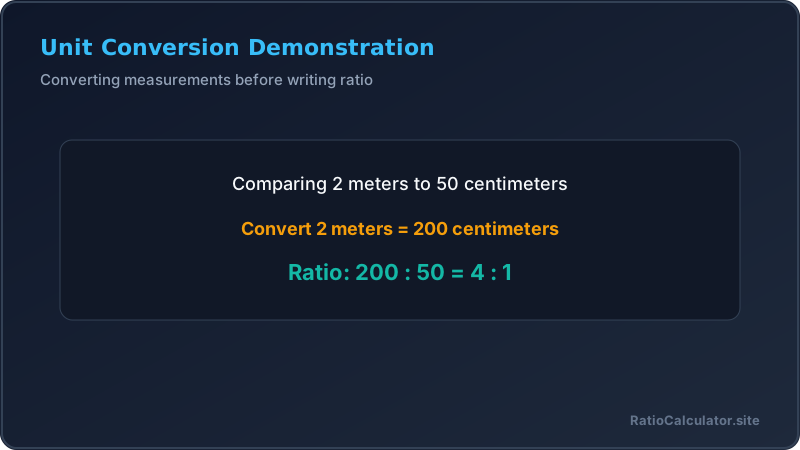
- Ensure both values share identical units of measurement before calculating. You cannot directly compare meters to centimeters without converting first.
- Simplify the final numbers by dividing both terms by their greatest common divisor until no common factor remains besides 1.
| Comparison Type | Initial Values | Unit Conversion Needed | Simplified Ratio |
|---|---|---|---|
| Counts of Objects | 15 Pens to 25 Pencils | No (both are object counts) | 3 : 5 |
| Lengths | 2 Meters to 50 Centimeters | Yes (convert 2 m to 200 cm) | 4 : 1 |
| Money | $45 to $60 | No (both in dollars) | 3 : 4 |
| Time | 45 Minutes to 2 Hours | Yes (convert 2 hours to 120 minutes) | 3 : 8 |
| Liquid Volume | 500 mL to 2 Liters | Yes (convert 2 L to 2000 mL) | 1 : 4 |
Step by Step Method With Worked Examples
Here is the exact step by step process applied across different types of quantities.
Example 1: Comparing Counts of People
In a science seminar, there are 28 undergraduate students and 21 graduate students. What is the ratio of undergraduate students to graduate students?
- Identify the requested order: undergraduate students first, graduate students second.
- Write the raw values: 28 : 21.
- Find the greatest common divisor of 28 and 21. The factors of 28 are 1, 2, 4, 7, 14, 28. The factors of 21 are 1, 3, 7, 21. The greatest common divisor is 7.
- Divide both values by 7: (28 ÷ 7) : (21 ÷ 7) = 4 : 3.
- Verification: 4 × 7 = 28 and 3 × 7 = 21. The ratio is 4 : 3.
Example 2: Comparing Measurements With Different Units
Find the ratio of 75 centimeters to 1.5 meters.
- Check the units: centimeters and meters do not match.
- Convert meters to centimeters: 1.5 meters × 100 = 150 centimeters.
- Write the ratio using matching units: 75 cm : 150 cm.
- Divide both numbers by their greatest common divisor (75): (75 ÷ 75) : (150 ÷ 75) = 1 : 2.
- The ratio is 1 : 2.
Example 3: Comparing Sums of Money
A freelance graphic designer earns $450 on project Alpha and $600 on project Beta. What is the ratio of earnings from project Alpha to project Beta?
- Identify the numbers: $450 and $600. Both use the same currency.
- Write the terms: 450 : 600.
- Divide both terms by 10 to remove trailing zeros: 45 : 60.
- Divide both terms by 15: (45 ÷ 15) : (60 ÷ 15) = 3 : 4.
- The ratio of Alpha earnings to Beta earnings is 3 : 4.
If you need to divide an overall budget between multiple project phases, you can use our Ratio Division Calculator to allocate total sums automatically.
Part to Part vs Part to Whole Ratios
When finding ratios from everyday situations, distinguish between part to part comparisons and part to whole comparisons.
- A part to part ratio compares one distinct group directly to another distinct group (for instance, 12 boys : 18 girls = 2 : 3).
- A part to whole ratio compares one specific group to the entire collection (for instance, 12 boys : 30 total students = 2 : 5).
When solving word problems or answering school exercises, read the prompt attentively to confirm whether the denominator or second term represents another subgroup or the complete collective total.
Common Mistakes to Avoid
- Forgetting unit conversion: Writing 2 meters to 40 cm as 2 : 40 instead of converting to 200 : 40 creates an error of 100 fold.
- Inverting the order: If a question asks for the ratio of red marbles to blue marbles, writing blue first inverts the true mathematical proportion.
- Incomplete simplification: Leaving 24 : 36 as 12 : 18 instead of continuing down to 2 : 3 leaves the answer unsimplified.
- Including units in the final ratio: Ratios represent pure dimensionless numbers. Write 4 : 1, never 4 cm : 1 cm.
How to Verify Your Answer
To confirm your simplified ratio is correct, multiply both numbers of your simplified ratio by the greatest common divisor you divided by. If you arrive back at your original starting quantities, your simplification is accurate. You can also convert both original and simplified values to decimals by dividing numerator by denominator; both decimals must match identically.
Reference standard: Learn more about ratio learning benchmarks at the National Council of Teachers of Mathematics.
Conclusion
Finding the ratio of two quantities is a straightforward process when you ensure units match, respect the order of terms, and simplify using the greatest common divisor. Whether you are working with classroom statistics, measurement conversions, or financial numbers, these steps guarantee accurate results every time. Use our free Ratio Calculator whenever you need instant verification.
Frequently Asked Questions
What is the ratio of two quantities?
A ratio of two quantities is a mathematical comparison of two numbers or measurements expressed through division.
How do you find the ratio of two numbers?
Write the first number, place a colon, write the second number, and divide both numbers by their greatest common divisor.
Must the units be the same when finding a ratio?
Yes, both quantities must be converted into the same unit before writing and simplifying the ratio.
Can a ratio have units of measurement?
No, a ratio is a pure dimensionless number because matching units cancel out during division.
What is the difference between 3 to 4 and 4 to 3?
The order indicates which quantity is being compared to which, so 3 to 4 represents an entirely different proportion than 4 to 3.
How do you simplify a ratio to lowest terms?
Divide both terms by their greatest common divisor until only 1 remains as a common factor.
Can a ratio be written as a fraction?
Yes, the ratio A : B can be written as the fraction A / B.