How to Use Ratios to Solve Mixture Problems: Step by Step
Master mixture ratio calculations step by step. Learn how to scale ingredients, compute component volumes, and solve two and three part mixture problems.
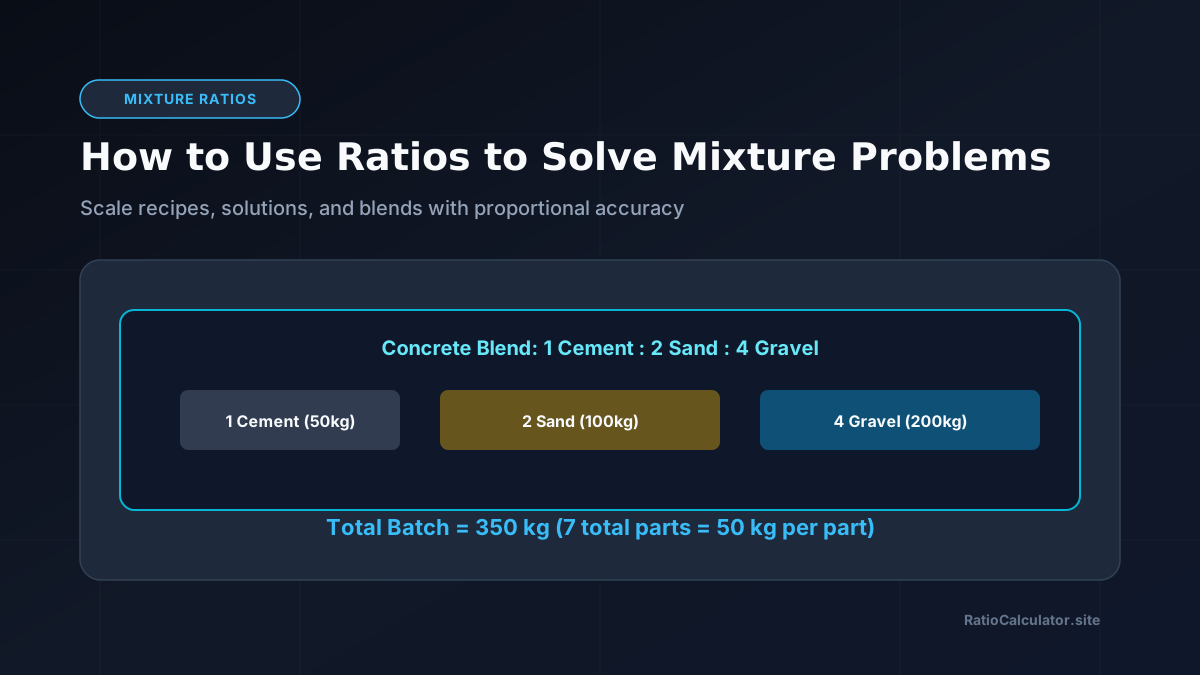
Mixture problems appear everywhere in daily life: blending juices, combining cooking ingredients, mixing soil amendments for gardening, and formulating mortar for masonry. In all these applications, the key to success is maintaining the exact proportional balance between components.
A mixture ratio expresses the proportional amount of each ingredient required to create a consistent compound. To solve mixture problems, you must connect the individual ingredient parts to the total volume or mass of the completed batch.
The standard calculation method involves summing the ratio parts to find the total batch units, dividing the desired batch size by that sum to determine the unit volume per part, and multiplying by each ingredient’s ratio number.
For example, if a fruit punch requires 1 part fruit syrup to 4 parts sparkling water, the total mixture consists of 1 + 4 = 5 parts. To prepare a 10 liter batch, each part equals 10 ÷ 5 = 2 liters. You need 2 liters of syrup and 8 liters of water.
For specialized industrial and culinary dilution calculations, explore our Dilution Ratio Calculator and Mixing Ratio Calculator.
Interactive Mixture Ratio Batch Calculator
Live ToolEnter your target batch size and component ratio parts to calculate exact ingredient amounts:
What Do Mixture Ratios Represent?
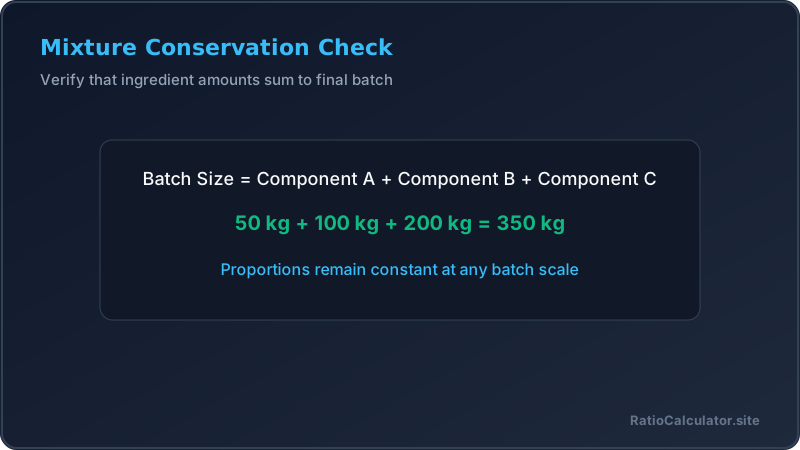
In any mixture calculation, all ingredients combine to form a whole. This principle of conservation means that the total volume or mass of the finished mixture equals the exact sum of its individual components.
Mixture ratios can be defined in two ways:
- Component to component ratios: Comparing ingredients directly to one another (for instance, 1 part concentrate to 4 parts water).
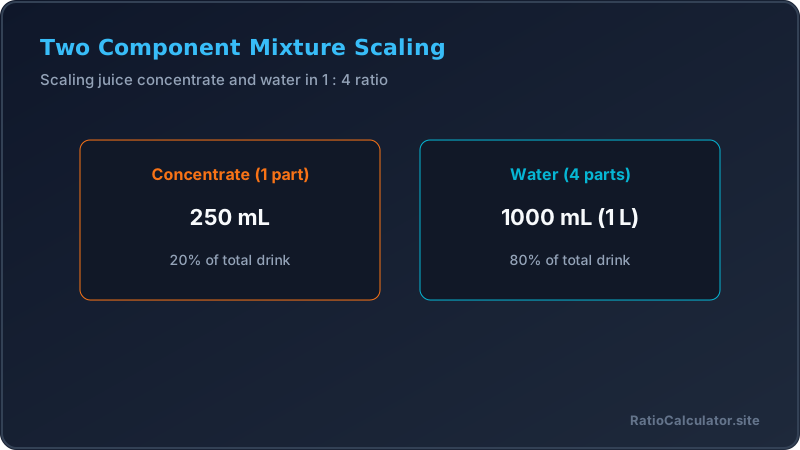
- Component to total mixture ratios: Comparing one specific ingredient to the complete finished blend (for instance, 1 part concentrate out of 5 total parts mixture = 20%).
Understanding this distinction prevents costly errors when preparing batches of paint, fertilizers, or kitchen recipes.
| Mixture Application | Standard Ratio | Total Parts | Ingredient 1 Share | Ingredient 2 Share | Ingredient 3 Share |
|---|---|---|---|---|---|
| Beverage Dilution | 1 Concentrate : 4 Water | 5 | 20% (1/5) | 80% (4/5) | Not Applicable |
| Standard Concrete | 1 Cement : 2 Sand : 3 Gravel | 6 | 16.7% (1/6) | 33.3% (2/6) | 50.0% (3/6) |
| Potting Soil Mix | 2 Peat : 1 Perlite : 1 Compost | 4 | 50% (2/4) | 25% (1/4) | 25% (1/4) |
| Pesto Sauce Base | 3 Basil : 2 Oil : 1 Pine Nuts | 6 | 50% (3/6) | 33.3% (2/6) | 16.7% (1/6) |
Step by Step Method for Two Component Mixtures
When mixing two ingredients to produce a target batch size:
- Identify the ratio: Write the ratio A : B.
- Sum the parts: Calculate Total Parts = A + B.
- Find unit volume: Divide the target total batch size by Total Parts.
- Calculate each component: Multiply A and B by the unit volume.
- Check: Confirm that Component A + Component B equals the target batch size.
Worked Example: Garden Liquid Plant Feed
A gardener prepares a mild liquid plant feed. The instructions indicate mixing plant nutrients with tap water in a 1 : 9 ratio. The watering can holds 15 liters of solution. How many liters of nutrient and water are required?
- Identify ratio: 1 nutrient : 9 water.
- Sum parts: 1 + 9 = 10 total parts.
- Calculate unit volume: 15 liters ÷ 10 parts = 1.5 liters per part.
- Calculate nutrient volume: 1 × 1.5 liters = 1.5 liters.
- Calculate water volume: 9 × 1.5 liters = 13.5 liters.
- Verify total: 1.5 L + 13.5 L = 15.0 L.
Step by Step Method for Three Component Mixtures
Many construction and culinary mixtures require three distinct components.
Worked Example: Construction Mortar Batch
A mason needs to mix 240 kilograms of dry mortar mix. The required recipe specifies 1 part masonry cement, 3 parts plaster sand, and 2 parts hydrated lime by weight. How many kilograms of each dry ingredient are needed?
- Identify the ratio: 1 cement : 3 sand : 2 lime.
- Sum the parts: 1 + 3 + 2 = 6 total parts.
- Find unit weight: 240 kg ÷ 6 parts = 40 kg per part.
- Cement required (1 part): 1 × 40 kg = 40 kg.
- Sand required (3 parts): 3 × 40 kg = 120 kg.
- Lime required (2 parts): 2 × 40 kg = 80 kg.
- Verification check: 40 kg + 120 kg + 80 kg = 240 kg.
To partition any overall material quota effortlessly, use our Ratio Division Calculator.
Finding a Missing Ingredient When One Is Known
In many practical situations, you do not have a predetermined total batch size. Instead, you have a fixed quantity of one ingredient on hand and need to know how much of the other ingredients to add.
Worked Example: Fixed Supply Calculation
A chef has 450 grams of tahini paste on hand to prepare a large bowl of hummus. The recipe ratio of chickpeas to tahini is 4 : 1 by weight. How many grams of cooked chickpeas does the chef need?
- Identify the given component: Tahini represents 1 part and equals 450 grams.
- Value of one part: 450 grams ÷ 1 = 450 grams.
- Chickpeas represent 4 parts: 4 × 450 grams = 1800 grams (1.8 kilograms).
- Total resulting hummus base: 1800 g + 450 g = 2250 g (2.25 kg).
Common Mistakes in Mixture Calculations
- Confusing solvent volume with total volume: Adding 1 liter of syrup to 4 liters of water produces 5 liters of punch. But if you want 4 liters of punch in total, you cannot add 1 liter to 4 liters; you must calculate 4 ÷ 5 = 0.8 L syrup and 3.2 L water.
- Mixing incompatible units: Measuring one ingredient in fluid ounces and another in milliliters without converting causes severe formulation errors.
- Ignoring unit weight vs unit volume: Solid ingredients like flour and water have different densities; always verify whether a mixture ratio is by weight or by volume.
- Altering proportions when scaling: Multiplying some ingredients by 2 and others by 3 ruins the mixture balance completely.
How to Verify Your Answer
To ensure your mixture calculation is reliable:
- Mass and volume balance check: Sum all calculated ingredient quantities. They must match your target batch size exactly.
- Simplification check: Write your calculated quantities as a ratio and simplify them by dividing by the unit value. The simplified numbers must match the original recipe ratio.
Reference standard: Explore agricultural mixing and spray dilution standards at Purdue University Extension.
Conclusion
Solving mixture problems with ratios relies on establishing the value of one proportional part. Once that single unit value is known, scaling any mixture up or down becomes simple arithmetic. Whether you are blending beverages, formulating mortar, or scaling recipes, these steps ensure perfect consistency. Use our free Ratio Calculator or Ratio Division Calculator for rapid verification.
Frequently Asked Questions
What does a 1 to 4 mixture ratio mean?
It means for every 1 unit of the first ingredient, you must add 4 units of the second ingredient, creating 5 total parts.
How do you find the total parts of a mixture?
Add all the individual ratio terms together to get the total number of parts.
How do you scale a recipe using ratios?
Divide the target total quantity by the sum of ratio parts to get the unit value, then multiply each ingredient by that unit value.
What is the difference between a ratio by weight and a ratio by volume?
A ratio by weight measures grams or kilograms, while a ratio by volume measures milliliters or liters.
How do you determine how much water to add to a concentrate?
Subtract the concentrate volume from the target total solution volume to find the required water volume.
Can a mixture ratio have three or more parts?
Yes, multi component mixtures like concrete (cement, sand, gravel) commonly have three or more ratio parts.
What happens if you change one ratio part without scaling the others?
The proportional balance of the mixture is broken, which alters taste, strength, or chemical consistency.