How to Solve Age Problems Using Ratios: Step by Step Examples
Master age ratio word problems step by step. Learn algebraic representations, the constant age difference principle, and past present future examples.
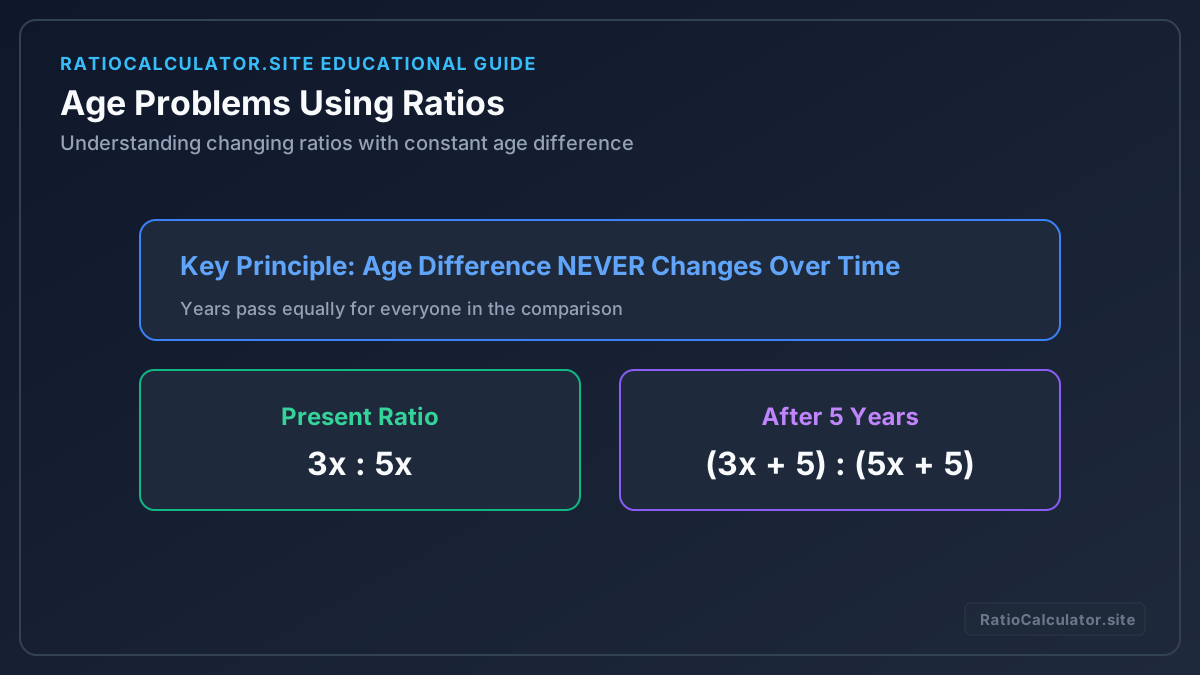
Age word problems involving ratios are among the most popular questions on school mathematics exams, aptitude assessments, and competitive placement tests. While these problems can initially seem confusing because people’s ages change over time, they are governed by one unbreakable mathematical truth: the difference between two people’s ages remains exactly constant throughout their lives.
Once you combine this constant age difference rule with basic algebraic representation, age ratio problems become straightforward linear equations.
To verify ratio proportions and solve algebraic relationships quickly, test the free Ratio Calculator on RatioCalculator.site.
The Golden Principle: Age Difference Never Changes
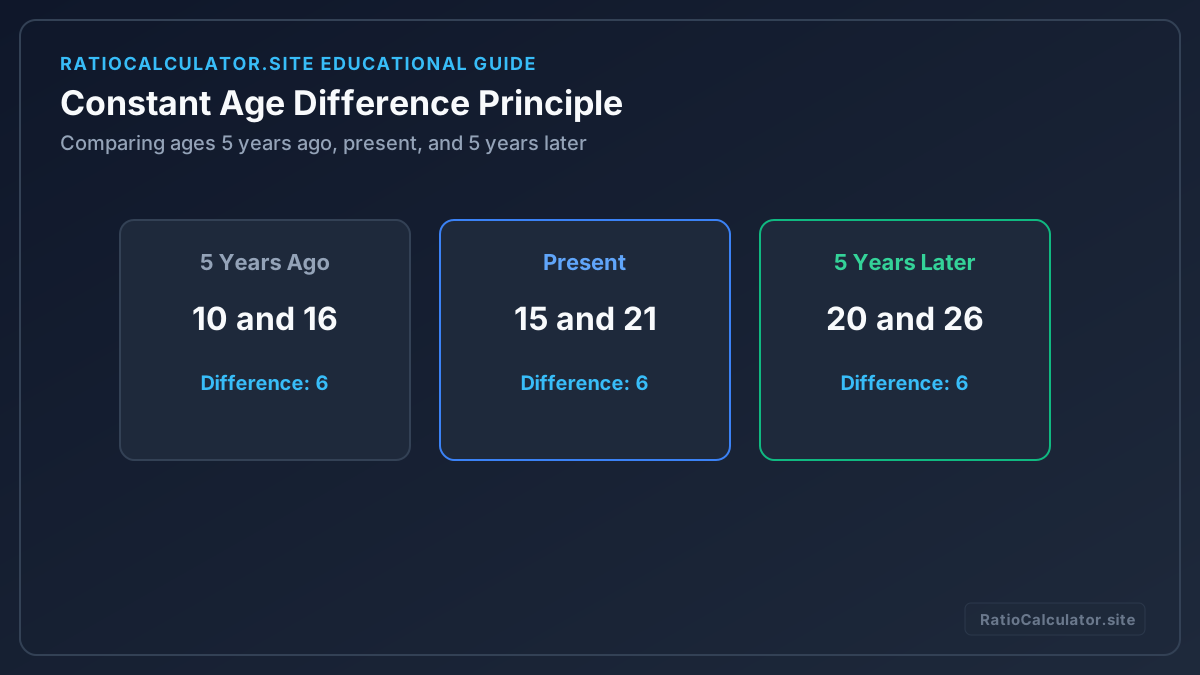
If Anna is 20 years old and her brother Ben is 14 years old today, the difference between their ages is 6 years. Ten years from now, Anna will be 30 and Ben will be 24; the difference is still 6 years. Five years ago, Anna was 15 and Ben was 9; the difference was still 6 years.
However, notice what happens to their age ratio over time:
- 5 years ago: 15 : 9 simplifies to 5 : 3 (ratio value = 1.67)
- Present day: 20 : 14 simplifies to 10 : 7 (ratio value = 1.43)
- 10 years later: 30 : 24 simplifies to 5 : 4 (ratio value = 1.25)
The ratio changes constantly because both people add the identical number of elapsed years, but their arithmetic difference never changes.
Standard Algebraic Setup for Age Ratio Problems
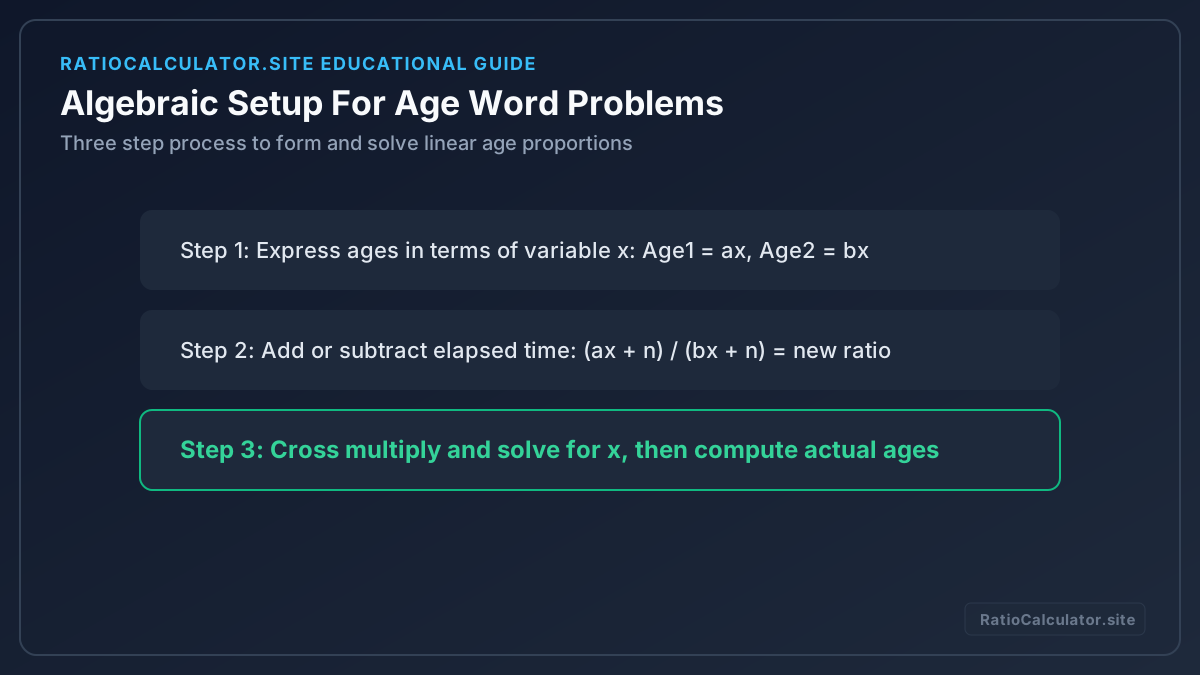
Follow this three step algebraic procedure:
Step 1: Assign Variables Using the Present Ratio
If the present ages of two individuals are in the ratio A : B, represent their present ages as:
- First Person Age = A * x
- Second Person Age = B * x where x represents the unknown common multiplier.
Step 2: Formulate the Time Shifted Equation
If the problem specifies a ratio n years in the future, add n to both ages: (A * x + n) / (B * x + n) = New Ratio
If the problem specifies a ratio n years in the past, subtract n from both ages: (A * x - n) / (B * x - n) = Past Ratio
Step 3: Solve for x and Calculate Actual Ages
Cross multiply to solve the linear equation for x, then substitute x back into the expressions A * x and B * x to find the real ages.
Step by Step Worked Examples
Example 1: Future Age Shift
The present ages of a father and his son are in the ratio 7 : 2. In 10 years, the ratio of their ages will become 9 : 4. Find their present ages.
- Let present age of father = 7x, and son = 2x.
- In 10 years, father will be (7x + 10) and son will be (2x + 10).
- Set up the proportion: (7x + 10) / (2x + 10) = 9 / 4
- Cross multiply:
- 4 * (7x + 10) = 9 * (2x + 10)
- 28x + 40 = 18x + 90
- Solve for x:
- 28x - 18x = 90 - 40
- 10x = 50
- x = 5
- Compute present ages:
- Father present age = 7 * 5 = 35 years
- Son present age = 2 * 5 = 10 years
- Verification: In 10 years, father is 45 and son is 20. 45 / 20 simplifies to 9 / 4.
Example 2: Past Age Shift
The ratio of the ages of two brothers is 4 : 3 today. Five years ago, the ratio of their ages was 3 : 2. Find their present ages.
- Let present ages be 4x and 3x.
- Five years ago, their ages were (4x - 5) and (3x - 5).
- Form proportion: (4x - 5) / (3x - 5) = 3 / 2
- Cross multiply:
- 2 * (4x - 5) = 3 * (3x - 5)
- 8x - 10 = 9x - 15
- Solve for x:
- 15 - 10 = 9x - 8x
- x = 5
- Present ages:
- Older brother = 4 * 5 = 20 years
- Younger brother = 3 * 5 = 15 years
- Verification: 5 years ago they were 15 and 10. 15 / 10 simplifies to 3 / 2.
Common Mistakes in Age Problems
- Adding Years to Only One Person: When 5 years pass, both individuals age by 5 years. Forgetting to add the years to both numerator and denominator invalidates the equation.
- Confusing Present Age with Past or Future Age: Always check whether the question asks for the present age, the age 5 years ago, or the age 10 years from now before finalizing your answer.
Contextual Internal Resources & Authority References
Deepen your algebra and word problem mastery with these related calculators and educational resources:
- Interactive Calculators: Convert proportional relationships into percentages with the Ratio to Percentage Calculator and verify general arithmetic on the Ratio Calculator.
- Related In-Depth Guides: Master complex narrative equations in How to Solve Ratio Word Problems, study How to Solve Double Ratio Problems, and practice How to Solve Ratio Problems With Percentages.
- Academic References: For formal linear equation solving techniques in age word problems, review Wolfram MathWorld Systems of Equations and the Khan Academy Algebra Word Problems Course.
Frequently Asked Questions
Why does the ratio of two people’s ages change over time?
Because adding the same number of years to both ages alters their relative fraction while leaving their difference unchanged.
What is the most important principle when solving age ratio problems?
The difference between two people’s ages remains completely constant throughout their entire lives.
How do you represent present ages from a given ratio A to B?
Represent the present ages as A multiplied by x and B multiplied by x, where x is the common multiplier.
What operation do you use for future ages versus past ages?
Add elapsed years for future ages and subtract elapsed years for past ages.
Can an age ratio ever become 1 to 1 between two different people?
No, because as long as there is an age difference, two people of different ages will never be the exact same age.
How do you verify your answer to an age ratio problem?
Substitute your calculated ages back into the future or past conditions to confirm that the resulting ratio simplifies correctly.
Can the variable x in an age problem be a decimal?
While exam problems usually yield whole numbers for ages, decimal solutions are mathematically valid representing partial years.