How to Find the Total From a Given Ratio and One Part
Master calculating the complete total amount from a given ratio and one known part. Complete guide with formulas, unit scaling, and real life money examples.
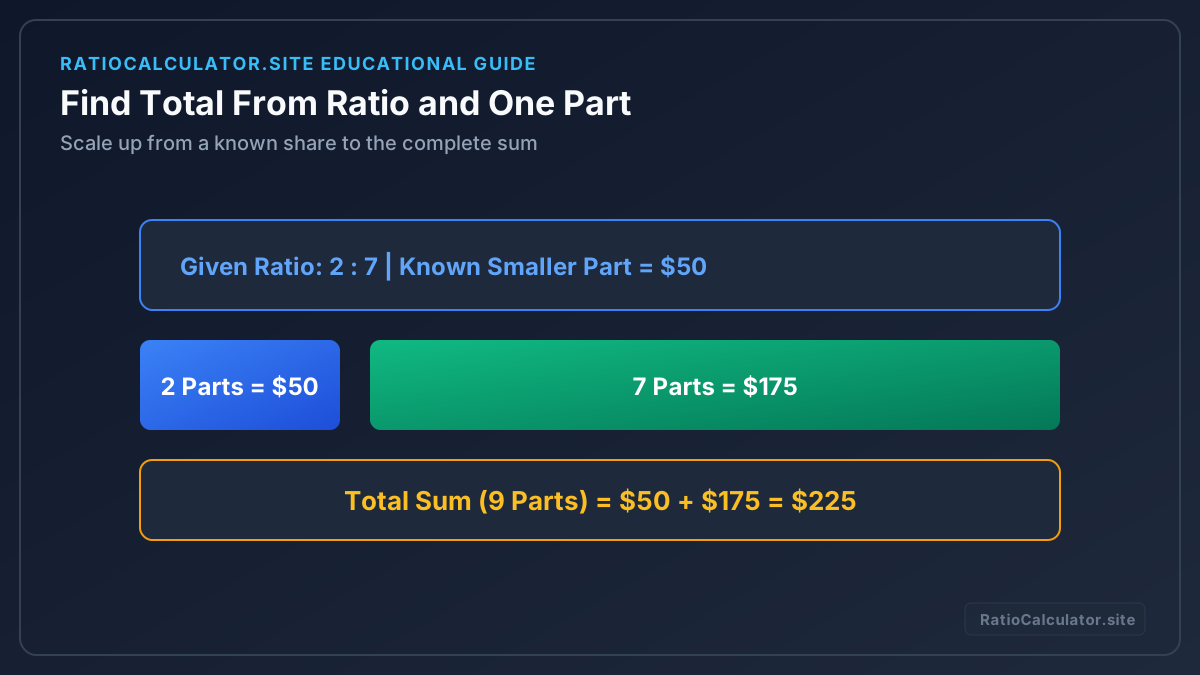
Many practical arithmetic scenarios provide you with the ratio between several components and the exact measurement of just one portion, requiring you to find the complete overall total. For example, if profits are divided between two business partners in the ratio 3 : 7 and the junior partner receives $15,000, what was the full business profit?
Solving for the total from a single known part requires establishing the value of one ratio unit and scaling up by the sum of all ratio parts.
For rapid verification of multi term totals, visit the free Ratio Calculator on RatioCalculator.site.
The Mathematical Principle of Finding the Total
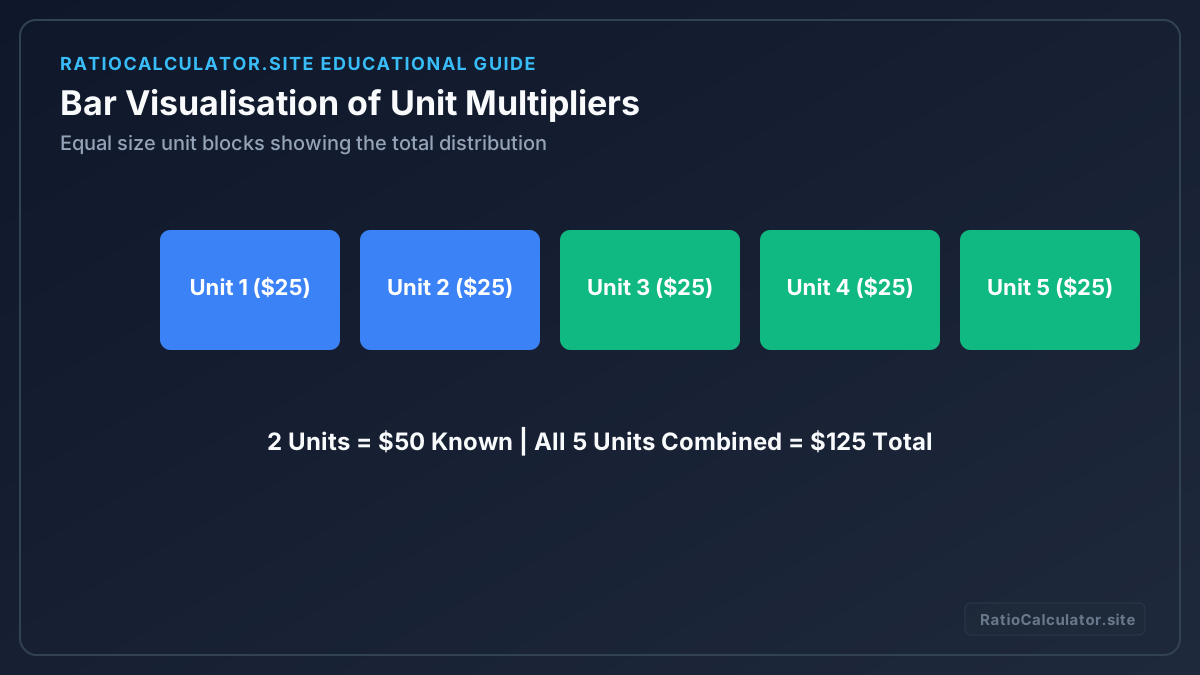
Every ratio problem consists of equal building blocks called ratio units. When you are told that a known portion represents a certain number of units, you can determine the value of exactly one building block.
Because the total consists of all building blocks combined, multiplying the value of one building block by the total number of ratio units gives the full amount.
The Step by Step Formula
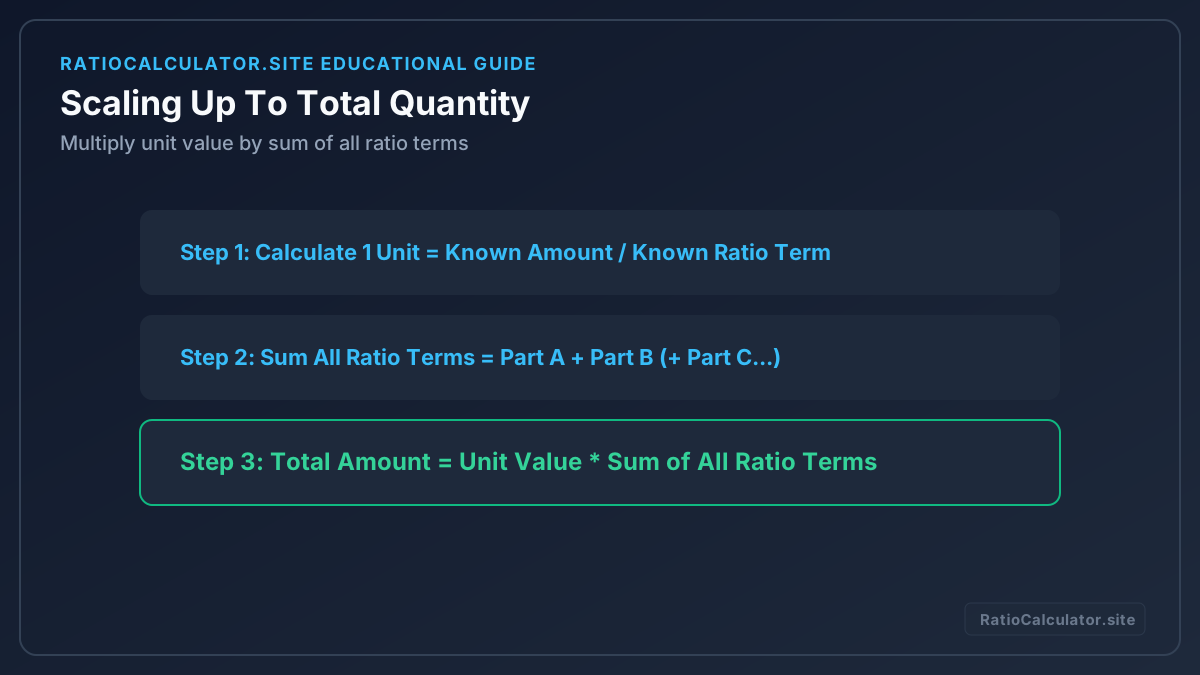
Follow this simple calculation sequence:
Step 1: Calculate the Value of One Ratio Unit
Divide the known part by its corresponding ratio number: Unit Value = Known Portion / Ratio Number for That Portion
Step 2: Sum All Ratio Terms
Add all the terms in the ratio to find the total units in the system: Total Ratio Units = Part A + Part B (+ Part C…)
Step 3: Multiply Unit Value by Total Ratio Units
Compute the overall total: Total Amount = Unit Value * Total Ratio Units
Alternatively, you can calculate each missing part individually and add them all together. Both mathematical methods produce the exact same final total.
Detailed Real Life Problem Examples
Example 1: Partnership Profit Distribution
Two partners, Sarah and Liam, share annual company profits in the ratio 2 : 5. Sarah receives $24,000 as her share. What was the company’s total profit?
- Identify given values:
- Sarah’s ratio shares = 2
- Sarah’s actual money = $24,000
- Liam’s ratio shares = 5
- Determine value per ratio unit:
- Unit Value = $24,000 / 2 = $12,000
- Calculate total ratio units:
- Total Units = 2 + 5 = 7 units
- Calculate total profit:
- Total Profit = $12,000 * 7 = $84,000
- Secondary verification: Liam’s share = 5 * $12,000 = $60,000. Sum = $24,000 + $60,000 = $84,000.
Example 2: Industrial Chemical Compound
A manufacturing batch blends water, acid, and solvent in the ratio 4 : 1 : 3. The batch uses 15 liters of acid. What is the total volume of the blended solution?
- Acid corresponds to 1 ratio unit.
- Therefore, 1 ratio unit = 15 liters.
- Total ratio units = 4 + 1 + 3 = 8 units.
- Total volume = 15 liters * 8 = 120 liters.
- Check parts: Water = 4 * 15 = 60 liters, Acid = 15 liters, Solvent = 3 * 15 = 45 liters. Sum = 60 + 15 + 45 = 120 liters.
Example 3: Fruit Harvest Weights
An orchard harvests apples and pears in the ratio 5 : 8. The weight of apples harvested is 450 kilograms. What is the combined weight of the entire fruit harvest?
- Apple ratio units = 5, representing 450 kg.
- Unit value = 450 / 5 = 90 kg per unit.
- Total ratio units = 5 + 8 = 13 units.
- Total harvest = 90 * 13 = 1,170 kg.
- Pear harvest = 8 * 90 = 720 kg. Total = 450 + 720 = 1,170 kg.
Common Mistakes to Avoid
- Multiplying the Known Part Directly by the Total Units: Multiplying $24,000 by 7 would yield an enormous incorrect total. You must divide by the known part’s ratio term first to find the single unit value.
- Adding the Ratio Terms to the Known Part: Ratios represent scaling multipliers, not absolute quantities. Never add ratio numbers directly to currency or kilogram values.
Contextual Internal Resources & Authority References
Strengthen your arithmetic comprehension and verify homework results with these specialized calculators and math guides:
- Interactive Calculators: Automate proportion totals with the Ratio Division Calculator and explore percentage distribution with the Ratio to Percentage Calculator.
- Related In-Depth Guides: Review How to Find a Ratio When One Part Is Known, discover How to Find the Original Amount From a Ratio, and learn How to Calculate a Ratio From a Total Amount.
- Core Tool: Perform instant scaling operations using the free Ratio Calculator.
- Academic References: Refer to Khan Academy Proportions and Rates and Wolfram MathWorld Proportion Principles for theoretical proofs.
Frequently Asked Questions
What is the formula to find the total from one part and a ratio?
The formula is Total = (Known Part / Known Ratio Term) * Sum of All Ratio Terms.
Why do you divide the known part by its ratio term?
Dividing by its ratio term calculates the numerical value of exactly one ratio unit.
Can this method be used when a ratio has three or more parts?
Yes, simply add all the ratio terms together and multiply that sum by the single unit value.
What should you do if the known part does not divide evenly?
Retain the unit value as a fraction to maintain complete mathematical accuracy before multiplying by the total parts.
How do you verify that your calculated total is correct?
Subtract the known part from the total to find the other part, then verify that both parts simplify to the original ratio.
What is the difference between finding a part and finding a total?
Finding a part calculates one recipient’s share, while finding the total calculates the combined sum of all shares.
Does the order of ratio terms affect the total?
The total sum remains identical regardless of order, provided each term is paired with its correct component.