How to Solve Ratio Problems With Fractions: Step by Step Guide
Master solving ratio problems with fractions using common denominators and cross multiplication. Step by step fraction ratio simplification with clear examples.

Ratios that contain fractions often look intimidating at first glance. Seeing an expression like 2/3 : 3/4 makes many learners wonder how to compare or simplify values when numerators and denominators are already involved.
The core principle to remember is that ratios express relationships between quantities. To solve a ratio problem containing fractions, your primary goal is to convert the fractional terms into clean, whole numbers. Once you eliminate the denominators, the ratio becomes simple to simplify, compare, and scale.
The most effective technique is multiplying all terms in the ratio by the least common multiple of their denominators.
For example, given the ratio 2/3 : 3/4, the denominators are 3 and 4. Their least common multiple is 12. Multiplying both terms by 12 produces (2/3 × 12) : (3/4 × 12), which simplifies cleanly to 8 : 9.
You can verify your fraction calculations or check equivalent forms using the Ratio Calculator on RatioCalculator.site.
Interactive Fraction Ratio Solver
Live ToolEnter two fractions below to calculate the least common denominator and whole number ratio:
Why Do Fractions Appear in Ratios?
Fractions appear naturally in real world ratio problems. In culinary recipes, you may mix 1/2 cup of olive oil with 3/4 cup of lemon juice. In carpentry, wood cuts often involve fractional measurements like 3/8 inch to 5/16 inch. In chemistry, proportions may call for 2/5 liter of solute per 1/3 liter of solvent.
Leaving terms as fractions makes direct comparison cumbersome. Converting them into whole number ratios gives you an intuitive perspective on which quantity is larger and by how much.
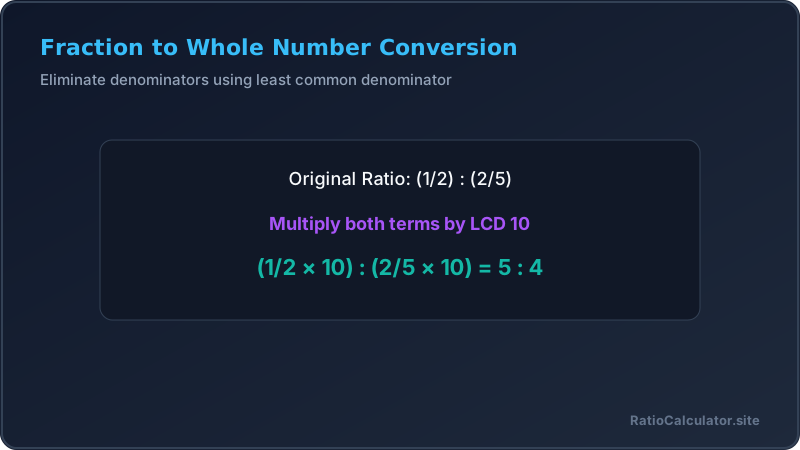
Method 1: The Least Common Denominator Technique
The least common denominator method is the universal solution for any fraction ratio, whether the problem involves two terms, three terms, or more.
Follow these four steps:
- Identify every denominator present across all terms in the ratio.
- Determine the least common multiple among those denominators.
- Multiply each term in the ratio by this least common multiple to eliminate all fractions.
- Simplify the resulting whole numbers by dividing by their greatest common divisor if possible.
| Original Fraction Ratio | Denominators | Least Common Denominator | Multiplication Step | Simplified Whole Ratio |
|---|---|---|---|---|
| 1/2 : 2/5 | 2, 5 | 10 | (1/2 × 10) : (2/5 × 10) | 5 : 4 |
| 2/3 : 3/4 | 3, 4 | 12 | (2/3 × 12) : (3/4 × 12) | 8 : 9 |
| 3/8 : 5/6 | 8, 6 | 24 | (3/8 × 24) : (5/6 × 24) | 9 : 20 |
| 1/2 : 1/3 : 1/4 | 2, 3, 4 | 12 | (1/2 × 12) : (1/3 × 12) : (1/4 × 12) | 6 : 4 : 3 |
Method 2: Diagonal Cross Multiplication for Two Fractions
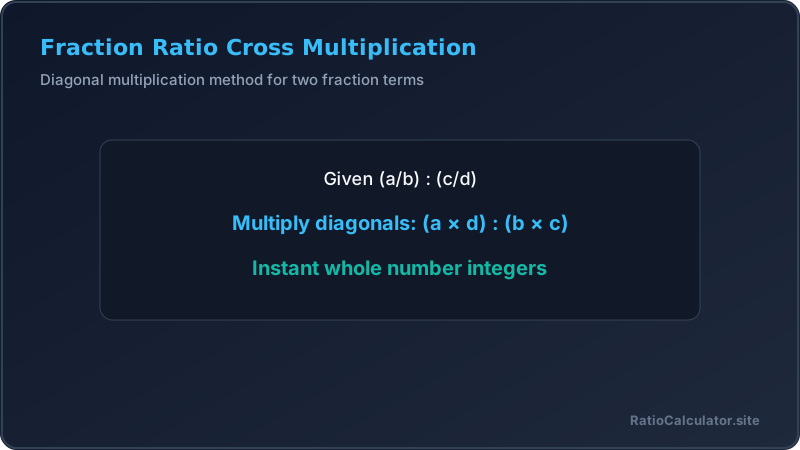
When working with exactly two fractions, diagonal cross multiplication provides the fastest route to whole numbers.
For any two fraction terms a/b : c/d:
- Multiply the numerator of the first fraction by the denominator of the second fraction: a × d.
- Multiply the denominator of the first fraction by the numerator of the second fraction: b × c.
- Write the whole number ratio as (a × d) : (b × c).
- Simplify the resulting integers if they share a common divisor.
Let us test 5/7 : 2/3 using cross multiplication:
- First term: 5 × 3 = 15
- Second term: 7 × 2 = 14
- Result: 15 : 14
Because 15 and 14 share no common factor greater than 1, the ratio is fully simplified at 15 : 14.
Handling Mixed Numbers in Ratios
If a problem contains mixed numbers, such as 1 1/2 : 2 1/4, you must convert each mixed number into an improper fraction before applying any ratio method.
Worked Example With Mixed Numbers
Simplify the ratio 1 1/2 : 2 1/4.
- Convert 1 1/2 to an improper fraction: (1 × 2 + 1) / 2 = 3/2.
- Convert 2 1/4 to an improper fraction: (2 × 4 + 1) / 4 = 9/4.
- Rewrite the ratio: 3/2 : 9/4.
- The denominators are 2 and 4. The least common multiple is 4.
- Multiply both terms by 4: (3/2 × 4) : (9/4 × 4) = 6 : 9.
- Simplify by dividing both terms by 3: (6 ÷ 3) : (9 ÷ 3) = 2 : 3.
- The simplified ratio is 2 : 3.
Solving Fraction Ratio Word Problems
Let us apply this knowledge to a practical scenario.
An artisan baker blends flour and water for a specialty loaf. The recipe specifies 3/4 kilogram of rye flour and 1/3 kilogram of spring water. If the baker wishes to prepare a larger batch maintaining the exact recipe, what is the ratio of flour to water in lowest whole terms?
- Identify the given quantities: Flour = 3/4 kg, Water = 1/3 kg.
- Write the ratio: 3/4 : 1/3.
- Determine the least common multiple of denominators 4 and 3, which is 12.
- Multiply both terms by 12: (3/4 × 12) : (1/3 × 12) = 9 : 4.
- Check for simplification: 9 and 4 share no common factors besides 1.
- The ratio of rye flour to spring water is 9 : 4.
If the baker needs to split a total dough mass of 26 kilograms in this exact proportion, they could use our Ratio Division Calculator to allocate 18 kg to flour and 8 kg to water.
Common Mistakes to Avoid
- Inverting the second fraction unnecessarily: Multiplying by the reciprocal is used when dividing one fraction by another to get a single fraction, but in a ratio, both terms must be multiplied by the same common denominator.
- Multiplying only one term by the common denominator: You must scale both sides of the colon by the identical factor to preserve proportional equivalence.
- Forgetting to simplify the final whole numbers: After clearing denominators, always check whether the resulting integers share a common divisor.
- Not converting mixed numbers first: Attempting to multiply mixed numbers directly almost always introduces algebraic errors.
How to Verify Your Answer
To confirm your result, convert both original fractions and your simplified whole numbers into decimals.
For our first example 2/3 : 3/4:
- Original values: 2/3 is approximately 0.6667 and 3/4 is 0.75. Dividing 0.6667 ÷ 0.75 gives 0.8889.
- Simplified values: 8 ÷ 9 gives 0.8889.
Since both decimal quotients match, your simplification is mathematically verified.
Reference standard: Explore mathematical fraction properties and definitions on Wolfram MathWorld.
Conclusion
Solving ratio problems with fractions requires only one core insight: multiplying every term by the least common denominator clears all fractions and converts the problem into whole numbers. Whether dealing with proper fractions, improper fractions, or mixed numbers, this structured method ensures complete accuracy. Check your work anytime using our Ratio Calculator.
Frequently Asked Questions
How do you simplify a ratio with fractions?
Multiply all terms in the ratio by the least common denominator to eliminate fractions, then simplify the resulting whole numbers.
Can a ratio have fractions as its terms?
Yes, ratios can contain fractions, but standard convention requires simplifying them to whole numbers in lowest terms.
What is the fastest method to solve two fraction ratios?
Diagonal cross multiplication is the fastest method to convert two fraction terms into whole numbers.
How do you solve a ratio with three fractions?
Find the least common multiple of all three denominators and multiply every term by that number.
How do you handle mixed numbers in a ratio?
Convert all mixed numbers into improper fractions before finding a common denominator.
Is 1/2 to 1/3 equal to 3 to 2?
Yes, multiplying both 1/2 and 1/3 by the common denominator 6 results in the ratio 3 : 2.
Why do we multiply by the common denominator?
Multiplying all parts by the common denominator eliminates division while preserving the exact proportional relationship.