How to Find the Fourth Proportional: Formula and Examples
Understand the fourth proportional definition, formula, and step by step calculation. Solve missing values with cross multiplication and clear examples.
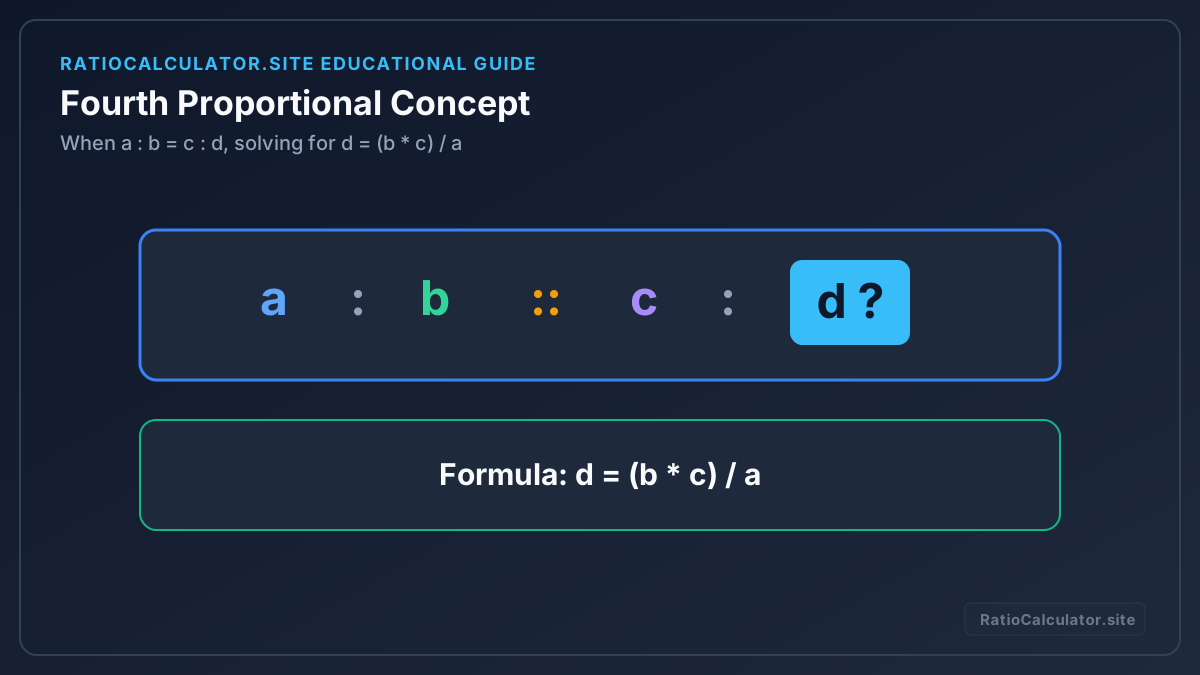
Proportions represent equality between two distinct ratios. When four quantities are arranged such that the ratio of the first two equals the ratio of the final two, they form a proportion. If three of these numbers are known and the fourth is unknown, the missing value is called the fourth proportional.
Finding the fourth proportional is a core algebraic topic frequently tested in competitive examinations and used in real world scaling calculations. Understanding its mathematical formula and cross multiplication logic enables quick problem solving.
For instant proportion validation, test the online Ratio Calculator on RatioCalculator.site.
Formal Mathematical Definition of the Fourth Proportional
In mathematical proportion theory, if four numbers a, b, c, and d satisfy the relation:
a : b = c : d
or written as equivalent fractions:
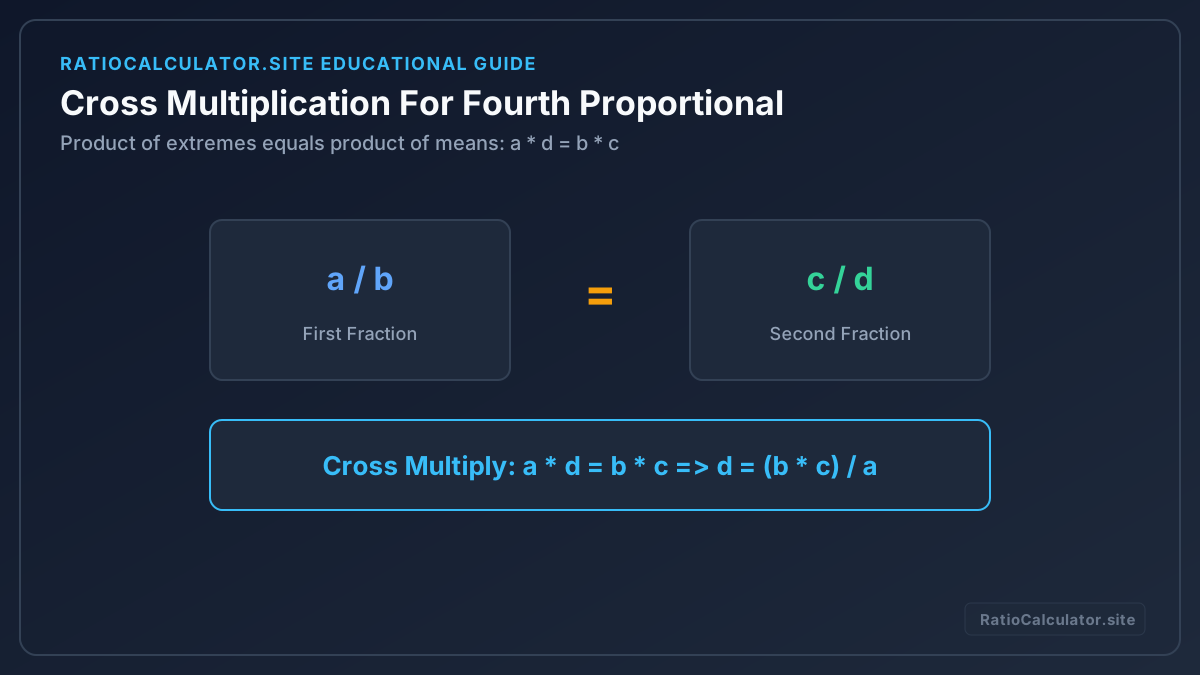
a / b = c / d
then d is designated as the fourth proportional to the three numbers a, b, and c taken in order.
The terms a and d are called the extremes (outer terms), while b and c are called the means (inner terms). A fundamental theorem of proportions states that the product of the extremes always equals the product of the means:
a * d = b * c
The Fourth Proportional Formula
From the fundamental equality a * d = b * c, solving for d yields the fourth proportional formula:
d = (b * c) / a
To compute the fourth proportional to three given numbers:
- Multiply the second number (b) by the third number (c).
- Divide the resulting product by the first number (a).
Step by Step Calculation Examples
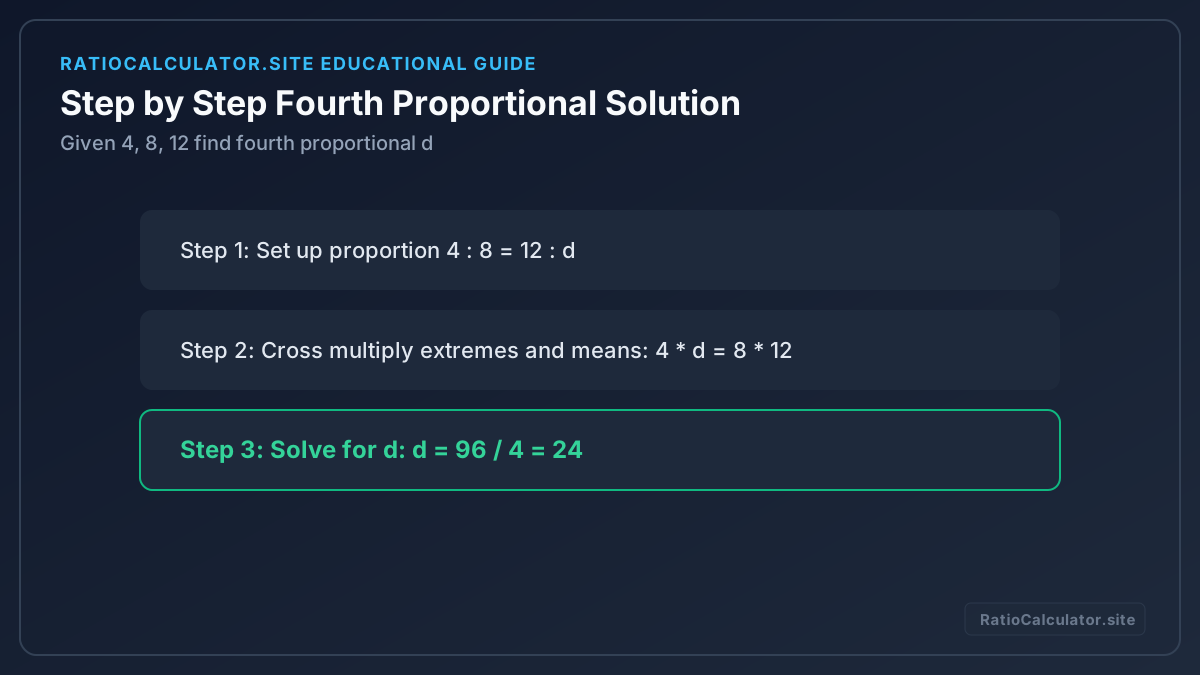
Example 1: Basic Integer Proportion
Find the fourth proportional to 4, 9, and 12.
- Assign the terms: a = 4, b = 9, c = 12
- Apply the formula: d = (b * c) / a
- Calculate the product of means: 9 * 12 = 108
- Divide by the first term: 108 / 4 = 27
- Result: The fourth proportional is 27.
- Verification check: 4 / 9 = 0.444… and 12 / 27 = 4 / 9 = 0.444…
Example 2: Measurements in Practical Context
If 6 liters of paint cover 45 square meters of wall surface, how many square meters will 14 liters cover under identical conditions?
- Set up the proportion: 6 : 45 = 14 : d
- Identify variables: a = 6, b = 45, c = 14
- Multiply means: 45 * 14 = 630
- Divide by extreme: 630 / 6 = 105
- Result: 14 liters of paint will cover 105 square meters.
Fourth Proportional vs Third Proportional
Students often confuse the fourth proportional with the third proportional. It is crucial to distinguish their mathematical definitions:
- Fourth Proportional involves four distinct positions (a : b = c : d), where three distinct numbers are provided and you solve for the fourth.
- Third Proportional involves continuous proportion with three terms (a : b = b : c), where only two numbers are provided and the middle term repeats as both mean positions.
Practical Examination Tips
- Maintain Sequence Order: The order in which numbers are listed dictates their assignment to a, b, and c. If numbers are given as 8, 5, 24, do not reorder them.
- Watch for Common Factors: Simplify fractions before large multiplication to avoid arithmetic errors. For instance, in (9 * 12) / 4, divide 12 by 4 first to get 9 * 3 = 27.
Contextual Internal Resources & Authority References
Deepen your mastery of cross multiplication and four term proportional equality with these tools:
- Interactive Calculators: Solve scale transformations with the Scale Factor Calculator and split proportional shares with the Ratio Division Calculator.
- Related In-Depth Guides: Study continued proportion theory in How to Find the Third Proportional, solve missing terms in How to Find the Missing Number in a Ratio, and review Solving Proportions & Cross Multiplication.
- Core Tool: Perform cross product validation in seconds using our online Ratio Calculator.
- Academic References: Read LibreTexts Mathematics Proportion Reference and Wolfram MathWorld Proportion Equations.
Frequently Asked Questions
What is the mathematical definition of a fourth proportional?
The fourth proportional is the fourth term d in a proportion a : b = c : d such that a multiplied by d equals b multiplied by c.
What is the formula for the fourth proportional?
The formula is d = (b * c) / a, where a, b, and c are the first three terms in order.
How does cross multiplication solve for the fourth proportional?
Cross multiplication establishes that the product of the outer terms equals the product of the inner terms.
Can the fourth proportional be a fraction or decimal?
Yes, if the product of b and c is not evenly divisible by a, the result is a rational fraction or decimal.
What is the difference between third and fourth proportional?
The third proportional requires two numbers in continuous proportion, while the fourth proportional requires three distinct numbers.
Why does the order of numbers matter in a fourth proportional problem?
Because changing the sequence alters which number acts as the divisor in the formula.
Can any of the terms in a proportion equal zero?
In standard proportions, terms cannot equal zero because division by zero is mathematically undefined.