How to Find a Ratio From a Word Problem: Complete Guide
Learn how to extract and calculate ratios from math word problems. Step by step guide covering order of terms, part to part, and part to whole problems.

Math word problems often present ratios wrapped inside real life stories. Whether a question describes students in an auditorium, ingredients in a bakery, or inventory in a warehouse, extracting the correct ratio requires identifying the relevant quantities, placing them in the correct sequence, and simplifying the numbers.
The most common reason people struggle with word problems is not the arithmetic. It is misreading the order of terms or confusing a subgroup with the entire total.
To find a ratio from a word problem, identify the two quantities being compared, determine which item is mentioned first, write the values with a colon, and divide both numbers by their greatest common divisor.
For instance, if a pet shelter cares for 16 dogs and 24 cats, the ratio of dogs to cats is 16 : 24. Dividing by 8 simplifies the relationship to 2 : 3.
You can verify any ratio word problem or solve proportion equations instantly with the Ratio Calculator on RatioCalculator.site.
Interactive Word Problem Ratio Extractor
Live ToolEnter group counts to calculate both part to part and part to whole proportions:
The Four Step Extraction Framework
To solve any ratio word problem consistently, apply this reliable four step process:
- Identify the quantities: Read the question and underline each quantity and its corresponding label.
- Determine the requested order: Check the question sentence to see which item must be the first term (antecedent) and which must be the second term (consequent).
- Set up the ratio: Write the raw numerical values separated by a colon.
- Simplify to lowest terms: Divide both terms by their greatest common divisor.
| Question Phrasing | First Term (Antecedent) | Second Term (Consequent) | Setup Example |
|---|---|---|---|
| Ratio of A to B | Quantity A | Quantity B | A : B |
| For every X there are Y | Quantity X | Quantity Y | X : Y |
| Ratio of part to total | Subgroup Part | Entire Sum | Part : (Part 1 + Part 2) |
| Proportion of B relative to A | Quantity B | Quantity A | B : A |

Worked Word Problem Examples
Here are four common word problem structures solved step by step.
Word Problem 1: Sports Team Record (Part to Part)
During a competitive basketball season, the Westlake Warriors played 36 matches. They won 24 games and lost 12 games. What is the ratio of wins to losses?
- Identify quantities: Wins = 24, Losses = 12, Total Games = 36.
- Identify requested order: “Wins to losses” means wins come first, losses second.
- Write raw ratio: 24 : 12.
- Simplify: The greatest common divisor of 24 and 12 is 12. Divide both by 12: (24 ÷ 12) : (12 ÷ 12) = 2 : 1.
- Answer: The ratio of wins to losses is 2 : 1.
Word Problem 2: Classroom Composition (Part to Whole)
Using the same basketball team from Problem 1, what is the ratio of wins to total games played?
- Identify quantities: Wins = 24, Total Games = 36.
- Identify requested order: “Wins to total games” means wins come first, total second.
- Write raw ratio: 24 : 36.
- Simplify: Divide both by 12: (24 ÷ 12) : (36 ÷ 12) = 2 : 3.
- Answer: The ratio of wins to total games is 2 : 3. This indicates that the team won two out of every three games played.
Word Problem 3: Bakery Production With Three Categories
A local bakery produces 45 fruit pastries every morning: 20 strawberry tarts, 15 blueberry tarts, and 10 peach tarts. What is the ratio of strawberry tarts to blueberry tarts to peach tarts?
- Identify quantities: Strawberry = 20, Blueberry = 15, Peach = 10.
- Requested order: Strawberry : Blueberry : Peach.
- Write raw three term ratio: 20 : 15 : 10.
- Simplify: Find greatest common divisor across all three numbers. The number 5 divides 20, 15, and 10.
- Divide by 5: (20 ÷ 5) : (15 ÷ 5) : (10 ÷ 5) = 4 : 3 : 2.
- Answer: The ratio is 4 : 3 : 2.
To check how these pastries divide as percentages of total output (44.4%, 33.3%, 22.2%), explore our Ratio to Percentage Calculator.
Word Problem 4: Finding an Unstated Quantity
In an orchard of 80 fruit trees, 35 are apple trees and the rest are pear trees. What is the ratio of apple trees to pear trees?
- Identify quantities: Total trees = 80, Apple trees = 35.
- Calculate missing quantity: Pear trees = 80 minus 35 = 45.
- Requested order: Apple trees first, pear trees second.
- Write raw ratio: 35 : 45.
- Simplify: Divide both terms by 5: (35 ÷ 5) : (45 ÷ 5) = 7 : 9.
- Answer: The ratio of apple trees to pear trees is 7 : 9.
If your word problem asks you to distribute a known quantity according to given ratio terms, try our Ratio Division Calculator for rapid calculations.
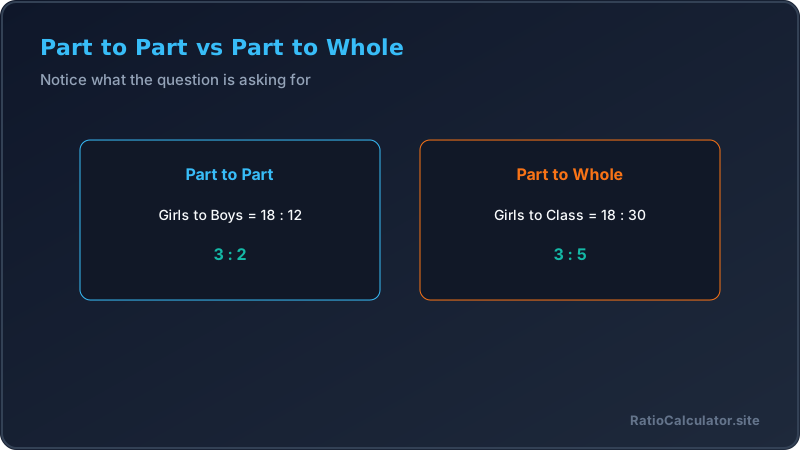
Part to Part vs Part to Whole: How to Spot the Difference
Failing to recognize whether a question seeks a part to part or part to whole ratio is the single biggest cause of lost marks on school tests.
Look for these linguistic signals:
- Part to part signals: Look for two distinct categories compared against each other, such as “cats to dogs”, “men to women”, or “passengers seated to passengers standing”.
- Part to whole signals: Look for words like “total”, “altogether”, “in the class”, “in the entire box”, or “of all participants”.
Always confirm whether the second number represents another part or the combined sum.
Common Mistakes to Avoid
- Writing terms backwards: If a problem asks for pear trees to apple trees, writing 7 : 9 instead of 9 : 7 is incorrect.
- Forgetting to calculate unstated parts: Using the total instead of subtracting to find the remaining subgroup.
- Ignoring units: If a recipe problem mentions 500 grams of sugar and 1 kilogram of flour, you must convert 1 kg to 1000 g before writing 500 : 1000 = 1 : 2.
- Leaving numbers unsimplified: Submitting 24 : 12 instead of 2 : 1 is incomplete in nearly all academic settings.
How to Verify Your Answer
To confirm your word problem answer, perform a reverse logic test. Multiply each term of your simplified ratio by the common factor you divided by. Add the parts together if working with a part to whole problem to ensure they match the total stated in the story.
For our orchard example: 7 × 5 = 35 apple trees, 9 × 5 = 45 pear trees. Summing 35 + 45 equals 80 total trees, confirming full mathematical harmony with the story.
Reference standard: Explore foundational ratio word problem tutorials on Math is Fun.
Conclusion
Finding a ratio from a word problem requires careful reading and systematic execution. By identifying the known values, deducing any hidden quantities, maintaining the specified sequence, and simplifying by the greatest common divisor, you can solve any ratio word problem with confidence. Use our Ratio Calculator to double check your solutions.
Frequently Asked Questions
What is the first step in solving a ratio word problem?
Identify the specific quantities mentioned and determine which quantity must be written first based on the question.
Why is the order of terms so important in word problems?
The first term corresponds to the first item named, so flipping the numbers changes the mathematical meaning completely.
How do you find the ratio when the total is given but one part is missing?
Subtract the known part from the total amount to find the missing part before writing the ratio.
What is the difference between part to part and part to whole?
Part to part compares one subgroup to another, while part to whole compares one subgroup to the complete total sum.
How do you simplify a ratio from a word problem?
Divide both terms by their greatest common divisor until no other common factor remains besides 1.
Can word problem ratios have three terms?
Yes, multi category problems such as recipe ingredients or team rosters can have three or more ratio terms.
How do you check if your word problem answer is correct?
Multiply the simplified ratio terms by the common divisor and confirm they equal the original quantities described in the problem.