How to Calculate a Ratio From a Total Amount: Easy Examples
Learn how to divide any total amount using a ratio. Easy step by step guide with original examples for two part and three part proportional calculations.
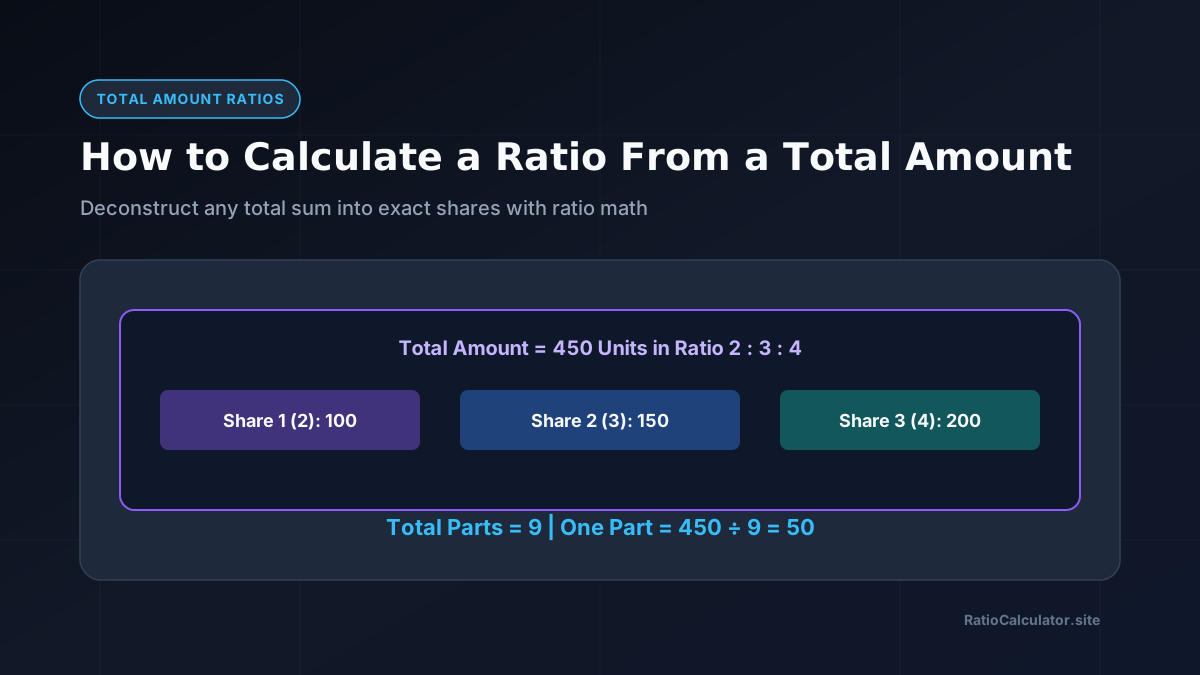
When you know the total size of something, such as a plot of land, a school budget, an inheritance, or a bulk shipment of goods, you often need to divide it into specific proportional pieces. This mathematical process is called calculating shares from a total amount using a ratio.
The universal method to calculate each share from a total amount is to add the ratio numbers together, divide the total amount by that sum to determine the value of one part, and multiply each ratio term by the unit value.
Alternatively, you can multiply the total amount directly by each fraction formed by placing an individual ratio number over the sum of all ratio parts.
For example, to divide 360 kilograms of livestock feed in a 4 : 5 ratio, sum the parts to get 4 + 5 = 9. Divide 360 kg by 9 to find that each part equals 40 kg. The first portion receives 4 × 40 kg = 160 kg, and the second portion receives 5 × 40 kg = 200 kg.
To compute custom shares or check your division automatically, use the Ratio Division Calculator on RatioCalculator.site.
Interactive Total Amount Ratio Divider
Live ToolEnter any total quantity and ratio numbers to divide the whole into exact proportional shares:
The Two Formulas for Total Amount Division
There are two mathematically equivalent paths to split a total amount using a ratio.
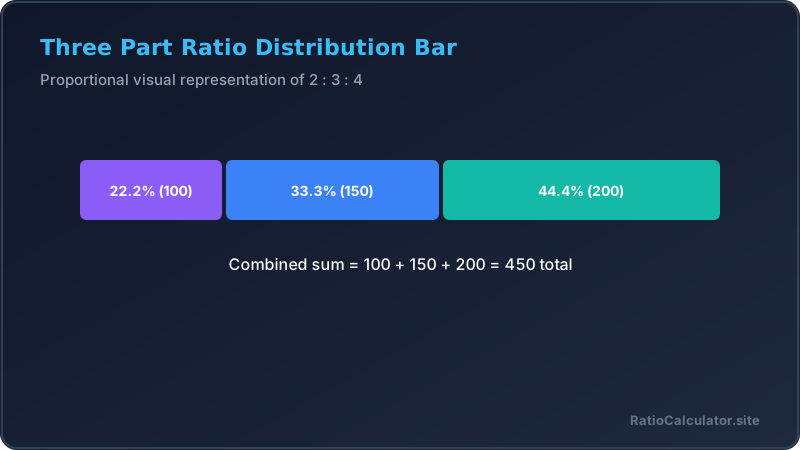
Method 1: The Unit Part Formula
This approach is the most intuitive for mental math and classroom coursework:
- Total Parts = Part A + Part B (+ Part C …)
- Unit Part Value = Total Amount ÷ Total Parts
- Share A = Part A × Unit Part Value
- Share B = Part B × Unit Part Value
Method 2: The Fraction of Total Formula
This approach calculates each share in a single arithmetic step:
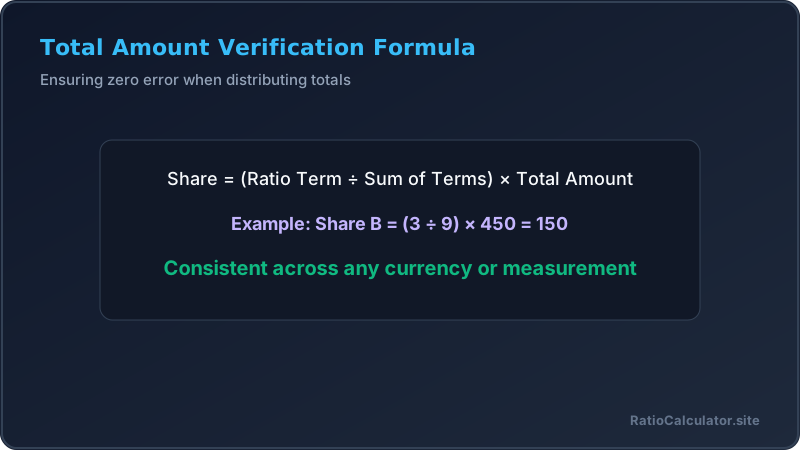
- Share A = (Part A ÷ Total Parts) × Total Amount
- Share B = (Part B ÷ Total Parts) × Total Amount
Both methods produce identical results. Choose whichever method feels clearer for your problem.
| Total Amount | Target Ratio | Total Parts | Fractional Share A | Fractional Share B | Calculated Results |
|---|---|---|---|---|---|
| 240 Units | 1 : 3 | 4 | 1/4 (60) | 3/4 (180) | 60 and 180 |
| 500 Liters | 3 : 7 | 10 | 3/10 (150) | 7/10 (350) | 150 L and 350 L |
| 720 Hectares | 5 : 4 | 9 | 5/9 (400) | 4/9 (320) | 400 ha and 320 ha |
| 900 Grams | 2 : 3 : 4 | 9 | 2/9 (200) | 3/9 (300) | 200 g, 300 g, 400 g |
Two Part Ratio Worked Examples
Let us examine two practical real world scenarios.
Example 1: Dividing Land Between Agricultural Plots
An agricultural cooperative owns 450 hectares of farmland. They decide to allocate the land between wheat cultivation and barley cultivation in the ratio 4 : 5. How many hectares are assigned to each crop?
- Identify the given values: Total Land = 450 hectares, Ratio = 4 : 5.
- Sum the ratio parts: 4 + 5 = 9 total parts.
- Compute the value of one part: 450 ha ÷ 9 parts = 50 ha per part.
- Wheat share (4 parts): 4 × 50 ha = 200 ha.
- Barley share (5 parts): 5 × 50 ha = 250 ha.
- Verify the total: 200 ha + 250 ha = 450 ha.
Example 2: Project Work Hours Allocation
A consulting agency has a budget of 160 billable hours for a client project. The hours must be split between design and development in the ratio 3 : 5. How many hours are dedicated to each discipline?
- Total Hours = 160, Ratio = 3 : 5.
- Total Parts = 3 + 5 = 8 parts.
- Value of one part: 160 hours ÷ 8 parts = 20 hours per part.
- Design hours (3 parts): 3 × 20 hours = 60 hours.
- Development hours (5 parts): 5 × 20 hours = 100 hours.
- Verification check: 60 + 100 = 160 hours.
Three Part Ratio Worked Examples
When dividing a total amount among three categories, the exact same mathematical logic applies.
Example 3: Dividing a Grain Storage Shipment
A warehouse receives a combined shipment of 1,200 kilograms of grain consisting of oats, barley, and wheat in the ratio 2 : 3 : 5. How many kilograms of each grain are in the shipment?
- Identify the given values: Total Grain = 1,200 kg, Ratio = 2 : 3 : 5.
- Add all parts together: 2 + 3 + 5 = 10 total parts.
- Compute the unit value: 1,200 kg ÷ 10 parts = 120 kg per part.
- Oats share (2 parts): 2 × 120 kg = 240 kg.
- Barley share (3 parts): 3 × 120 kg = 360 kg.
- Wheat share (5 parts): 5 × 120 kg = 600 kg.
- Verification check: 240 kg + 360 kg + 600 kg = 1,200 kg.
To convert each category into a percentage share of the entire warehouse shipment (20%, 30%, 50%), check out our Ratio to Percentage Calculator.
Converting Shares to Percentages for Verification
Expressing each share as a percentage of the total amount provides an intuitive double check on your math:
- Percentage of Share A = (Share A ÷ Total Amount) × 100
- In our grain example: (240 ÷ 1200) × 100 = 20%
- Percentage of Share B = (360 ÷ 1200) × 100 = 30%
- Percentage of Share C = (600 ÷ 1200) × 100 = 50%
- Sum of percentages: 20% + 30% + 50% = 100% exact.
Common Mistakes to Avoid
- Dividing the total by the count of categories: Dividing 1,200 kg by 3 grain types gives 400 kg each, which completely destroys the 2 : 3 : 5 proportional distribution.
- Inverting the order of shares: Accidental transposition leads to assigning 600 kg to oats instead of wheat.
- Omitting the final sum check: Failing to add all calculated shares together to confirm they match the original total.
- Rounding individual parts prematurely: Always keep full precision until the final answers are calculated.
How to Verify Your Answer
To confirm your division from a total amount is accurate:
- Sum verification: Add all individual calculated shares together. The sum must match your original starting total amount exactly.
- Ratio reduction test: Write the calculated values in order and divide by their greatest common divisor. They must reduce cleanly back to the initial ratio.
Reference standard: Study proportional division theory in open textbooks at OpenStax Prealgebra.
Conclusion
Calculating shares from a total amount using a ratio is an indispensable tool across finance, project planning, resource allocation, and academic math. By calculating the value of one single ratio part or multiplying the total by each part’s fraction, you ensure exact proportional distribution. Explore our Ratio Division Calculator or the core Ratio Calculator to streamline your calculations.
Frequently Asked Questions
What is the formula to calculate a ratio from a total amount?
Individual Share = (Individual Ratio Part ÷ Total Sum of Parts) × Total Amount.
What is the value of one part in ratio division?
The value of one part is the total amount divided by the sum of all ratio parts.
How do you divide an amount into a three part ratio?
Sum all three ratio numbers, divide the total amount by that sum, and multiply each ratio number by the resulting unit value.
How do you verify that your ratio shares are correct?
Sum all calculated shares together to confirm the result equals the original total amount.
What happens if the ratio numbers do not divide evenly into the total?
The shares will contain decimals or fractions, which can be rounded to required decimal places.
Can you calculate percentage shares directly from the ratio?
Yes, divide each ratio term by the sum of parts and multiply by 100 to find the percentage.
Why does dividing by the sum of parts work?
The sum of parts represents the total number of equal slices that make up the entire quantity.